
Pet Grooming Blueprint
Blueprint Course
Pet Grooming Blueprint
Wags, clippers, and a loyal recurring clientele.
This course walks you from zero to a working pet grooming business run from a home studio: whether the work fits you, how to handle animals safely, what it costs to set up, how to price grooms from real costs, how to get your first 10 clients, and how to run groom days so owners rebook every 4–8 weeks. It is built for a solo groomer starting with roughly $1,400 to $1,800 in a dedicated home space. Every money example uses the same base case: 12 grooms a week at a $70 average, about $6 in shampoo and consumables per groom, and about $310 a month in fixed costs including roughly $200 for home-studio utilities and space. That pencils out to a typical range of $1,200 to $3,000 a month in profit before tax — a range, not a promise. A mobile van or trailer is covered honestly as a later upgrade path with real conversion costs ($10,000 and up), not as something you need on day one. Your results depend on your market, your skill, and your prices.
What you get
Built for operators who want a clear path — not a pile of generic tips.
The base case
One worked example, not a target
Planning estimates, before tax and before anything you pay yourself — no income is guaranteed. Your own prices, volume and costs will differ; the course walks you through replacing every number here with yours.
Who this fits
- You are calm and confident handling dogs of every size and temperament — including the nervous ones
- You are patient with particular owners and can deliver bad news (matting, behavior) kindly
- You are physically comfortable lifting dogs and standing through back-to-back grooms
- You can run a recurring appointment calendar and protect it with rebooking discipline
- You have (or can create) a home space with water access that can become a grooming studio
Honest risks
- Bites and scratches are a constant occupational risk — animal handling skill is safety equipment, not a nice-to-have.
- An injured pet is both heartbreak and liability; a clipper nick or a fall from the table can end a client relationship and trigger a claim. Insurance is essential.
- Local zoning and permit rules for home-based studios vary widely; some areas restrict client traffic, signage, or animal businesses at home. Location-dependent — verify before you spend.
- The work is physically hard on your back, hands, and wrists over years of table time; an injury stops revenue.
- Throughput is capped by grooming time per pet — you cannot scale hours you don't have, so pricing discipline matters more than volume.
- Matted, aggressive, or medically fragile pets present judgment calls; taking the wrong dog is more expensive than declining it.
Who should skip this one
- You are uneasy around large, strong, or unpredictable dogs — handling nerves transmit straight to the animal and raise bite risk for both of you.
- You have no home space that can legally and practically become a studio (water access, ventilation, zoning) and no budget for renting a station — the $10k+ mobile van route is not a day-one substitute.
- You need dependable income immediately; building a rebooking clientele takes weeks of unpaid practice and outreach, and no income is guaranteed.
- You have existing back, hand, or wrist problems that hours of lifting dogs and repetitive scissor work would aggravate.
- You will skip the safety and intake routine when you're busy — vaccination checks, temperament notes, and matting waivers are what stand between you and a serious incident.
Curriculum
10 modules · 35 lessons · 2 hr 13 min of reading
01What This Business Really Isfree sample4 lessons · 16 min
Before you buy clippers, understand the job: what you sell, what the money actually looks like from a home studio, and whether this fits your life.
- What the Work Really Is(free sample below)4 min
- The Math of a Grooming Month5 min
- Who This Fits — and Who It Doesn't3 min
- Home Studio vs. Mobile Van vs. Shop: Why Home Wins Early4 min
02Animal Handling & Safety First4 lessons · 15 min
Handling skill is your real safety equipment. Read stress signals, restrain safely, know your first-aid basics, and learn when the right answer is no.
- Reading the Dog: Stress Signals Before They Escalate4 min
- Safe Restraint and Handling Basics4 min
- Bites, Scratches, and Your First-Aid Plan3 min
- When to Say No: Matted, Aggressive, and Fragile Pets4 min
03Startup Costs and Your Home Studio3 lessons · 13 min
Exactly what the startup money buys, how to convert your space into a safe wet-work studio, and the zoning homework to do before you spend.
- Your Startup Budget: $1,400 Required, $1,800 Typical5 min
- Building the Studio: Water, Drainage, Ventilation, Footing4 min
- Zoning, Neighbors, and Running a Business at Home4 min
04Equipment and Supplies3 lessons · 11 min
The table, tub, and dryer that do the heavy lifting; the clippers, blades, and shears that do the craft; and the consumables math behind $6 a groom.
- Table, Tub, and Dryer: Your $500 Foundation4 min
- Clippers, Blades, and Shears: The Craft Tools4 min
- Consumables: Where the $6 a Groom Goes3 min
05Services and Pricing4 lessons · 16 min
A simple menu, prices built from real costs and real minutes — never hourly-wage framing — and the surcharges and policies that protect your schedule.
- Your Service Menu: Two Packages, Clear Add-Ons4 min
- Price From Costs and Value — Never From an Hourly Wage5 min
- Size, Coat, and Condition: The Surcharge Discipline4 min
- Rebooking Cycles, No-Show Fees, and Protecting the Calendar3 min
06Legal, Insurance, and Taxes4 lessons · 15 min
Education, not legal advice: registration and home-occupation permits, the insurance that actually covers pets in your care, the tax set-aside habit, and the paperwork every client signs.
- Registration, Licenses, and Home-Occupation Permits4 min
- Insurance: Why General Liability Alone Isn't Enough4 min
- Taxes: The Set-Aside Habit That Saves You in April4 min
- Client Agreements: Vaccination Policy, Releases, and Records3 min
07Branding and Being Findable3 lessons · 10 min
A trustworthy name, before/after photos that sell for you, and the free local listings that make a home studio discoverable.
- Your Name and Brand: Trust at First Glance3 min
- Before/After Photos: The Best Marketing in Grooming3 min
- Google Business Profile and Local Listings4 min
08Your First 10 Customers3 lessons · 12 min
Warm circle first, pet-professional partners second, neighborhood platforms third — a concrete sequence from zero clients to a rebooking core.
- Start With the Dogs You Already Know4 min
- Partners: Vets, Walkers, Sitters, and Pet Stores4 min
- Neighborhood Platforms — and Converting First Grooms Into Regulars4 min
09Service Delivery: Running a Great Groom Day3 lessons · 11 min
The drop-off routine that prevents disputes, a repeatable groom workflow with safety checkpoints, and the pickup handoff that earns the rebook.
- Drop-Off: The Five-Minute Check-In That Prevents Disputes4 min
- The Groom Workflow: Same Order, Every Dog4 min
- Pickup: The Handoff That Earns the Rebook3 min
10Reviews, Referrals, Operations, and Growth4 lessons · 14 min
The review engine, referral loop, weekly operating rhythm, raising prices on a full book — and the honest math on the mobile-van upgrade.
- The Review Engine3 min
- Referrals and Keeping the Clients You Have3 min
- Your Weekly Operating Rhythm3 min
- Growth: Raising Prices, Then (Maybe) Going Mobile5 min
Why people buy this
Built for first-time operators who want a clear path — not generic AI chat.
Honest fit check
Who should start — and who should skip — so you don't waste months on the wrong business.
Do-this-next lessons
Every lesson ends in an action: scripts, checklists, pricing math you can use this week.
One-time purchase
One payment of $59. No course subscription.
Pet Grooming Blueprint is part of the OwnerLaunch founding library. Figures in the course are planning estimates before tax — no income is guaranteed.
Blueprint FAQ
Why $59 for this Blueprint?+
You get a full operator course (10 modules, 35 lessons), a free sample lesson before you buy, downloadable templates after purchase, and a path into a personalized Launch Kit if you want one. It's a one-time payment — not a subscription for the course itself.
What do I get before I pay?+
The full curriculum outline, honest fit/risk lists, money base-case assumptions, a short course preview video when available, and one complete free sample lesson — real course content, not a teaser paragraph.
Is this legal, tax, or financial advice?+
No. OwnerLaunch is educational only. Licensing, insurance, tax, and filing requirements are location-dependent — verify with official sources and licensed professionals.
Can I upgrade to a Launch Kit later?+
Yes. Blueprint owners typically pay only the difference for a personalized Launch Kit (names, brand, pricing, copy, documents, 30-day plan). The course and kit are separate purchases.
Included templates & tools
- 30-Day Launch Checklist — The whole course sequenced into four weeks: zoning homework and studio buildout, safety practice, paperwork, and your first founding clients.
- Outreach Scripts: Founding Clients, Partners, Rebooks, and Reviews — Word-for-word scripts for the warm-circle founding offer, the pet-professional partner pitch, the pickup rebook, confirmations, and the review ask.
- Client & Pet Intake Form Template — Fill-in intake form covering owner details, pet health and behavior history, vaccination policy, matted-coat release, and photo permission.
- Pricing Calculator Worksheet — Compute your real cost per groom, before-tax margin at each price point, and monthly totals — anchored to the $70 / $6 / $310 base case.
- Groom-Day Safety & Check-In Checklist — The wall checklist for every appointment: drop-off documentation, table and dryer safety, stress-signal checkpoints, and the incident log.
- Founder Fit Self-Check Quiz — Twelve honest yes/no questions across handling, physical, business, and logistics — with scoring guidance and what each 'no' means.
Free sample lesson
Real course content — not a teaser paragraph. The rest unlocks after purchase.
From module: What This Business Really Is
What the Work Really Is
~4 min read
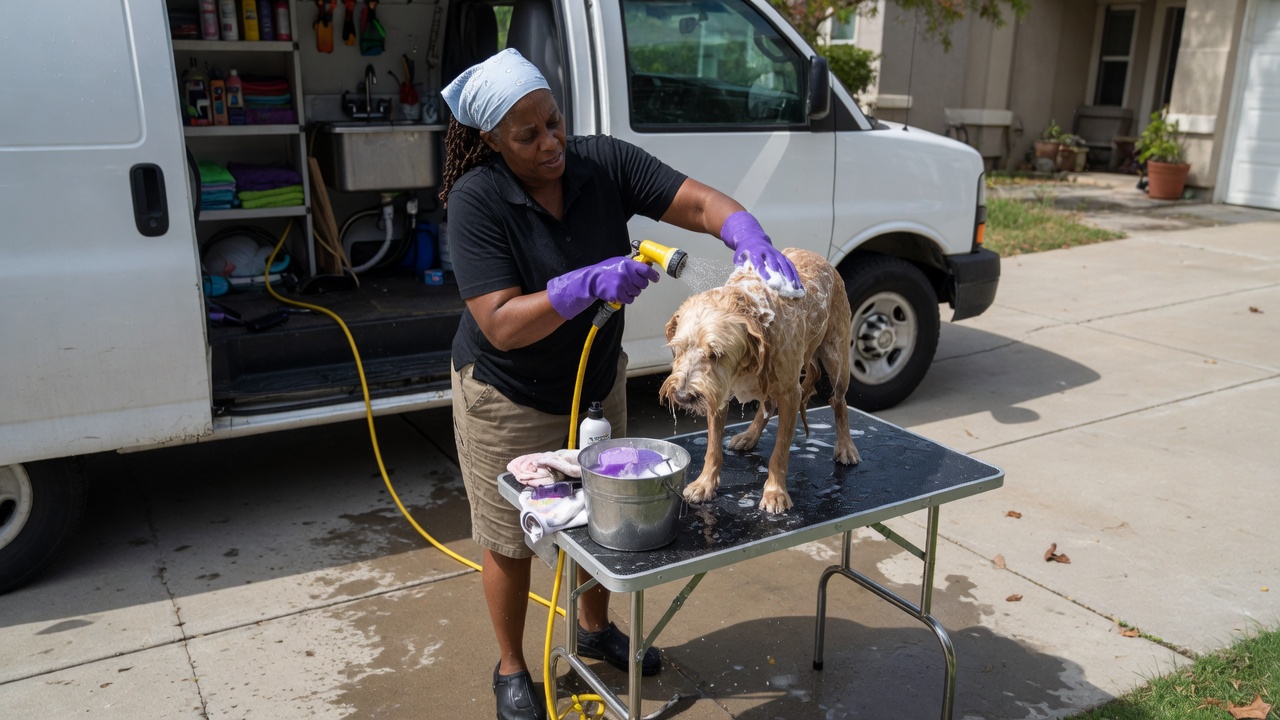
Pet grooming means bathing, drying, brushing out, trimming, and styling dogs (and the occasional brave cat) — plus nails, ears, and sanitary trims — on a recurring 4–8 week cycle. In this course you do it from a home studio: a garage, basement, or spare room converted into a safe, clean grooming space. Owners drop off, you groom, they pick up a fresh-smelling dog and rebook before they leave. The recurring cycle is the whole business model: coats grow back on schedule, so a client you keep is revenue you keep.
The work itself is equal parts animal handling and craft. A full groom on one dog runs roughly 60 to 120 minutes depending on size, coat, and behavior — most of it standing at a table, hands on a live animal that may be wiggly, anxious, or matted. Do it calmly and well and the before/after photos market the business for you. Rush it and you risk a nick, a scared dog, and a client who never comes back.
- You sell three things: bath-and-tidy packages, full grooms, and add-ons (de-shedding, de-matting, teeth, nails-only visits)
- The stable money is the rebook cycle — clients on a standing 4–8 week appointment
- The hidden job: safety — reading the dog, safe restraint, and knowing when to say no
- The base case here is a home studio; a grooming van is a later, costed upgrade — not a starting requirement
Action · task
Groom (or thoroughly bathe) a dog this week
This week, bathe, dry, and brush out a dog you have access to — your own, or a friend's with permission. Time every phase (bath, dry, brush-out, nails if you're able). Take before and after photos. Write down what the dog struggled with, what your body felt, and which step took longest. This is the cheapest possible test of whether you want this business.
Ready to make it yours?
A Launch Kit turns this Blueprint into your business: personalized name, brand, pricing, website copy, documents, and Action Plan.
Basic
$119 current
Pro
$199 current
Apply your Blueprint credit to Basic for +$60 or Pro for +$140.
More Blueprints
Related course · Home Services
Mobile Detailing Business Blueprint
Launch a mobile detailing business from your driveway to your first paying route.
Related course · Home Services
Residential Cleaning Business Blueprint
Launch a solo residential cleaning business — from first supply kit to a recurring weekly client base.
Recommended next · Beauty & Personal Care
Mobile Barber Blueprint
Build a book of regulars behind a chair — then take the chair to them.
Recommended next · Beauty & Personal Care
Nail Tech Blueprint
From licensed skill to a full self-booked schedule.
Recommended next · Beauty & Personal Care
Lash Tech Blueprint
Precision beauty work with strong rebooking rates.
All figures are estimates and assume a solo groomer with no employees, working from a home studio in a typical U.S. market. The base case throughout is 12 grooms a week at a $70 average groom, about $6 in variable consumables per groom, and about $310 a month in fixed costs (including roughly $200 in home-studio utilities and space share). All profit figures are before tax and before anything you pay yourself; the typical range of $1,200 to $3,000 a month before tax is an estimate of typical outcomes, not a guarantee — no income is guaranteed, and your market, prices, skill, and effort decide where you land. A mobile grooming van or trailer is treated as an optional later upgrade with significant costs ($10,000 and up), not part of the startup budget. Legal, zoning, tax, and insurance lessons are education only, not professional advice; requirements are location-dependent and vary by state, county, and city — verify locally.
Educational guidance only — not legal, tax, or financial advice.Details
OwnerLaunch provides educational business guidance, AI-generated drafts, and checklists. It is not a law firm, tax advisor, CPA, registered agent, or government agency. Information may not be complete or current for your specific location. Always verify requirements with official federal, state, city, and county sources and consult qualified professionals when needed.