
Mobile Detailing Business Blueprint
Blueprint Course
Mobile Detailing Business Blueprint
Launch collection candidateLaunch a mobile detailing business from your driveway to your first paying route.
This course walks you from zero to a working mobile detailing business: what the job really is, what it costs to start, what to buy, how to price, how to get your first 10 customers, and how to run jobs so people rebook. It is built for a solo operator starting with roughly $1,250 to $2,000, working from their own vehicle. Every money example uses the same base case: 5 jobs a week at a $180 average ticket, about $18 in product per job, and about $170 a month in fixed costs. That pencils out to a typical range of $1,200 to $3,400 a month in profit before tax — a range, not a promise. Your results depend on your market, your effort, and your prices.
What you get
Built for operators who want a clear path — not a pile of generic tips.
The base case
One worked example, not a target
Planning estimates, before tax and before anything you pay yourself — no income is guaranteed. Your own prices, volume and costs will differ; the course walks you through replacing every number here with yours.
Who this fits
- You take pride in detail work and can stay meticulous on car number four of the day
- You are comfortable with physical outdoor work in heat, cold, and awkward positions
- You have (or can get) a reliable vehicle that can carry equipment and a water tank
- You want repeat monthly customers, not just one-off jobs
- You can be presentable and communicative at strangers' homes and workplaces
Honest risks
- Weather cancels jobs. Rain days compress your schedule and your income for the week.
- You work around expensive paint. One wrong pad, dirty towel, or harsh product can cause a claim that costs more than a month of profit.
- Water and power access is not guaranteed. Jobs without customer hookups need a tank and often a generator — extra cost, weight, and setup time.
- It is physically demanding. Bending, kneeling, and scrubbing for hours wears on your body, and an injury stops revenue.
- Equipment failure (pressure washer, generator, vacuum) stops revenue until it is fixed or replaced.
- Demand is seasonal in cold climates. Winter volume drops; interior work and garage jobs soften the dip but rarely erase it.
Who should skip this one
- You don't have a vehicle that can carry water, a pressure washer, and equipment — mobile is the whole model here.
- You're not prepared for hours of hot, wet, physically repetitive work on your feet and knees.
- You need dependable income immediately; the first-10-customers plan takes weeks of unpaid hustle and no income is guaranteed.
- You won't document vehicle condition before every job — skipping the inspection routine eventually costs you a damage dispute.
Curriculum
9 modules · 35 lessons · 2 hr 21 min of reading
01What This Business Really Isfree sample4 lessons · 16 min
Before you buy a single bottle of soap, understand the job: what you sell, what the money actually looks like, and whether this fits your life.
- What the Work Really Is(free sample below)4 min
- The Math of a Detailing Month5 min
- Who This Fits — and Who It Doesn't3 min
- Mobile vs. Fixed Location: Why Mobile Wins Early4 min
02Setting Up: Budget, Basics, and Logistics3 lessons · 14 min
Exactly what the startup money buys, the boring-but-necessary setup steps, and the vehicle and water/power logistics that make or break a mobile operation.
- Your Startup Budget: $1,250 Required, $2,000 Typical5 min
- Registration, Bank Account, and Simple Bookkeeping4 min
- Vehicle, Water, and Power: The Logistics Nobody Talks About5 min
03Equipment and Supplies4 lessons · 15 min
What to buy, what each thing does, what it costs per job, and how to load it so setup takes 10 minutes instead of 30.
- Core Equipment: The $450 Machine Trio4 min
- Chemicals and Consumables: Your $18-Per-Job Reality4 min
- Tanks and Generators: Powering Jobs Without Hookups4 min
- Load-Out: Organizing Your Rolling Shop3 min
04Services and Pricing4 lessons · 17 min
A clean three-tier menu, pricing by vehicle size and condition, the add-ons that lift your average ticket, and the maintenance plans that stabilize your month.
- Your Service Menu: Three Tiers, No Confusion4 min
- Pricing by Size and Condition5 min
- Add-Ons and Upsells: Lifting the Average Ticket4 min
- Maintenance Plans: The Route Is the Stability4 min
05Legal, Insurance, and Taxes: What to Understand4 lessons · 16 min
Education — not advice — on business structures, licenses, insurance, and the tax set-aside habit. Everything here varies by location; the goal is to know what questions to ask.
- Business Structures: Sole Proprietor vs. LLC (Education)4 min
- Licenses, Permits, and the EIN (Education)4 min
- Insurance: Why $70 a Month Is in Your Fixed Costs (Education)4 min
- Taxes: The Set-Aside Habit (Education)4 min
06Branding and Being Findable4 lessons · 15 min
A name and look you won't outgrow, a Google Business Profile that collects reviews, and the before/after photo engine that does your marketing for you.
- Name and Brand Basics3 min
- Google Business Profile: Your Real Storefront4 min
- The Before/After Engine4 min
- Taking Bookings Without Drowning in Texts4 min
07Your First 10 Customers4 lessons · 15 min
A concrete sequence: three portfolio cars, then your neighborhood and local groups, then offices, realtors, and dealers — with the follow-up habits that turn interest into bookings.
- Customers 1–3: The Portfolio Cars4 min
- Customers 4–7: Neighborhood and Local Groups4 min
- Customers 8–10: Offices, Realtors, and Dealers4 min
- Follow-Up: Where the Bookings Actually Happen3 min
08Delivering the Job4 lessons · 16 min
The pre-job routine that prevents disasters, an on-site workflow that hits consistent quality on a schedule, and the weather playbook every mobile operator needs.
- The Pre-Job Routine: Confirm, Inspect, Protect4 min
- The On-Site Workflow: Same Order, Every Car5 min
- The Final Walkaround: Where Rebookings Are Won3 min
- Weather: The Boss You Didn't Hire4 min
09Reviews, Referrals, and Running the Machine4 lessons · 17 min
The review engine that compounds, referral and repeat systems, a weekly operations rhythm that keeps the wheels on, and an honest look at when — and whether — to grow.
- The Review Engine4 min
- Referrals and the Repeat Route4 min
- The Weekly Operations Rhythm4 min
- Growth: When, How, and Whether5 min
Why people buy this
Built for first-time operators who want a clear path — not generic AI chat.
Honest fit check
Who should start — and who should skip — so you don't waste months on the wrong business.
Do-this-next lessons
Every lesson ends in an action: scripts, checklists, pricing math you can use this week.
One-time purchase
One payment of $59. No course subscription.
Mobile Detailing Business Blueprint is part of the OwnerLaunch founding library. Figures in the course are planning estimates before tax — no income is guaranteed.
Blueprint FAQ
Why $59 for this Blueprint?+
You get a full operator course (9 modules, 35 lessons), a free sample lesson before you buy, downloadable templates after purchase, and a path into a personalized Launch Kit if you want one. It's a one-time payment — not a subscription for the course itself.
What do I get before I pay?+
The full curriculum outline, honest fit/risk lists, money base-case assumptions, a short course preview video when available, and one complete free sample lesson — real course content, not a teaser paragraph.
Is this legal, tax, or financial advice?+
No. OwnerLaunch is educational only. Licensing, insurance, tax, and filing requirements are location-dependent — verify with official sources and licensed professionals.
Can I upgrade to a Launch Kit later?+
Yes. Blueprint owners typically pay only the difference for a personalized Launch Kit (names, brand, pricing, copy, documents, 30-day plan). The course and kit are separate purchases.
Included templates & tools
- Equipment & Startup Checklist — The full buy list with budget lines — required versus optional — plus setup steps to complete before your first paid job.
- Service Menu & Pricing Worksheet — Build your three-tier menu, size/condition pricing matrix, add-on list, and maintenance plan — anchored to the $180 sedan full detail.
- Pre-Job Vehicle Inspection Checklist — The confirm-inspect-protect routine for every job: day-before confirmation, documented damage walkaround, and site checks.
- First-Customers Outreach Scripts — Copy-and-adapt scripts for portfolio cars, local group posts, neighbor knocks, property managers, realtors, dealers, and follow-ups.
- Job Quote & Agreement Template — The one-page quote you send after seeing photos of the vehicle: package, condition adders, total, what's included, and the pre-work damage acknowledgment.
- 30-Day Launch Checklist — The whole course compressed into a four-week launch sequence — setup, pricing, portfolio cars, and your first paying customers.
- Mobile Detailing Launch Readiness Quiz — A ten-question self-check on condition quoting, paint safety, water and power logistics, runoff, insurance, pricing, and repeat-route operations.
Free sample lesson
Real course content — not a teaser paragraph. The rest unlocks after purchase.
From module: What This Business Really Is
What the Work Really Is
~4 min read
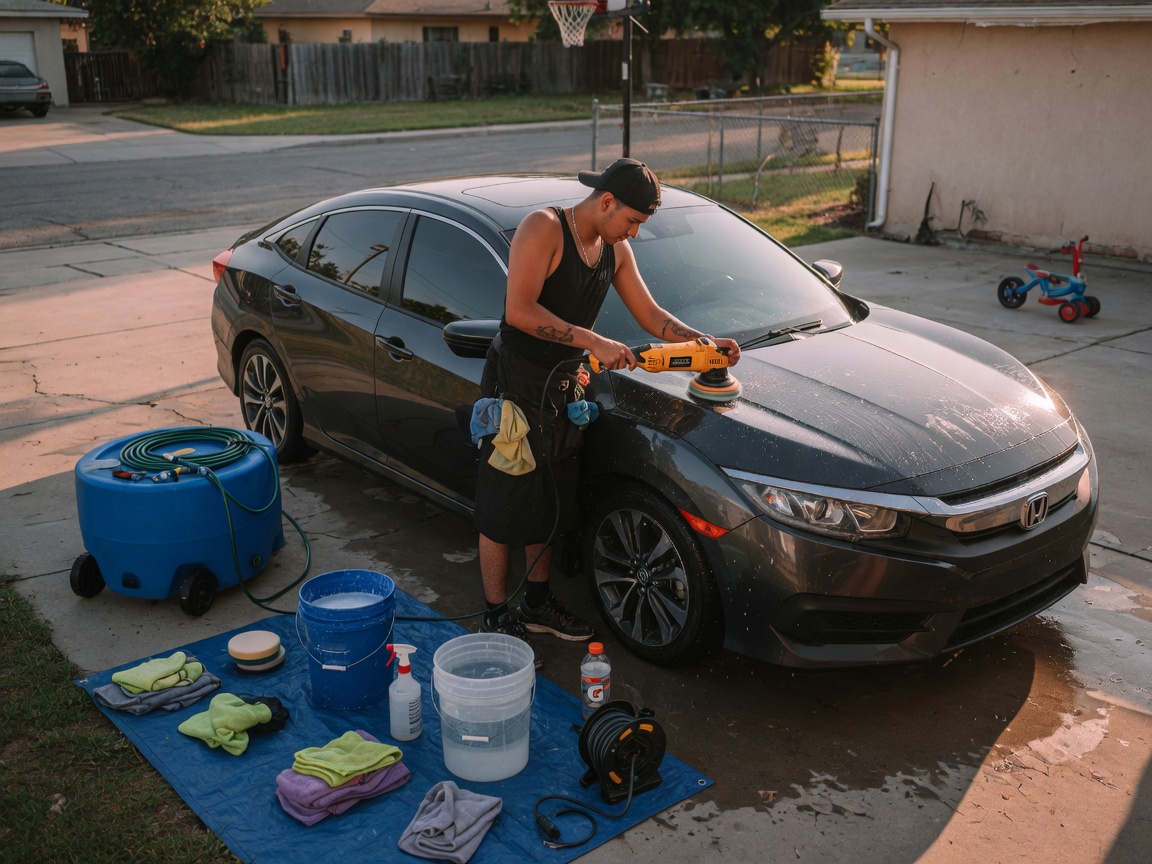
Mobile detailing means you drive to the customer — their driveway, their office parking lot — and clean and restore their vehicle on site. You bring the water, the power, the products, and the skill. They pay a premium because they never have to leave home. That convenience premium is the whole business model: a fixed-location wash competes on speed and price; you compete on results and 'I didn't have to do anything.'
The work itself is physical and repetitive. A full detail on one sedan is roughly two to four hours of vacuuming, scrubbing, wiping, washing, drying, and dressing — much of it bent over, kneeling, or reaching into footwells. Do that well and the transformation photographs beautifully, which is why detailing markets itself better than almost any other local service. Do it fast and sloppy and you will not get the rebook or the review.
- You sell three things: interior details, exterior details, and full details (both together)
- The stable money is repeat maintenance washes — customers on a monthly schedule
- The high-margin money is upsells: polish, ceramic coating, odor and pet-hair work
- The hidden job: logistics — routing, water, power, and weather, every single day
Action · task
Do a full detail on your own car
This week, detail your own vehicle end to end — interior and exterior — with whatever you have. Time yourself. Take before and after photos. Write down the three steps that took longest and how your body felt afterward. This is the cheapest possible test of whether you want this business.
Recommended software
OwnerLaunch may earn a commission if you purchase through this link, at no extra cost to you. Recommendations are based on product fit, not commission rate.
banking
Relay
Free business banking with multiple sub-accounts, so you can split every deposit into operating money, supplies, and tax savings.
- Best for:
- Detailers who want a Profit First-style setup — separate buckets for chemicals, equipment upgrades, and taxes — without fees.
- Price:
- Free (an optional paid tier exists)
- Downside:
- Online-only, so cash deposits are awkward, and there is no physical branch when something goes sideways.
- Cheaper:
- It is already free; a free business checking account at a local credit union is the traditional alternative.
payments
Square
Take card and tap-to-pay payments in the customer's driveway using just your phone, with same-or-next-day payouts.
- Best for:
- Mobile detailers finishing $150–$300 jobs on site — customers expect to tap a card, and your phone becomes the reader.
- Price:
- Free app; roughly 2.6%–3.5% per transaction
- Downside:
- Fees on a $250 detail are real money, and instant payouts cost an extra percentage on top.
- Cheaper:
- Zelle for repeat customers — no fees, but no card acceptance and no built-in records.
scheduling
Square Appointments
Online booking where customers pick a package and time slot, pay a deposit up front, and get automatic reminders — killing no-shows.
- Best for:
- Detailers plagued by no-shows: the free solo tier plus card-on-file deposits changes customer behavior overnight.
- Price:
- Free for one person (paid tiers from roughly $29/mo); card fees apply to deposits
- Downside:
- It assumes appointment-style booking, so multi-day jobs and flexible routing need manual workarounds.
- Cheaper:
- The free tier is the cheap option; Google Calendar plus a text conversation is free but wins back the no-show problem.
invoicing
Square Invoices
Professional invoices and estimates by text or email — with deposit requests for big jobs like ceramic coating and fleet work.
- Best for:
- Detailers quoting larger jobs (boats, RVs, small fleets) where a written estimate and partial deposit protect both sides.
- Price:
- Free to send; card fees roughly 2.9%–3.3% per paid invoice
- Downside:
- Card processing fees apply to every online payment, and heavy invoice customization is limited.
- Cheaper:
- Wave's free invoicing if you are not already inside the Square ecosystem.
bookkeeping
Wave
Free bookkeeping that imports bank transactions and categorizes chemical, equipment, and fuel spending so tax time is not archaeology.
- Best for:
- Solo detailers with straightforward finances — the free tier covers income, expenses, and reports without a subscription.
- Price:
- Free (receipt-scanning and payroll add-ons cost extra)
- Downside:
- No automatic mileage tracking, which is a real gap for a business that drives to every job.
- Cheaper:
- It is already free; the only cheaper option is a spreadsheet, which costs you instead at tax time.
insurance
NEXT Insurance
Online general liability for auto detailing — covering scenarios like damage to a customer's vehicle or property while you work.
- Best for:
- Detailers who want a certificate of insurance quickly, especially before pitching dealerships or office-park fleet work that requires proof.
- Price:
- Roughly $25–$80/mo depending on coverage
- Downside:
- You must read the fine print yourself: care/custody/control of customer vehicles and your own van or trailer often need separate coverage.
- Cheaper:
- Thimble's short-term or per-job coverage if you are only detailing on weekends so far.
website / domain
Squarespace
A polished, image-forward website that shows off before-and-after shots — which is most of what sells detailing.
- Best for:
- Detailers whose Instagram already proves the work and who want a website that looks as good as the paint correction.
- Price:
- Roughly $16–$25/mo (custom domain included on annual plans)
- Downside:
- It is one of the pricier builders, and a brand-new detailer gets most of the same benefit from free channels first.
- Cheaper:
- Carrd at $19/yr for a one-page portfolio, or a free Google Business Profile plus an active Instagram to start.
crm
HubSpot Free CRM
Tracks every customer's vehicle, package history, and next follow-up, so 'time for your 6-month maintenance detail' texts actually go out.
- Best for:
- Detailers building repeat business, where a reminder at the right interval turns one-time customers into a maintenance plan; the free tier is enough to start.
- Price:
- Free (paid tiers from roughly $15–$20/mo)
- Downside:
- It is office-sales software at heart, so expect to ignore most features and bend contact records to hold vehicle notes.
- Cheaper:
- A Google Sheet with columns for customer, vehicle, last service, and next follow-up date.
phone / sms
Google Voice
A free separate business number for your flyers, listings, and Instagram, keeping your personal number out of circulation.
- Best for:
- New detailers who want a professional, permanent business line at zero cost from day one.
- Price:
- Free (personal) – roughly $10/mo (Google Workspace business version)
- Downside:
- No auto-replies or business texting automation on the free tier, and occasional spam-filter false positives.
- Cheaper:
- The free personal tier is the cheap option; it is enough to start.
reviews
Google Business Profile
Puts you on Google Maps for 'mobile detailing near me' and collects the reviews that let you charge more than the guy with none.
- Best for:
- Every mobile detailer — it is free, and photo-heavy profiles fit a visual business unusually well.
- Price:
- Free
- Downside:
- Service-area verification can be slow, and review growth takes consistent asking — the profile does not fill itself.
- Cheaper:
- It is already free; texting your review link after each job costs nothing.
ai / tools
Canva
Makes your before-and-after social posts, price lists, flyers, and business cards look professional, with built-in AI tools for copy and image cleanup.
- Best for:
- Detailers marketing on Instagram and Facebook, where the free tier's templates cover almost everything a solo operator posts.
- Price:
- Free–$15/mo (Pro)
- Downside:
- The polished-template look is everywhere, and the AI features push you toward the Pro subscription.
- Cheaper:
- The free tier is the cheap option and is enough to start; your phone's photo editor covers basic before-and-afters.
niche / software
Urable
Booking and CRM software built for detailers: package-based online booking, deposits, vehicle records per customer, and job workflows.
- Best for:
- Detailers doing steady weekly volume who want detailing-specific booking (vehicle type, add-ons, travel time) instead of bending a generic scheduler.
- Price:
- Roughly $25–$60/mo depending on plan
- Downside:
- It is a monthly subscription whose extra value over Square Appointments only shows up once your booking volume and add-on complexity grow.
- Cheaper:
- Square Appointments' free solo tier handles booking and deposits at zero cost.
Ready to make it yours?
A Launch Kit turns this Blueprint into your business: personalized name, brand, pricing, website copy, documents, and Action Plan.
Basic
$119 current
Pro
$199 current
Apply your Blueprint credit to Basic for +$60 or Pro for +$140.
More Blueprints
Related course · Home Services
Lawn Care Business Blueprint
From honest fit-check to first customer — one short, practical step at a time.
Related course · Home Services
Residential Cleaning Business Blueprint
Launch a solo residential cleaning business — from first supply kit to a recurring weekly client base.
Recommended next · Home Services
Pressure Washing Blueprint
Launch a pressure washing business where before/after photos do the selling.
Recommended next · Home Services
Handyman Services Blueprint
Turn small repairs and endless to-do lists into a trusted local business.
Recommended next · Home Services
Junk Removal Blueprint
Launch a junk removal business — from your first trailer load to a repeatable local operation.
All figures assume a solo operator with no employees, working from their own vehicle, in a typical U.S. market. The base case throughout is 5 jobs a week at a $180 average ticket (standard sedan full detail), about $18 in variable product cost per job, and about $170 a month in fixed costs. All profit figures are before tax and before anything you pay yourself. Ranges are typical outcomes, not guarantees — your market, prices, and effort decide where you land. Legal, tax, and insurance lessons are education only, not professional advice; requirements vary by state, county, and city.
Educational guidance only — not legal, tax, or financial advice.Details
OwnerLaunch provides educational business guidance, AI-generated drafts, and checklists. It is not a law firm, tax advisor, CPA, registered agent, or government agency. Information may not be complete or current for your specific location. Always verify requirements with official federal, state, city, and county sources and consult qualified professionals when needed.