
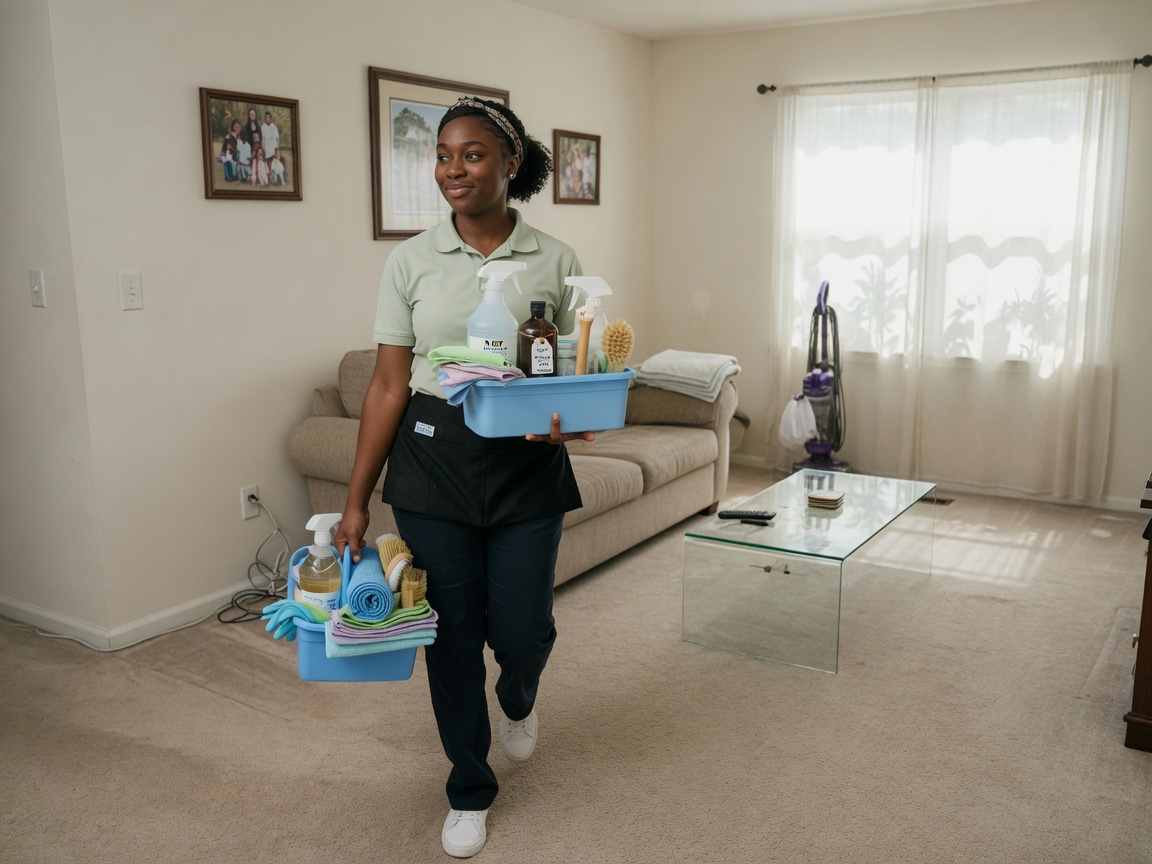
Residential Cleaning Business Blueprint
Blueprint Course
Residential Cleaning Business Blueprint
Launch collection candidateLaunch a solo residential cleaning business — from first supply kit to a recurring weekly client base.
This course walks you through starting a solo residential cleaning business step by step. You learn what the work really looks like, what it costs to start (about $770 required, around $1,100 with useful extras), how to price by home size instead of by the hour, and how to land your first 10 customers without paid ads. The goal is a base of recurring weekly and biweekly clients — recurring clients are the business. A typical established solo operator in this model earns roughly $1,500–$3,600 per month in profit before tax, depending on schedule, pricing, and local demand. That is a typical range, not a promise. Every lesson ends with one concrete action, so by the end of the course you have a working business, not just notes.
What you get
Built for operators who want a clear path — not a pile of generic tips.
The base case
One worked example, not a target
Planning estimates, before tax and before anything you pay yourself — no income is guaranteed. Your own prices, volume and costs will differ; the course walks you through replacing every number here with yours.
Who this fits
- You want the lowest-cost entry into a local service business — about $770 in required startup costs.
- You are detail-oriented and take pride in visible, finished work.
- You are comfortable working inside strangers' homes and earning their trust.
- You can keep a repeating weekly schedule reliably — recurring clients depend on it.
- You have a vehicle and can handle medium physical work: bending, scrubbing, carrying a vacuum.
Honest risks
- Trust-sensitive work: one break, loss, or theft accusation can badly damage your reputation — insurance and clear policies matter from day one.
- Physical wear from repetitive bending, scrubbing, and lifting adds up over months.
- Cancellations and reschedules fragment your calendar and cut into income until your policies and client base mature.
- Heavy competition: franchises and undercutting solo cleaners make this a price-sensitive market.
- Your income is capped by your own cleaning hours until you add help — growth past roughly full-time capacity requires hiring.
- There are no guaranteed results. Profit depends on your pricing, schedule, and local market.
Who should skip this one
- You're uncomfortable working alone inside strangers' homes, or being trusted with keys and alarm codes.
- You can't do several hours of bending, scrubbing, and lifting per job — cleaning is physical work with no shortcut.
- You need dependable income right away; a recurring-client base takes months to build and no income is guaranteed.
- You won't follow the same checklist every single time — consistency IS the product, and improvisers churn clients.
Curriculum
9 modules · 32 lessons · 2 hr 11 min of reading
01The Business Model: What This Work Really Isfree sample4 lessons · 16 min
What a residential cleaning business actually looks like day to day, why recurring clients are the whole game, the honest math behind the profit range, and whether this business fits you.
- What the Work Really Is(free sample below)4 min
- Why Recurring Clients Are the Business4 min
- The Honest Math: Revenue, Costs, and Profit Before Tax5 min
- Is This Business for You?3 min
02Startup Setup and Costs3 lessons · 13 min
The full startup budget line by line ($770 required, ~$1,100 typical), the accounts and basic structure to set up in week one, and a launch sequence that gets you ready to quote real jobs.
- Your Startup Budget, Line by Line4 min
- Week One: Accounts, Money, and Basic Structure5 min
- Your Launch Sequence: First 30 Days4 min
03Equipment and Supplies3 lessons · 13 min
Exactly what to buy for your $150 supply kit and $220 vacuum-and-mop budget, how to organize a caddy system that saves time on every job, and how to keep supply costs near $12 per clean.
- The Core Kit: What $370 of Gear Buys5 min
- The Caddy System: Set Up Like a Pro4 min
- Keeping Supply Costs Near $12 per Clean4 min
04Services and Pricing4 lessons · 17 min
Your service menu, how to quote by home size instead of by the hour, where the $130 standard clean comes from, premium pricing for deep and move-out cleans, and how to handle quotes and objections.
- Your Service Menu4 min
- Pricing by Home Size, Not by the Hour5 min
- Premium Jobs: Deep Cleans and Move-Outs4 min
- Quoting Calls and Price Objections4 min
05Legal and Insurance: What to Understand3 lessons · 13 min
Education — not legal, tax, or insurance advice — on business registration and structure, general liability insurance for in-home work, and simple tax habits. Everything here varies by location; verify locally.
- Registration and Business Structure, Explained5 min
- Insurance for Working in Homes4 min
- Simple Tax Habits from Day One4 min
06Branding and Online Presence4 lessons · 15 min
A trustworthy name and look, a Google Business Profile that gets you found, a simple one-page website, and a before/after photo habit that does your marketing for you.
- A Name and Look That Builds Trust4 min
- Google Business Profile: Your Most Important Listing4 min
- A One-Page Website That Converts4 min
- The Before/After Photo Habit3 min
07Your First 10 Customers4 lessons · 15 min
A concrete plan to land ten paying clients without paid ads: warm network and local Facebook groups, realtors and Airbnb hosts, neighborhood door cards, and converting every first clean into a recurring plan.
- Start Warm: Your Network and Local Facebook Groups4 min
- Realtors, Property Managers, and Airbnb Hosts4 min
- Door Cards and Route Density3 min
- Converting First Cleans into Recurring Clients4 min
08Service Delivery: Clean Like a Professional3 lessons · 13 min
The room-by-room system that makes every clean consistent, the client-file habits that make you trusted with keys and codes, and how to handle problems, damage, and complaints like a professional.
- The Room-by-Room System5 min
- Client Files, Keys, and Trust Habits4 min
- Problems, Damage, and Complaints4 min
09Reviews, Referrals, Operations, and Growth4 lessons · 16 min
The review-collection system that compounds, a two-sided referral program, weekly operations habits that keep the business healthy, and the honest options for growing past a full solo schedule.
- The Review System4 min
- A Two-Sided Referral Program3 min
- Your Weekly Operations Rhythm4 min
- Growing Past a Full Solo Schedule5 min
Why people buy this
Built for first-time operators who want a clear path — not generic AI chat.
Honest fit check
Who should start — and who should skip — so you don't waste months on the wrong business.
Do-this-next lessons
Every lesson ends in an action: scripts, checklists, pricing math you can use this week.
One-time purchase
One payment of $59. No course subscription.
Residential Cleaning Business Blueprint is part of the OwnerLaunch founding library. Figures in the course are planning estimates before tax — no income is guaranteed.
Blueprint FAQ
Why $59 for this Blueprint?+
You get a full operator course (9 modules, 32 lessons), a free sample lesson before you buy, downloadable templates after purchase, and a path into a personalized Launch Kit if you want one. It's a one-time payment — not a subscription for the course itself.
What do I get before I pay?+
The full curriculum outline, honest fit/risk lists, money base-case assumptions, a short course preview video when available, and one complete free sample lesson — real course content, not a teaser paragraph.
Is this legal, tax, or financial advice?+
No. OwnerLaunch is educational only. Licensing, insurance, tax, and filing requirements are location-dependent — verify with official sources and licensed professionals.
Can I upgrade to a Launch Kit later?+
Yes. Blueprint owners typically pay only the difference for a personalized Launch Kit (names, brand, pricing, copy, documents, 30-day plan). The course and kit are separate purchases.
Included templates & tools
- Supply Checklist Template — The full starter supply kit and vehicle restock checklist, with budget targets matching the course ($150 supplies, $220 vacuum and mop).
- Pricing Worksheet — Build your full price table by home size, anchored on the $130 standard recurring clean, with recurring discounts and premium multipliers.
- First-Clean Walkthrough Checklist — The complete room-by-room checklist for a first clean, plus the arrival routine, end-of-clean walk-through, and the recurring-plan conversion moment.
- Outreach Scripts — Copy-and-adapt scripts for the personal network announcement, local Facebook groups, realtors and property managers, Airbnb hosts, and quote follow-ups.
- Client Intake Form Template — The fill-in client file you complete at every walkthrough: access, alarm, pets, product preferences, off-limits areas, and the recurring plan agreed.
- 30-Day Launch Checklist — The whole course compressed into a four-week launch sequence — from setup week to your first recurring clients.
- Cleaning Business Launch Readiness Quiz — A ten-question self-check on quoting, chemical safety, access controls, recurring economics, service recovery, and hiring boundaries.
Free sample lesson
Real course content — not a teaser paragraph. The rest unlocks after purchase.
From module: The Business Model: What This Work Really Is
What the Work Really Is
~4 min read
A residential cleaning business is simple to describe and demanding to do well. You clean homes on a repeating schedule — weekly, biweekly, or monthly — plus higher-priced deep cleans and move-in/move-out jobs. You quote by home size, show up on time, clean to a consistent standard, and turn one-time cleans into recurring clients. The work is indoor and year-round, so weather never cancels your day. That is a real advantage over lawn care or pressure washing.
Be honest with yourself about the physical side. A working day means two to three homes of bending, scrubbing, vacuuming, and carrying gear up stairs. It is medium-intensity physical work, repeated. Most solo cleaners finish 1–3 homes per working day. The mental side matters too: you are alone in strangers' homes, trusted with their keys, their pets, and their belongings. Trust is the product as much as the clean is.
- Core services: standard recurring cleans, deep cleans, move-in/move-out cleans, and Airbnb turnover cleaning.
- Typical schedule: 1–3 homes per working day; this course's default model assumes 7 cleans per week.
- The customer you want: a recurring weekly or biweekly client, not a string of one-time jobs.
- What separates pros from amateurs: consistency. The same corners cleaned the same way, every visit.
Action · task
Do a timed practice clean
Clean your own kitchen and one bathroom to a standard you would charge for — every surface, every corner, appliance fronts, floors. Time yourself. Write down how long it took and how your body feels afterward. This is one slice of a working day; a typical job is a whole home. If you finished and would do it again tomorrow, this business is physically realistic for you.
Recommended software
OwnerLaunch may earn a commission if you purchase through this link, at no extra cost to you. Recommendations are based on product fit, not commission rate.
banking
Novo
Free online business checking that keeps cleaning income separate from personal money, with invoicing and budgeting 'reserves' built in.
- Best for:
- Solo cleaners who want no-monthly-fee business banking they can run entirely from a phone.
- Price:
- Free
- Downside:
- It is an online-only fintech account, so depositing cash from cash-paying clients is inconvenient.
- Cheaper:
- It is already free; a free business checking account at a local credit union handles cash better.
payments
Square
Lets clients pay by card, tap-to-pay, or a texted payment link, and gives you a clean record of every payment.
- Best for:
- Cleaners who invoice after each visit and want clients to pay from their phone in seconds.
- Price:
- Free app; roughly 2.6%–3.5% per transaction
- Downside:
- Card fees take a real bite out of a $150 cleaning, so many cleaners keep a free option alongside it.
- Cheaper:
- Zelle for regular clients who are comfortable with it — no fees, but no card option and no built-in records.
scheduling
Calendly
A booking link where new clients pick a walkthrough or cleaning slot themselves, ending the back-and-forth 'what time works?' texts.
- Best for:
- Cleaners booking estimates and first-time cleans — the free tier with one event type is enough to start.
- Price:
- Free–$12/mo
- Downside:
- The free tier only allows one event type, and it does not handle recurring weekly clients well — that stays in your calendar.
- Cheaper:
- The free tier is the cheap option; sharing your Google Calendar availability by text is free too.
invoicing
Wave
Free unlimited professional invoices with online card payment, plus automatic reminders that chase late payers for you.
- Best for:
- Cleaners who invoice after every job and want a polished invoice without a subscription — the free tier is genuinely enough.
- Price:
- Free to invoice; roughly 2.9% + 60¢ if the client pays by card
- Downside:
- Support is limited on the free plan, and features beyond invoicing and bookkeeping (like payroll) cost extra.
- Cheaper:
- It is already free; a Google Docs invoice template is the only cheaper route.
bookkeeping
Wave
Free bookkeeping that pulls in your bank transactions so income and supply expenses are categorized and tax-ready.
- Best for:
- Solo cleaners with simple finances — one bank account, supplies, mileage — where the free tier covers everything needed.
- Price:
- Free (receipt-scanning and payroll add-ons cost extra)
- Downside:
- No built-in automatic mileage tracking, which matters when you drive between houses every day.
- Cheaper:
- It is already free; a spreadsheet plus a shoebox of receipts is the only cheaper option and not worth the April pain.
insurance
Thimble
General liability insurance you can buy by the month or even by the job — covering the broken-vase and scratched-floor scenarios clients worry about.
- Best for:
- Part-time or just-starting cleaners who want to insure only the work they actually have, then scale up.
- Price:
- Roughly $25–$60/mo (short-term and per-job options can be less)
- Downside:
- Per-job and monthly flexibility can cost more per unit of coverage than an annual policy once you are cleaning full-time.
- Cheaper:
- An annual general liability policy from an online provider like NEXT often works out cheaper at full-time volume.
website / domain
Wix
A simple drag-and-drop website with your services, prices, photos, and a contact form — plus room to add online booking later.
- Best for:
- Cleaners who want a few pages (services, pricing, about, contact) rather than a single-page site.
- Price:
- Free with Wix branding; roughly $17–$29/mo for a custom domain plan (domain itself roughly $10–$15/yr)
- Downside:
- The free tier shows Wix ads and a Wix web address, which looks less professional on a flyer.
- Cheaper:
- Carrd at $19/yr for a clean one-page site, or just a free Google Business Profile to start.
crm
Less Annoying CRM
A deliberately simple customer database: every client's address, pets, key location, preferences, and follow-up dates in one place.
- Best for:
- Cleaners whose business runs on repeat clients and referrals, where remembering details is the service.
- Price:
- Roughly $15/mo per user
- Downside:
- No free tier, so it is a monthly cost from day one for something a spreadsheet can approximate.
- Cheaper:
- A Google Sheet, or the free HubSpot CRM tier if you want a real CRM at zero cost.
phone / sms
OpenPhone
A business phone line on your existing phone with auto-replies, scheduled texts, and saved message snippets for quoting and confirmations.
- Best for:
- Cleaners who run the whole business over text and want missed calls answered automatically with a booking link.
- Price:
- Roughly $15/mo per user
- Downside:
- It is a subscription for things Google Voice does a rougher version of free.
- Cheaper:
- Google Voice's free personal tier — a separate number without the automation.
reviews
Google Business Profile
Puts your cleaning business on Google Maps and local search and collects the reviews new clients read before they text you.
- Best for:
- Every local cleaner — 'house cleaning near me' searches land here, and the profile is free.
- Price:
- Free
- Downside:
- Verification for a home-based, service-area business can take days to weeks and occasionally requires extra steps.
- Cheaper:
- It is already free; asking for reviews by text costs nothing extra.
ai / tools
ChatGPT
Writes your quote replies, cleaning checklists, client policies, and awkward-message responses in seconds.
- Best for:
- Cleaners who would rather clean than write — checklists per home and polite late-payment texts are its sweet spot; the free tier is enough to start.
- Price:
- Free–$20/mo
- Downside:
- It can produce confident but wrong information, so never rely on it for legal, tax, or insurance answers without verifying.
- Cheaper:
- The free tier is the cheap option; other free assistants like Claude or Gemini work similarly.
niche / software
ZenMaid
Scheduling software built specifically for maid services: recurring cleans, client notes, automated appointment reminders, and work orders for future helpers.
- Best for:
- Cleaners with a full recurring book (roughly 20+ regular clients) where reminder texts and rescheduling eat real hours.
- Price:
- Roughly $50+/mo
- Downside:
- The price is steep for a brand-new solo cleaner and only earns its keep once your calendar is genuinely full.
- Cheaper:
- Square Appointments' free tier plus Google Calendar covers most solo needs at zero cost.
Ready to make it yours?
A Launch Kit turns this Blueprint into your business: personalized name, brand, pricing, website copy, documents, and Action Plan.
Basic
$119 current
Pro
$199 current
Apply your Blueprint credit to Basic for +$60 or Pro for +$140.
More Blueprints
Related course · Home Services
Lawn Care Business Blueprint
From honest fit-check to first customer — one short, practical step at a time.
Related course · Home Services
Mobile Detailing Business Blueprint
Launch a mobile detailing business from your driveway to your first paying route.
Recommended next · Home Services
Pressure Washing Blueprint
Launch a pressure washing business where before/after photos do the selling.
Recommended next · Home Services
Handyman Services Blueprint
Turn small repairs and endless to-do lists into a trusted local business.
Recommended next · Home Services
Junk Removal Blueprint
Launch a junk removal business — from your first trailer load to a repeatable local operation.
All numbers assume a solo operator with no employees, cleaning standard suburban homes, with a default of 7 cleans per week at about $130 per standard recurring clean, roughly $12 in supplies per clean, and about $150 per month in fixed costs (insurance, phone/software, marketing). Startup budget is about $770 for required items and around $1,100 with useful optional items. All profit figures are before tax — set aside a share of every payment for taxes. Revenue is not profit. Nothing here is legal, tax, or insurance advice; requirements vary by state, county, and city, so verify locally. Typical profit ranges describe what established solo operators commonly report — they are not a promise or a guarantee of results.
Educational guidance only — not legal, tax, or financial advice.Details
OwnerLaunch provides educational business guidance, AI-generated drafts, and checklists. It is not a law firm, tax advisor, CPA, registered agent, or government agency. Information may not be complete or current for your specific location. Always verify requirements with official federal, state, city, and county sources and consult qualified professionals when needed.