
Nail Tech Blueprint
Blueprint Course
Nail Tech Blueprint
Launch collection candidateFrom licensed skill to a full self-booked schedule.
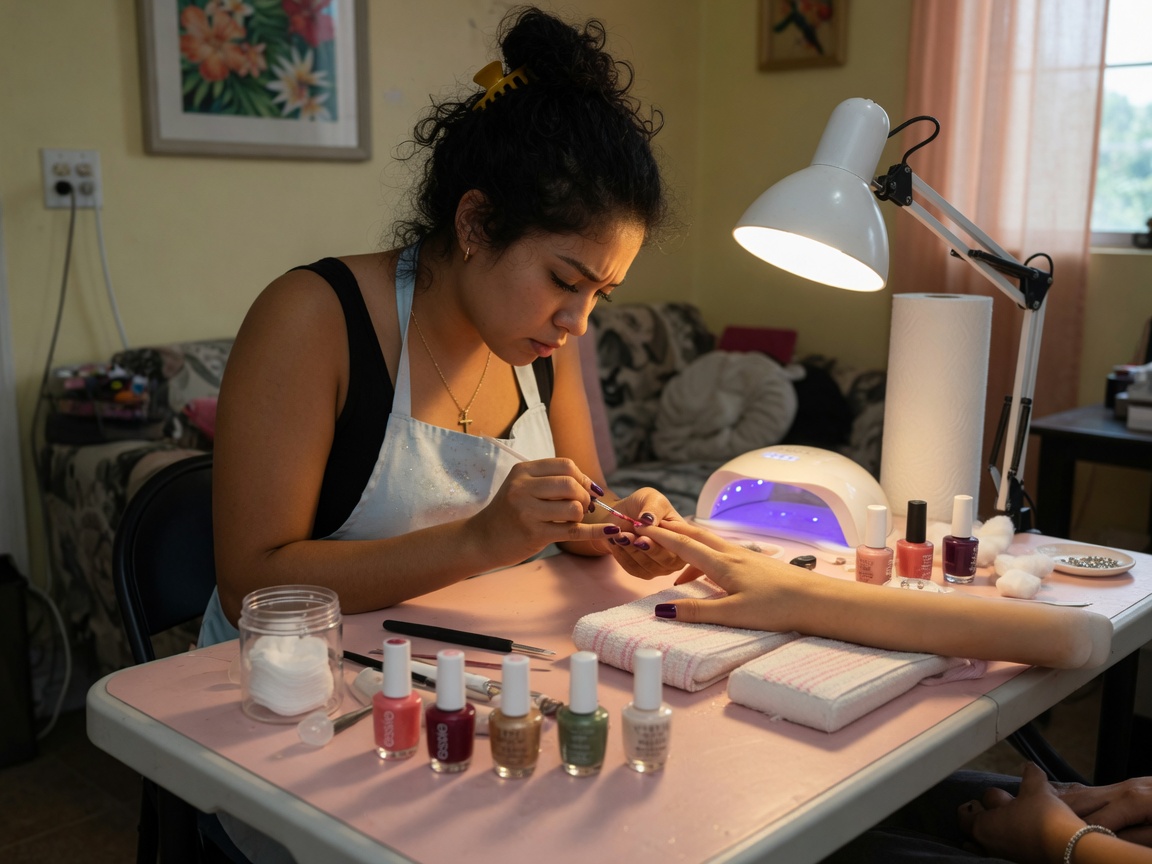
This course walks you from licensed nail tech (or student close to licensure) to a business owner with a self-booked schedule: choosing between a booth-rent station, a salon suite, and a compliant home studio, what each costs to start, how to price sets and fills from real costs, how to get your first 10 paying clients, and the rebooking habits that make nail work unusually predictable revenue — clients return every 2 to 4 weeks. Every money example uses the same base case: 18 sets a week at a $55 average service, about $8 in product per set, and about $760 a month in fixed costs — booth rent of roughly $650 being the big one. That pencils out to a typical range of $1,200 to $3,200 a month in profit before tax — a range, not a promise; no income is guaranteed. One thing before anything else: nail services are a licensed trade nearly everywhere in the U.S., and no lesson here replaces your state's license. Sanitation is the second non-negotiable — it is the difference between a career and a reputation-ending incident.
What you get
Built for operators who want a clear path — not a pile of generic tips.
The base case
One worked example, not a target
Planning estimates, before tax and before anything you pay yourself — no income is guaranteed. Your own prices, volume and costs will differ; the course walks you through replacing every number here with yours.
Who this fits
- You hold (or are actively earning) a state nail technician or cosmetology license
- You have steady hands and genuinely enjoy detailed, close-up creative work for hours at a stretch
- You are warm with clients — the appointment is an experience, not just a service
- You can hold yourself to strict sanitation discipline on every single client, even when you are behind schedule
- You are patient enough to build a book of regulars over months, not weeks
Honest risks
- State licensing is mandatory nearly everywhere before you can legally charge for nail services — program hours and exams take real time and money before your first paying client.
- Booth rent is due whether or not your book is full. A slow month still costs roughly $650 in rent.
- Sanitation failures are reputation-enders. A single infection complaint or failed inspection can undo a year of book-building.
- Product sensitivities are real: clients can react to acrylics and gels, and you work with those chemicals daily — ventilation and technique matter for your own health too.
- Repetitive-strain injuries in your hands, wrists, neck, and back are the career risk in this trade, and an injury stops revenue.
- Book-building is slow. Instagram posting and referrals take months of consistency before the calendar fills, and no income is guaranteed in the meantime.
Who should skip this one
- You do not have a nail technician or cosmetology license and are not willing to complete your state's required program and exams first — nothing in this course replaces licensure, and working unlicensed risks fines and losing the career before it starts.
- You cut corners under pressure. If you would ever skip disinfection to stay on schedule, this trade will eventually end your reputation — sanitation discipline is the job.
- You need dependable income immediately. Building a book of regulars takes months of consistent work and no income is guaranteed.
- You have existing hand, wrist, or neck problems that hours of fine detail work would aggravate — repetitive strain is the injury profile of this trade.
Curriculum
10 modules · 35 lessons · 1 hr 49 min of reading
01What a Nail Business Really Isfree sample3 lessons · 10 min
Before you rent a booth or buy a lamp, understand the job: what you sell, what the money actually looks like at 18 sets a week, and whether this trade fits your hands, your patience, and your life.
- The Work, the License, and the Book(free sample below)4 min
- The Money, Honestly3 min
- Is This Business Right for You?3 min
02Booth, Suite, or Home Studio: Choosing Your Model3 lessons · 10 min
Where you work shapes your costs, your independence, and your compliance load. Compare the booth-rent station, the salon suite, and the home studio with honest math.
- The Booth-Rent Model (Our Base Case)3 min
- Salon Suites and Home Studios4 min
- Choose Your Model3 min
03Startup Costs and Setup3 lessons · 8 min
The real startup number for a booth-based launch — about $1,140 required, $1,500 typical — line by line, plus the setup week that turns purchases into a business.
- The Real Startup Number3 min
- What Not to Buy Yet2 min
- Your Setup Week3 min
04Equipment and Supplies3 lessons · 9 min
The core kit that earns its price, the product library that keeps cost per set near $8, and the sanitation station your license depends on.
- The Core Kit3 min
- Products and Your Cost Per Set3 min
- The Sanitation Station3 min
05Services and Pricing4 lessons · 13 min
Build a menu around the $55 average set, price from real costs instead of copying competitors, and make fills the loyalty engine that fills your calendar.
- Your Service Menu3 min
- Price From Real Costs, Not Vibes4 min
- Fills: The Rebooking Engine3 min
- Art, Lengths, and Premium Pricing3 min
06Legal, Licensing, Insurance, and Taxes: What to Understand5 lessons · 16 min
Education, not legal advice: the license that must come first, the sanitation rules boards inspect, how registration and EINs actually work, what insurance covers, and the tax set-aside habit. Requirements vary by state and city — verify everything locally.
- Your License Comes First4 min
- Sanitation Rules and Inspections3 min
- Business Structure and Registration3 min
- Insurance Basics3 min
- Taxes and the Set-Aside Habit3 min
07Branding and Being Findable3 lessons · 9 min
Your portfolio is your brand. Build a camera-ready posting habit, a booking link that converts, and the local search presence that catches people typing 'nail tech near me.'
- Portfolio Before Logo3 min
- Instagram and the Booking Link3 min
- Google Profile and Local Search3 min
08Your First 10 Clients4 lessons · 12 min
A concrete sequence — warm circle, referral loop, and local outreach — that fills the first pages of your book without spending on ads.
- The Warm-Circle Launch3 min
- The Referral Loop3 min
- Local Outreach and Salon Traffic3 min
- From 10 Clients to a Full Book3 min
09Delivering the Set4 lessons · 12 min
The appointment experience that makes clients rebook: consultation, quality that survives three weeks, a sanitation routine clients can see, and protecting the hands your business runs on.
- The Appointment Experience3 min
- Quality That Survives Three Weeks3 min
- The Sanitation Routine in Practice3 min
- Protect Your Hands and Body3 min
10Reviews, Rebooking, and Growth3 lessons · 10 min
Turn a working book into a durable business: a review engine, calendar protection against no-shows, and the honest growth levers — prices, premiums, and capacity.
- The Review Engine3 min
- No-Shows and Calendar Protection3 min
- Growth: The Honest Levers4 min
Why people buy this
Built for first-time operators who want a clear path — not generic AI chat.
Honest fit check
Who should start — and who should skip — so you don't waste months on the wrong business.
Do-this-next lessons
Every lesson ends in an action: scripts, checklists, pricing math you can use this week.
One-time purchase
One payment of $59. No course subscription.
Nail Tech Blueprint is part of the OwnerLaunch founding library. Figures in the course are planning estimates before tax — no income is guaranteed.
Blueprint FAQ
Why $59 for this Blueprint?+
You get a full operator course (10 modules, 35 lessons), a free sample lesson before you buy, downloadable templates after purchase, and a path into a personalized Launch Kit if you want one. It's a one-time payment — not a subscription for the course itself.
What do I get before I pay?+
The full curriculum outline, honest fit/risk lists, money base-case assumptions, a short course preview video when available, and one complete free sample lesson — real course content, not a teaser paragraph.
Is this legal, tax, or financial advice?+
No. OwnerLaunch is educational only. Licensing, insurance, tax, and filing requirements are location-dependent — verify with official sources and licensed professionals.
Can I upgrade to a Launch Kit later?+
Yes. Blueprint owners typically pay only the difference for a personalized Launch Kit (names, brand, pricing, copy, documents, 30-day plan). The course and kit are separate purchases.
Included templates & tools
- 30-Day Launch Checklist — The whole course sequenced into four weeks: license and model decisions, setup week, portfolio build, and the first-clients push.
- First 10 Clients Outreach Scripts — Copy-and-personalize messages for the warm-circle launch, referral follow-ups, stylist cross-referrals, and local group posts.
- Client Intake & Consultation Template — A fill-in form for the first five minutes of every appointment: history, sensitivities, lifestyle, and the agreed plan for the set.
- Set Pricing Calculator — A by-hand worksheet: your real cost per set plus your share of fixed costs, then before-tax margin at three price points per service.
- Booth vs. Suite vs. Home Studio Worksheet — A side-by-side decision worksheet for Module 2: real rents, compliance load, cash runway, and a scored recommendation.
- Launch Readiness Self-Check — A 12-question self-check across licensing, sanitation, money, and marketing — find the gaps before your first paying client does.
Free sample lesson
Real course content — not a teaser paragraph. The rest unlocks after purchase.
From module: What a Nail Business Really Is
The Work, the License, and the Book
~4 min read
A nail business is an appointment book. You sell gel and acrylic sets, fills, manicures, and nail art — but what you are really building is a roster of regulars who sit in your chair every 2 to 4 weeks. That repeat cycle is the whole economic engine: a modest book of loyal clients produces steady, predictable revenue that most local businesses would envy. New-client hunting never fully stops, but past the first year, most of your income should come from people who already know you.
Two non-negotiables sit underneath everything. First, licensure: nail services are a licensed trade nearly everywhere in the U.S. Your state's cosmetology or barbering board sets required training hours and exams, and they vary a lot by state — this is location-dependent, so verify with your own state board before you plan anything else. Second, sanitation: state boards inspect, clients notice, and a single infection complaint can end a reputation. The techs who last treat disinfection like a ritual, not a chore.
- You sell time slots: a full set is roughly 1.5–2.5 hours of close, detailed handwork
- The stable money is fills every 2–3 weeks — the loyalty engine
- The premium money is nail art, lengths, and specialty gels
- The hidden job: calendar management — rebooking, no-show policy, and a booking link that works while you sleep
Action · task
Check your licensing status today
Write down your current licensing status: licensed, enrolled in a program, or neither. If you are not yet licensed, look up your state board's website today and note the required hours, the exams, and the cost of the license. That timeline is the start date of your business — everything else in this course builds on it.
Ready to make it yours?
A Launch Kit turns this Blueprint into your business: personalized name, brand, pricing, website copy, documents, and Action Plan.
Basic
$119 current
Pro
$199 current
Apply your Blueprint credit to Basic for +$60 or Pro for +$140.
More Blueprints
Related course · Beauty & Personal Care
Mobile Barber Blueprint
Build a book of regulars behind a chair — then take the chair to them.
Recommended next · Beauty & Personal Care
Pet Grooming Blueprint
Wags, clippers, and a loyal recurring clientele.
Recommended next · Beauty & Personal Care
Lash Tech Blueprint
Precision beauty work with strong rebooking rates.
Recommended next · Beauty & Personal Care
Hair Braiding Blueprint
Build a braiding book that stays full.
All figures are estimates that assume a solo licensed nail tech with no employees, renting a booth or station in a typical U.S. market. The base case throughout is 18 sets a week at a $55 average service, about $8 in variable product cost per set, and about $760 a month in fixed costs (booth rent $650, booking software and phone $60, marketing $50). All profit figures are before tax and before anything you pay yourself. Ranges are typical outcomes under these assumptions, not guarantees — no income is guaranteed, and your market, prices, skill, and effort decide where you land. Licensing, legal, tax, and insurance lessons are education only, not professional advice; requirements vary by state, county, and city — verify everything with your state board and local officials.
Educational guidance only — not legal, tax, or financial advice.Details
OwnerLaunch provides educational business guidance, AI-generated drafts, and checklists. It is not a law firm, tax advisor, CPA, registered agent, or government agency. Information may not be complete or current for your specific location. Always verify requirements with official federal, state, city, and county sources and consult qualified professionals when needed.