
Hair Braiding Blueprint
Blueprint Course
Hair Braiding Blueprint
Build a braiding book that stays full.
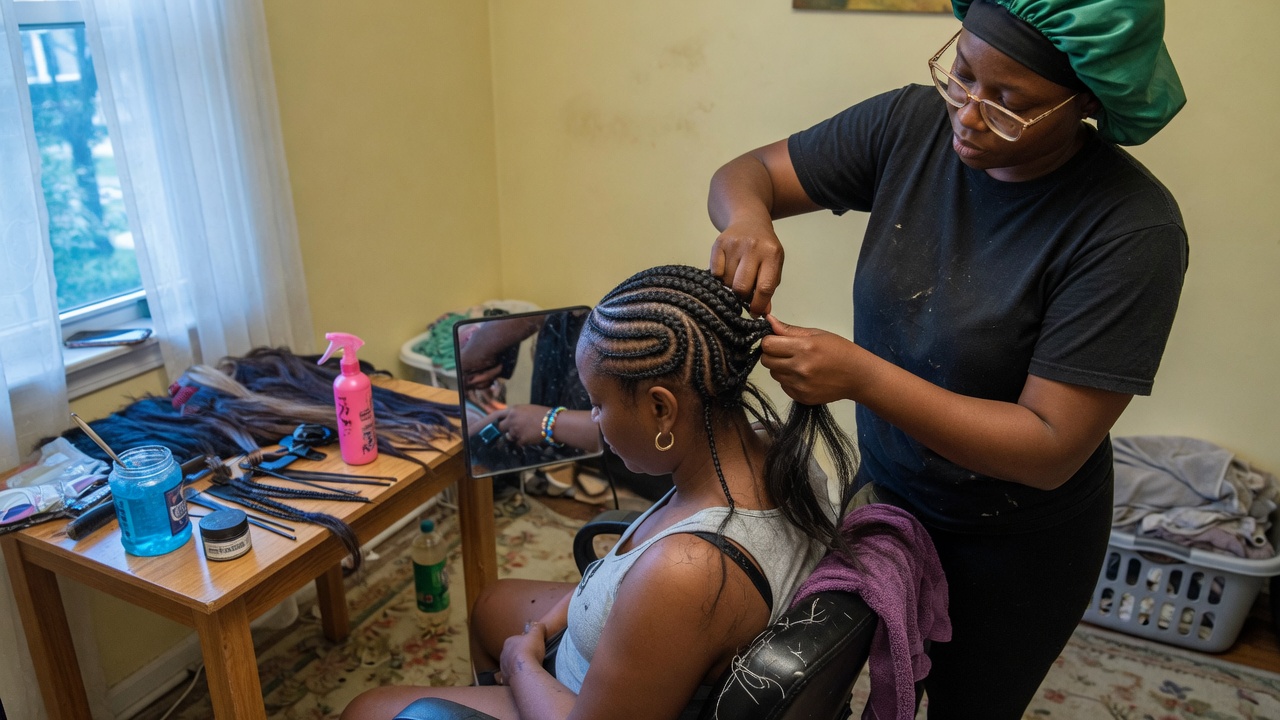
This course takes you from skilled braider to booked-out business owner: choosing between a compliant home studio and a rented booth, what each honestly costs, how to price every style from the hours it takes instead of guessing, and how to get your first 10 paying clients. Braiding has a special economic shape — one client can sit in your chair for 2 to 7 hours — so the pricing modules are built around time-per-style math: what each install really earns per hour after product and fixed costs. Every money example uses the same explicit base case, because these figures are not inherited from the Discover profile for this trade: 10 clients a week at a $140 average ticket (menu from $80 short styles to $300+ long knotless), about $10 in product per install, and about $260 a month in home-studio fixed costs. That pencils to roughly $4,900 a month before tax at a full book, with a typical range of $1,500 to $4,800 — a range under stated assumptions, not a promise; no income is guaranteed, and these are planning estimates you must verify against your own market. One thing to settle before anything else: whether your state treats natural hair braiding as a deregulated trade, a lightly registered specialty, or work that requires a full cosmetology license. That single location-dependent question changes your timeline more than anything else in this course, and Module 5 walks you through answering it properly.
What you get
Built for operators who want a clear path — not a pile of generic tips.
The base case
One worked example, not a target
Planning estimates, before tax and before anything you pay yourself — no income is guaranteed. Your own prices, volume and costs will differ; the course walks you through replacing every number here with yours.
Who this fits
- You already braid at a level people compliment — clean parts, consistent tension, styles that last weeks
- You can stay focused and friendly through 4-to-6-hour installs, including the third one that week
- You want a low-overhead start: braiding can launch from a compliant home studio for a few hundred dollars
- You are patient enough to build a book of repeat clients over months — braids come back every 4 to 8 weeks
- You are willing to research your state's braiding rules honestly before taking a paying client
Honest risks
- Licensing is genuinely unsettled ground: some states have deregulated natural hair braiding, some require a lighter specialty registration, and others still require a full cosmetology license (often 1,000+ training hours). Getting this wrong can mean fines or board action — verify your state before your first paying client.
- Your hours are the inventory. A 6-hour install caps how many clients a week your body can take, and wrist, shoulder, and back strain are the career injuries of this trade.
- Underpricing is the classic failure: a $120 style that takes 6 hours pays less per hour than most part-time jobs once product and fixed costs come out.
- Book-building is slow. Referrals and Instagram take months of consistent posting before your calendar fills, and no income is guaranteed in the meantime.
- No-shows hurt more here than in most trades — a missed 5-hour appointment is most of a working day gone.
- Home-studio rules (zoning, home-occupation permits) are separate from braiding licensure and vary by city — a compliant home setup takes homework, not just a chair.
Who should skip this one
- You are not willing to research your state's braiding licensure rules before charging — in full-licensure states, working unlicensed risks fines and board action that can follow you into any future beauty career.
- You need dependable income in the next 60 days. A braiding book takes months of referrals and consistent posting to fill, and no income is guaranteed while it builds.
- You have existing wrist, shoulder, neck, or back problems that hours of sustained tension work would aggravate — repetitive strain is the injury profile of this trade.
- You want to price by vibes and undercut everyone. This course prices every style from hours and costs; if $100 for a 6-hour install sounds fine to you, the math modules will be an uncomfortable read.
- You lose patience with people in long appointments. A braiding client shares your space for half a day — the experience is part of the product.
Curriculum
10 modules · 32 lessons · 1 hr 35 min of reading
01What a Braiding Business Really Is3 lessons · 10 min
Before you buy a chair or post a price list, understand the job: what you actually sell, what the money looks like at 10 clients a week, and whether hours-long detail work fits your body and your patience.
- The Work and the Book3 min
- The Money, Honestly4 min
- Is This Business Right for You?3 min
02Startup Costs and Your Space: Home Studio or Booth3 lessons · 10 min
Braiding is one of the cheapest skilled trades to launch — $500 to $1,500 done sensibly. Choose between a compliant home studio and a rented booth with honest math, then budget the startup list line by line.
- The Home Studio (Our Base Case)3 min
- The Booth Alternative3 min
- The $500–$1,500 Startup Budget4 min
03Equipment, Products, and the Hair Question3 lessons · 8 min
The kit is small but the details matter: a chair that protects your back, lighting that sells your work, products that cost $5–$15 per install — and a clear policy on who buys the extension hair.
- Your Working Kit3 min
- Who Buys the Hair? Set the Policy Now3 min
- Stocking Products Without Wasting Money2 min
04Pricing: The Hours Inside Every Stylefree sample4 lessons · 13 min
Braiding pricing fails when you copy other people's flat prices and ignore the hours. This module builds your menu from time-per-style math: what each install really pays per hour after product and fixed costs.
- Your Hours Are the Inventory(free sample below)4 min
- Building the Menu from a Floor, Not a Guess4 min
- Deposits, No-Shows, and Protecting Long Appointments3 min
- When and How to Raise Prices2 min
05Legal, Insurance, and Taxes: The Braiding License Question4 lessons · 13 min
Education only, never legal advice: how to find out — properly — whether your state requires a license to braid for money, plus business registration, insurance, and the tax set-aside habit. Everything here is location-dependent.
- The Braiding License Question (Answer This First)4 min
- Registering the Business (Without Getting Sold Things)3 min
- Insurance That Fits a Braider3 min
- Taxes: The Set-Aside Habit3 min
06Your Brand and Being Findable3 lessons · 8 min
In braiding, your portfolio IS your brand: photos sell hours before you say a word. Build a name, an Instagram that books, and a Google presence that catches people searching 'braider near me'.
- A Name and a Look You Won't Outgrow2 min
- The Portfolio Engine: Photos That Book3 min
- Getting Found: Google and Local Search3 min
07Your First 10 Clients3 lessons · 9 min
The first 10 come from people who already know you, model calls that fill your portfolio, and follow-up discipline — not from ads. This module is a two-week sequence, not a theory.
- The Warm Circle: 20 Messages3 min
- Model Calls That Pay You Forward3 min
- Follow-Up Discipline and Counting to 103 min
08Service Delivery: The Long-Appointment Experience3 lessons · 8 min
A braiding appointment is hours of shared space. Consultation, prep enforcement, pacing, and aftercare are what turn a good install into a rebooked client — and protect your hands for the next one.
- Consultation and the Booking Confirmation3 min
- Pacing the Install (and Protecting Your Body)3 min
- Aftercare, the Photo, and the Send-Off2 min
09Reviews, Referrals, and the Rebooking Cycle3 lessons · 7 min
Braids come out in 4 to 8 weeks — which means every client is a scheduled repeat sale if you run the cycle on purpose. Reviews and referrals compound the same appointment into new clients.
- The Review Ask That Actually Works2 min
- Rebook Before They Leave3 min
- Referrals on Purpose2 min
10Operations, Money Rhythm, and Growing Past Full3 lessons · 9 min
A weekly money-and-calendar review keeps the business honest; a full book gives you three levers — raise prices, shift the style mix, or expand capacity. Grow on purpose, not by exhaustion.
- The 20-Minute Weekly Review3 min
- When the Book Is Full: Three Levers3 min
- Your 30-Day Launch, Assembled3 min
Why people buy this
Built for first-time operators who want a clear path — not generic AI chat.
Honest fit check
Who should start — and who should skip — so you don't waste months on the wrong business.
Do-this-next lessons
Every lesson ends in an action: scripts, checklists, pricing math you can use this week.
One-time purchase
One payment of $59. No course subscription.
Hair Braiding Blueprint is part of the OwnerLaunch founding library. Figures in the course are planning estimates before tax — no income is guaranteed.
Blueprint FAQ
Why $59 for this Blueprint?+
You get a full operator course (10 modules, 32 lessons), a free sample lesson before you buy, downloadable templates after purchase, and a path into a personalized Launch Kit if you want one. It's a one-time payment — not a subscription for the course itself.
What do I get before I pay?+
The full curriculum outline, honest fit/risk lists, money base-case assumptions, a short course preview video when available, and one complete free sample lesson — real course content, not a teaser paragraph.
Is this legal, tax, or financial advice?+
No. OwnerLaunch is educational only. Licensing, insurance, tax, and filing requirements are location-dependent — verify with official sources and licensed professionals.
Can I upgrade to a Launch Kit later?+
Yes. Blueprint owners typically pay only the difference for a personalized Launch Kit (names, brand, pricing, copy, documents, 30-day plan). The course and kit are separate purchases.
Included templates & tools
- 30-Day Braiding Launch Checklist — The whole course sequenced into four weeks of checkboxes — licensing answer first, then setup, pricing, brand, and your first paying installs.
- Warm-Circle and DM Reply Scripts — Copy-and-personalize scripts for the first-10 push: warm-circle messages, the 3-day follow-up, model-call posts, and DM replies that turn questions into bookings.
- Client Intake and Booking Policy Template — A fill-in consultation form plus the booking-policy and confirmation text every appointment should run on — hair specs, prep rules, deposits, and tension history.
- Time-per-Style Pricing Calculator — The course's pricing centerpiece as a worksheet: compute each style's effective hourly rate, build prices from your hourly floor, and see your real weekly capacity — all by hand.
- Launch-Readiness Self-Check Quiz — Twelve yes/no questions that tell you honestly whether to launch now or close specific gaps first — licensing first, always.
Free sample lesson
Real course content — not a teaser paragraph. The rest unlocks after purchase.
From module: Pricing: The Hours Inside Every Style
Your Hours Are the Inventory
~4 min read
Every business sells something scarce. A braider's scarce thing is not braids — it is hours, and there are only so many your hands can work in a week. A $250 knotless install that takes 5 hours and an $80 kids' style that takes 90 minutes are not just different prices; they are different rates for the same scarce hours. Until you see every style as an hourly rate, you cannot price, schedule, or grow on purpose.
The math is three steps. First, effective hourly rate: (price − product cost) ÷ hours. That $250 knotless with $12 of product over 5 hours earns $47.60 an hour before fixed costs. The $80 kids' style with $5 of product over 1.5 hours earns $50 an hour — quietly better. Second, fixed-cost share: your $260 a month spread over 40 installs is $6.50 per appointment that has to come out before profit. Third, capacity: at roughly 35 chair-hours a week, your style mix decides your ceiling — a week of five 6-hour installs books 30 hours for maybe $1,300, while a smarter mix of long and short styles books the same hours for more.
Action · worksheet
Rate your three most common styles
For your three most-requested styles, write down: honest hours it takes you, product cost, and the price you planned to charge. Compute (price − product) ÷ hours for each. Circle any style earning under $30/hour — those are your underpriced styles, and the next lesson fixes them.
Ready to make it yours?
A Launch Kit turns this Blueprint into your business: personalized name, brand, pricing, website copy, documents, and Action Plan.
Basic
$119 current
Pro
$199 current
Apply your Blueprint credit to Basic for +$60 or Pro for +$140.
More Blueprints
Related course · Beauty & Personal Care
Mobile Barber Blueprint
Build a book of regulars behind a chair — then take the chair to them.
Related course · Beauty & Personal Care
Nail Tech Blueprint
From licensed skill to a full self-booked schedule.
Recommended next · Beauty & Personal Care
Pet Grooming Blueprint
Wags, clippers, and a loyal recurring clientele.
Recommended next · Beauty & Personal Care
Lash Tech Blueprint
Precision beauty work with strong rebooking rates.
Recommended next · Beauty & Personal Care
Hair Stylist (Booth Rental) Blueprint
Rent the chair, own the book, and make the rent clock work for you.
All figures are estimates, and because these figures are not inherited from the Discover profile for braiding, the base case is a stated planning scenario you must check against your own market: a solo braider with no employees, working from a compliant home studio (or a rented booth), doing 10 clients a week at a $140 average ticket across a menu from $80 short styles to $300+ long installs, spending $5 to $15 in product per install (about $10 average, with extension hair billed separately or supplied by the client), carrying about $260 a month in fixed costs at home (roughly $550 to $700 in a booth), and starting up for $500 to $1,500. All profit figures are before tax and before anything you pay yourself; the typical range of $1,500 to $4,800 a month reflects ramp-up months, style mix, and seasonality — it is not a guarantee, and no income is guaranteed. Licensing is the big variable in this trade: natural hair braiding is deregulated or lightly registered in many states but requires full cosmetology licensure in others, and this course cannot tell you which applies to you. Legal, tax, licensing, and insurance lessons are education only, not professional advice — verify everything with your state board and local officials.
Educational guidance only — not legal, tax, or financial advice.Details
OwnerLaunch provides educational business guidance, AI-generated drafts, and checklists. It is not a law firm, tax advisor, CPA, registered agent, or government agency. Information may not be complete or current for your specific location. Always verify requirements with official federal, state, city, and county sources and consult qualified professionals when needed.