
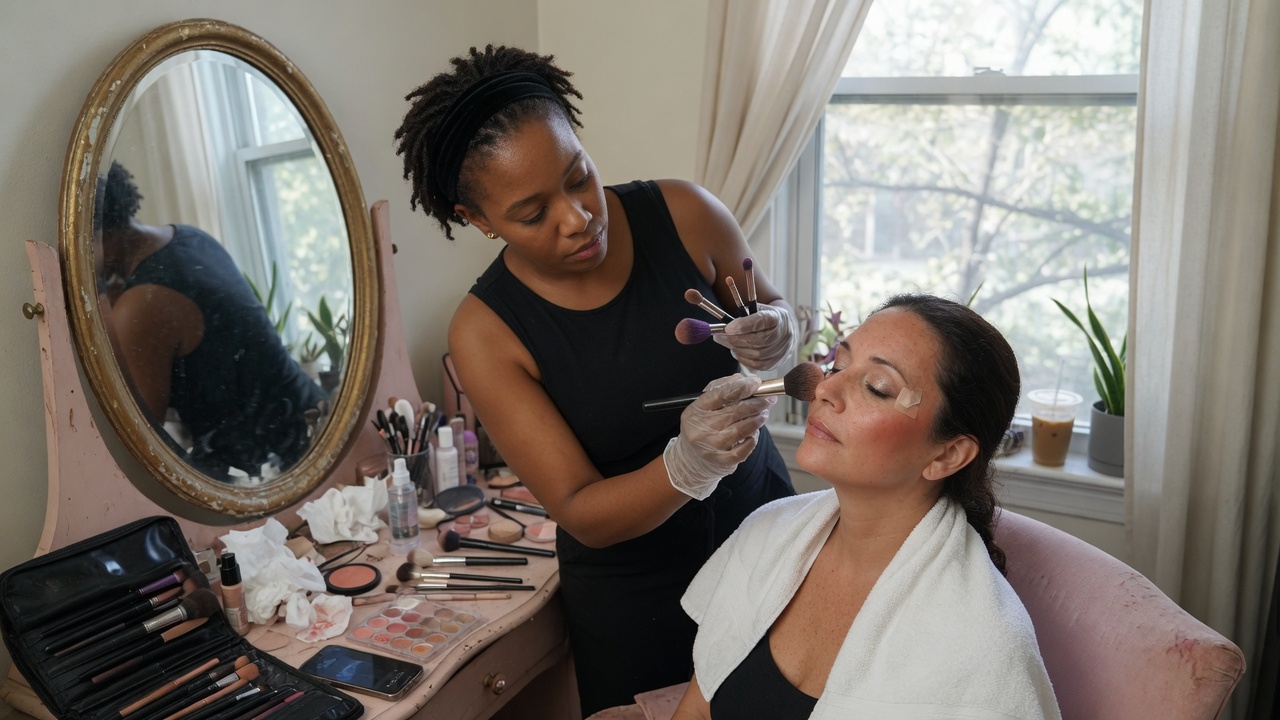
Freelance Makeup Artist Blueprint
Blueprint Course
Freelance Makeup Artist Blueprint
Events, weddings, and shoots on your own rates.
This course takes you from doing faces for friends to running a freelance mobile makeup business built around weddings and events: assembling a professional kit without blowing your budget, pricing bridal work from real costs, building the portfolio that gets you hired, and surviving the off-season. Every money example uses the same explicit base case: a mobile artist focused on bridal and event work, booking 4 to 8 jobs a week in wedding season, charging $150 to $350 for a bridal application and $80 to $120 per bridal-party face, spending roughly $10 to $20 in kit consumables per face, after a startup investment of $800 to $2,500 in a pro kit and business basics. Those are planning estimates for a typical U.S. market — ranges, not promises; no income is guaranteed. Two realities shape everything here. First, weddings are seasonal: most cluster from late spring through fall, so your year has a harvest and a winter, and the course teaches you to plan cash around both. Second, in some states paid makeup application legally requires an esthetician or cosmetology license while many others exempt it — that is location-dependent, and the legal module shows you exactly how to find your state's answer before you charge your first dollar.
What you get
Built for operators who want a clear path — not a pile of generic tips.
The base case
One worked example, not a target
Planning estimates, before tax and before anything you pay yourself — no income is guaranteed. Your own prices, volume and costs will differ; the course walks you through replacing every number here with yours.
Who this fits
- You already have real makeup skill — on other people's faces, across different skin tones and ages, not just your own
- You are calm and warm under pressure: wedding mornings are emotional, early, and run on a strict timeline
- You are comfortable being mobile — packing a kit, driving to venues and homes, and working in whatever light and space you find
- You can treat hygiene as a ritual: clean brushes, disposables, and no double-dipping on every single face
- You can handle seasonal income — busy summers and falls, quiet winters — without panicking
Honest risks
- Licensing is genuinely unsettled ground: some states require an esthetician or cosmetology license to apply makeup for pay, and working unlicensed where one is required risks fines and shutdown. You must verify your state's rule before charging.
- Wedding work is sharply seasonal — most weddings fall between late spring and fall. Off-season months can produce a fraction of peak income, and no income is guaranteed in any month.
- Hygiene failures end careers. An eye infection or cold-sore transmission traced to your kit is a reputation and liability event a small business may not survive.
- Bookings depend on a portfolio. Until you have strong photos of real work on diverse faces, you will struggle to charge professional rates — building that portfolio takes unpaid or low-paid practice time.
- Wedding mornings are unforgiving: one late arrival or blown timeline can mean a devastated client, a public bad review, and lost vendor referrals.
- A professional kit is a real ongoing cost — products expire, shades run out, and restocking eats margin if you never track cost per face.
Who should skip this one
- Your state requires an esthetician or cosmetology license for paid makeup application and you are not willing to complete it — nothing in this course replaces licensure, and working unlicensed where it is required risks fines and losing the business before it starts.
- You need steady, predictable income every month. Wedding work is seasonal and book-building is slow; no income is guaranteed, and the off-season is real.
- You would ever cut hygiene corners to save time or product — reusing disposables, double-dipping into products, or skipping brush cleaning between faces. That habit ends careers in this trade.
- You dislike early mornings, driving, or being 'on' with emotional clients. Bridal work is 5 a.m. call times, venue logistics, and being the calmest person in the room.
Curriculum
10 modules · 35 lessons · 2 hr 1 min of reading
01Is a Freelance Makeup Business Right for Youfree sample3 lessons · 11 min
What the job actually is — early mornings, mobile kits, emotional clients, and a sharply seasonal calendar — what the money looks like under an honest base case, and a go/no-go decision before you spend a dollar.
- What This Business Really Is(free sample below)4 min
- The Money: An Honest Season and Off-Season4 min
- Founder Fit: The Go/No-Go Decision3 min
02Startup Costs and Setup3 lessons · 11 min
Where the $800–$2,500 actually goes, what you can safely skip at the start, and the boring business basics — name, bank account, simple bookkeeping — done in an afternoon.
- The $800–$2,500 Startup Budget, Line by Line4 min
- What You Can Skip at First3 min
- Business Basics in an Afternoon4 min
03Your Kit: Equipment, Supplies, and Hygiene4 lessons · 14 min
Building a professional kit that serves every skin tone, the sanitation ritual that protects clients and your career, what each face really costs you in product, and the mobile setup that makes any room your studio.
- Building a Kit for Every Face4 min
- The Sanitation Ritual (Non-Negotiable)4 min
- What a Face Costs You: Consumables Math3 min
- The Mobile Setup: Any Room Becomes a Studio3 min
04Services and Pricing4 lessons · 14 min
A clean service menu, prices built from real costs instead of guesses, and the bridal-specific machinery — trials, minimums, deposits, travel fees, and early-start fees — that protects your margin and your calendar.
- Your Service Menu3 min
- Price From Costs, Not Vibes4 min
- Bridal Machinery: Minimums, Deposits, and Fees4 min
- Trials: The Paid Audition That Closes the Booking3 min
05Legal, Insurance, and Taxes (Education, Not Advice)4 lessons · 13 min
The licensing question answered honestly — some states require an esthetician or cosmetology license for paid makeup, many exempt it — plus registration, liability insurance, and the tax habits that keep a freelancer out of trouble. Everything here is location-dependent education, never legal advice.
- The Licensing Reality: It Depends on Your State4 min
- Registering the Business3 min
- Insurance That Fits the Work3 min
- Freelancer Tax Habits3 min
06Branding, Portfolio, and Being Findable4 lessons · 14 min
Your portfolio is the business: how to build one before you have paying clients, brand yourself credibly, and set up the Instagram-plus-booking-page presence that turns lurkers into inquiries.
- Building a Portfolio Before You Have Clients4 min
- Your Brand in One Line3 min
- An Instagram That Actually Books4 min
- The Booking Page and Google Presence3 min
07Marketing: Your First 10 Paying Clients4 lessons · 13 min
Turning practice models and your warm network into paid bookings, building the vendor referral web — photographers, planners, venues, bridal shops — and using directories and bridal shows without wasting money.
- Convert the Warm Circle First3 min
- The Vendor Referral Web4 min
- Directories and Bridal Shows, Without Burning Money3 min
- Counting to Ten: The Launch Scoreboard3 min
08Service Delivery: Trials and the Wedding Day3 lessons · 11 min
Running trials that convert into bookings, building a wedding-morning timeline that never runs late, and the on-location professionalism — skin safety, calm, clean kit — that turns one wedding into three referrals.
- Running Trials That Convert4 min
- The Wedding-Morning Timeline4 min
- On-Location Professionalism and Skin Safety3 min
09Seasonality and Cash Flow3 lessons · 10 min
Wedding income arrives in a wave, not a stream. How to book the peak deliberately, build the off-season revenue mix — holiday glam, proms, shoots, lessons — and bank enough of the season to make the winter boring instead of frightening.
- The Shape of a Bridal Year3 min
- Booking the Peak Deliberately3 min
- The Off-Season Mix and the Cash Reserve4 min
10Reviews, Referrals, and Growth3 lessons · 10 min
Turning every wedding into reviews and the next bookings, raising rates as demand fills, and the growth paths — a busier book, an assistant, an associate artist, or teaching — once the engine runs.
- The Review Engine3 min
- Referrals and the Repeat-Client Layer3 min
- Raising Rates and Choosing Your Growth Path4 min
Why people buy this
Built for first-time operators who want a clear path — not generic AI chat.
Honest fit check
Who should start — and who should skip — so you don't waste months on the wrong business.
Do-this-next lessons
Every lesson ends in an action: scripts, checklists, pricing math you can use this week.
One-time purchase
One payment of $59. No course subscription.
Freelance Makeup Artist Blueprint is part of the OwnerLaunch founding library. Figures in the course are planning estimates before tax — no income is guaranteed.
Blueprint FAQ
Why $59 for this Blueprint?+
You get a full operator course (10 modules, 35 lessons), a free sample lesson before you buy, downloadable templates after purchase, and a path into a personalized Launch Kit if you want one. It's a one-time payment — not a subscription for the course itself.
What do I get before I pay?+
The full curriculum outline, honest fit/risk lists, money base-case assumptions, a short course preview video when available, and one complete free sample lesson — real course content, not a teaser paragraph.
Is this legal, tax, or financial advice?+
No. OwnerLaunch is educational only. Licensing, insurance, tax, and filing requirements are location-dependent — verify with official sources and licensed professionals.
Can I upgrade to a Launch Kit later?+
Yes. Blueprint owners typically pay only the difference for a personalized Launch Kit (names, brand, pricing, copy, documents, 30-day plan). The course and kit are separate purchases.
Included templates & tools
- 30-Day Launch Checklist — The whole course sequenced into four weeks: verify licensing, build the kit and hygiene caddy, price the menu, launch the portfolio sprint, and start counting to ten paid bookings.
- Vendor and Practice-Model Outreach Scripts — Copy-and-adapt scripts for recruiting practice models, introducing yourself to photographers, hair stylists, planners, venues, and bridal shops, and following up without being a pest.
- Bridal Quote and Booking Agreement Template — A fill-in one-page quote and booking agreement: services, face count, timeline, travel, retainer, balance, and cancellation terms — the paperwork that prevents payment disputes.
- Pricing Calculator Worksheet — Compute your real cost per face, per-booking travel and fixed-cost shares, and the before-tax margin at each menu price — by hand, with explicit formulas.
- Kit Hygiene Checklist — The per-face sanitation ritual, the after-event deep clean, and the restock list — print it, tape it in the kit lid, follow it every time.
- Licensing and Launch Self-Check Quiz — Ten questions to confirm you understand the location-dependent licensing reality, the hygiene rules, and the money math before you take your first paid booking.
Free sample lesson
Real course content — not a teaser paragraph. The rest unlocks after purchase.
From module: Is a Freelance Makeup Business Right for You
What This Business Really Is
~4 min read
A freelance makeup business is a mobile service built around other people's biggest days. Your core product is bridal and event work: you drive to a home, hotel room, or venue with your kit, and you make a bride and her party look like the best version of themselves under time pressure, in unfamiliar light, while everyone around you is nervous. Photoshoots, proms, galas, and holiday parties fill in around the weddings, but bridal is where the money and the referrals concentrate.
Two structural facts define the trade before any skill question. First, seasonality: most U.S. weddings cluster from late spring through fall, so your year has a peak season where a good artist books 4 to 8 jobs a week and an off-season where the phone slows dramatically. Second, the legal ground varies: some states require an esthetician or cosmetology license to apply makeup for pay, while many exempt makeup artistry entirely. That is location-dependent — Module 5 shows you exactly how to verify your state's rule, and you must do it before charging anyone.
Action · task
Find three working artists' rate cards
Today, find three bridal makeup artists working in your area (Instagram, The Knot, Google). Write down their bridal price, bridal-party price, and travel policy if published. Compare them to this course's base case ($150–$350 bridal, $80–$120 per party face) and note whether your market runs high or low.
Ready to make it yours?
A Launch Kit turns this Blueprint into your business: personalized name, brand, pricing, website copy, documents, and Action Plan.
Basic
$119 current
Pro
$199 current
Apply your Blueprint credit to Basic for +$60 or Pro for +$140.
More Blueprints
Related course · Beauty & Personal Care
Lash Tech Blueprint
Precision beauty work with strong rebooking rates.
Related course · Beauty & Personal Care
Hair Braiding Blueprint
Build a braiding book that stays full.
Recommended next · Beauty & Personal Care
Mobile Barber Blueprint
Build a book of regulars behind a chair — then take the chair to them.
Recommended next · Beauty & Personal Care
Nail Tech Blueprint
From licensed skill to a full self-booked schedule.
Recommended next · Beauty & Personal Care
Pet Grooming Blueprint
Wags, clippers, and a loyal recurring clientele.
These figures are not inherited from the Discover profile for this course; all figures are explicit planning estimates that assume a solo freelance MOBILE makeup artist focused on bridal and event work in a typical U.S. market, with no employees and no studio lease. The base case throughout: 4 to 8 bookings a week during wedding season, a bridal application priced $150–$350, bridal-party members $80–$120 per face, kit consumables of roughly $10–$20 per face, and a startup budget of $800–$2,500 for a professional kit and business basics. All profit figures are before tax and before anything you pay yourself, given as ranges under these assumptions — no income is guaranteed, and seasonality means some months will be far below peak. Licensing, legal, tax, and insurance lessons are education only, not professional advice; whether paid makeup application requires an esthetician or cosmetology license is location-dependent and varies by state — verify everything with your state board and local officials.
Educational guidance only — not legal, tax, or financial advice.Details
OwnerLaunch provides educational business guidance, AI-generated drafts, and checklists. It is not a law firm, tax advisor, CPA, registered agent, or government agency. Information may not be complete or current for your specific location. Always verify requirements with official federal, state, city, and county sources and consult qualified professionals when needed.