
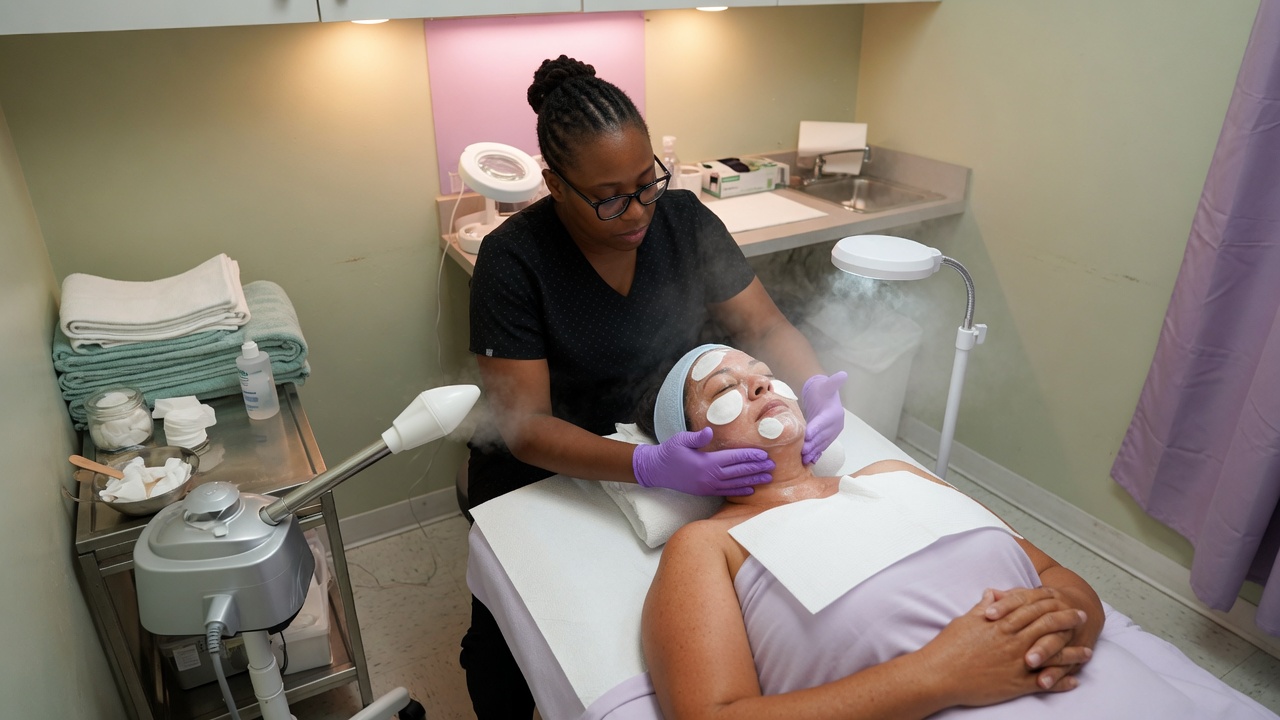
Solo Esthetician Suite Blueprint
Blueprint Course
Solo Esthetician Suite Blueprint
Your own suite, your own brand, your own clients.
This course takes you from licensed esthetician working for someone else to owner of your own salon suite: how suite rental actually works, the break-even math that tells you whether a given rent is safe for your book, what a $2,000–$4,500 launch really buys (first month's rent plus equipment), how to price facials, peels, waxing, and add-ons from real costs, how retail product becomes a second revenue stream, and how to pass a state-board inspection with a routine instead of luck. Every money example uses the same base case: 18 services a week at an $85 average ticket, about $14 in product per service, and about $1,285 a month in fixed costs — suite rent of roughly $1,100 being by far the biggest line. That pencils out to a typical range of $1,500 to $4,500 a month in profit before tax — a range under stated assumptions, not a promise; no income is guaranteed. One boundary before anything else: this course assumes you already hold an esthetician license. Esthetics is a state-licensed trade everywhere in the U.S. — programs run roughly 250 to 750+ hours depending on the state — and nothing here replaces or shortcuts that license. What this course teaches is the part school skipped: the business of going independent.
What you get
Built for operators who want a clear path — not a pile of generic tips.
The base case
One worked example, not a target
Planning estimates, before tax and before anything you pay yourself — no income is guaranteed. Your own prices, volume and costs will differ; the course walks you through replacing every number here with yours.
Who this fits
- You hold a current state esthetician (or cosmetology) license and have real treatment-room experience
- You have a starting book — even 10–20 clients who would follow you — or the patience to build one over months
- You can carry a fixed rent bill through slow months without panic, because the suite is due whether you are booked or not
- You genuinely enjoy the client relationship — consultations, skin-care education, and the trust that makes rebooking natural
- You can hold yourself to strict sanitation discipline on every service, even when you are running behind
Honest risks
- An esthetician license is mandatory everywhere in the U.S. before you can legally perform skin-care services for pay — if you are not licensed yet, that program (roughly 250–750+ hours depending on your state) comes first, before any lesson in this course applies.
- Suite rent of roughly $800–$1,500 a month is due whether or not you are booked. It is the dominant fixed cost of this model, and a thin book can lose money for months.
- Most suite operators require a lease commitment (commonly 6–12 months). Signing before your book supports the rent is the classic way this business fails.
- Sanitation failures and failed state-board inspections are reputation-enders. Skin services carry real infection and injury risk, and boards inspect suites just like salons.
- Scope-of-practice lines are legal lines: certain peels, devices, and anything medical belong to other licenses in many states. Crossing them risks your license.
- Book-building is slow. Referrals, rebooking, and local visibility take months of consistency before the calendar fills, and no income is guaranteed in the meantime.
Who should skip this one
- You are not a licensed esthetician and are not willing to complete your state's required program (roughly 250–750+ hours) and exams first — this course teaches the business of going independent, not the trade, and working unlicensed risks fines and the career itself.
- You have no savings runway. The suite rent is due from day one, a book takes months to build, and no income is guaranteed — signing a lease without 2–3 months of rent saved is how this model bankrupts people.
- You cut corners under pressure. If you would ever skip disinfection or reuse a single-use item to stay on schedule, skin services will eventually end your reputation and possibly your license.
- You want passive income or a side experiment. A suite is a lease, an inspection-ready room, and a client book that only grows when you show up consistently.
Curriculum
10 modules · 35 lessons · 1 hr 54 min of reading
01Is a Solo Suite Right for You?4 lessons · 13 min
What going independent actually means, the license boundary this course sits behind, the honest money math at 18 services a week, and a go/no-go decision.
- The License Comes First — This Course Is the Business3 min
- The Money, Honestly4 min
- Employee, Commission, or Your Own Suite3 min
- The Go / No-Go Decision3 min
02The Suite Decision: Rent Math That Protects Youfree sample4 lessons · 13 min
How suite rental actually works, the break-even math that tells you whether a rent is safe for your current book, how to tour suites like an owner, and the runway rule for signing.
- How Suite Rental Actually Works3 min
- The Rent Number: Your Break-Even in Services(free sample below)4 min
- Touring Suites Like an Owner3 min
- Runway and the Signing Decision3 min
03Startup Costs: The Real $2,000–$4,5003 lessons · 10 min
The launch budget line by line — first month's suite rent plus equipment at the low end, deposit, retail inventory, and upgrades at the high end — and the setup week that turns purchases into an inspection-ready room.
- The Required List, Line by Line4 min
- What Takes It to $4,500 — and What Can Wait3 min
- Setup Week: From Empty Room to Inspection-Ready3 min
04Equipment and Backbar: Buy Like a Professional3 lessons · 10 min
The core equipment decisions, choosing one professional product line and mastering it, and computing the real product cost of every service on your menu.
- Core Equipment Without the Overspend3 min
- One Professional Line, Mastered3 min
- What Every Service Really Costs You4 min
05Menu and Pricing: Priced From Cost, Not Fear4 lessons · 14 min
A menu architecture that guides clients to the right service, prices built from cost per service plus your share of fixed costs, add-ons that raise the average ticket, and retail as the second revenue stream.
- A Menu That Sells the Right Thing3 min
- Set Prices From Cost — Never From an Hourly Wage4 min
- Add-Ons: How $85 Becomes $1103 min
- Retail: The Second Revenue Stream on Your Shelf4 min
06Legal, Insurance, and Taxes — Education, Not Advice4 lessons · 13 min
The license and establishment layer, scope-of-practice lines, business registration, insurance, and the tax habits of a suite owner. Everything here is education only and location-dependent — verify locally.
- Your License, the Suite's License, and the Scope Line4 min
- Registering the Business (Without the Myths)3 min
- Insurance: The Non-Negotiable Line3 min
- Taxes: The Set-Aside Habit3 min
07Brand and Being Findable3 lessons · 9 min
A suite brand clients trust before they meet you: name and look, a booking page with honest policies, and the Google-plus-Instagram presence that fills a solo calendar.
- A Brand That Matches the Room3 min
- The Booking Page and the Policies That Protect It3 min
- Google for Strangers, Instagram for Proof3 min
08Your First 10 Clients3 lessons · 9 min
The warm-circle launch, the building and local-pro referral network, and a launch offer that fills the early calendar without training your market to wait for discounts.
- The Warm-Circle Launch3 min
- The Building Is a Referral Network3 min
- A Launch Offer That Doesn't Cheapen You3 min
09Delivery: The Appointment, the Clean Room, the Inspection4 lessons · 13 min
The consultation and intake that protect the client and you, a repeatable treatment run-sheet that ends in a rebook, the sanitation routine that passes unannounced state-board inspections, and the retail recommendation that never feels like selling.
- Consultation and Intake: Protect the Skin, Protect Yourself3 min
- The Run-Sheet: Same Great Hour, Every Time3 min
- Sanitation: Run the Room Inspection-Ready4 min
- The Recommendation That Never Feels Like Selling3 min
10Retention, the Money Rhythm, and Growth3 lessons · 10 min
The review engine, the rebook cadence that makes revenue predictable, a 20-minute weekly money review built on your break-even, and the honest growth paths from a full solo book.
- Reviews and the Rebook Cadence3 min
- The 20-Minute Weekly Money Review3 min
- Slow Weeks, Full Books, and What Comes Next4 min
Why people buy this
Built for first-time operators who want a clear path — not generic AI chat.
Honest fit check
Who should start — and who should skip — so you don't waste months on the wrong business.
Do-this-next lessons
Every lesson ends in an action: scripts, checklists, pricing math you can use this week.
One-time purchase
One payment of $59. No course subscription.
Solo Esthetician Suite Blueprint is part of the OwnerLaunch founding library. Figures in the course are planning estimates before tax — no income is guaranteed.
Blueprint FAQ
Why $59 for this Blueprint?+
You get a full operator course (10 modules, 35 lessons), a free sample lesson before you buy, downloadable templates after purchase, and a path into a personalized Launch Kit if you want one. It's a one-time payment — not a subscription for the course itself.
What do I get before I pay?+
The full curriculum outline, honest fit/risk lists, money base-case assumptions, a short course preview video when available, and one complete free sample lesson — real course content, not a teaser paragraph.
Is this legal, tax, or financial advice?+
No. OwnerLaunch is educational only. Licensing, insurance, tax, and filing requirements are location-dependent — verify with official sources and licensed professionals.
Can I upgrade to a Launch Kit later?+
Yes. Blueprint owners typically pay only the difference for a personalized Launch Kit (names, brand, pricing, copy, documents, 30-day plan). The course and kit are separate purchases.
Included templates & tools
- 30-Day Suite Launch Checklist — The whole course sequenced into four weeks: suite decision and paperwork, setup week, brand and presence, and the founding-clients push.
- First 10 Clients Outreach Scripts — Copy-and-personalize messages for the warm-circle launch, follow-ups, referral partners in and out of the building, reactivation, and the review ask.
- Client Intake & Consultation Template — A fill-in form for the first five minutes of every appointment: skin history, medications and contraindications, the agreed plan and price, and the close-out record.
- Suite Pricing & Rent Break-Even Calculator — A by-hand worksheet: your real cost per service, your suite-rent break-even in services, before-tax margin at three price points, and the monthly picture with retail.
- Suite Tour Comparison Worksheet — A side-by-side worksheet for Module 2's tours: real rent and terms, esthetics-fit requirements, building quality, and a scored decision tied to your break-even.
- Suite Launch Readiness Self-Check — A 12-question self-check across licensing, the lease math, sanitation, money, and marketing — find the gaps before your first paying client does.
Free sample lesson
Real course content — not a teaser paragraph. The rest unlocks after purchase.
From module: The Suite Decision: Rent Math That Protects You
The Rent Number: Your Break-Even in Services
~4 min read
This is the most important math in the course. Every service you deliver contributes its price minus its product cost toward your bills. Base case: $85 average ticket minus $14 product = $71 of contribution per service. Break-even is just your fixed bills divided by that number — it converts scary monthly rent into a concrete count of appointments.
Run it. Rent alone: $1,100 ÷ $71 ≈ 16 services a month — about 4 a week just to pay for the room. All fixed costs: $1,285 ÷ $71 ≈ 18 services a month — about 4 to 5 a week before you earn a dollar for yourself. Everything above that line is yours (before tax). At the base-case 18 services a week, you cover the month's fixed costs in the first week and the other three weeks are margin.
Now use it as a decision tool. A $1,500 suite needs $1,500 ÷ $71 ≈ 21 services a month for rent alone; an $800 suite needs about 11. Compare that to the book you counted in Module 1: if your current regulars alone cover break-even, the lease is safe. If break-even needs clients you have not met yet, you are signing a bet — sometimes a reasonable one, but know you are making it, and size your savings runway accordingly.
Action · worksheet
Compute your three break-evens
Using your estimated average ticket and product cost, compute contribution per service (ticket − product). Then for the cheapest, middle, and most expensive suite on your shortlist, compute rent ÷ contribution = services per month to cover rent, and (rent + $185 other fixed) ÷ contribution = services to cover everything. Write all three next to your real book count from Module 1.
Ready to make it yours?
A Launch Kit turns this Blueprint into your business: personalized name, brand, pricing, website copy, documents, and Action Plan.
Basic
$119 current
Pro
$199 current
Apply your Blueprint credit to Basic for +$60 or Pro for +$140.
More Blueprints
Related course · Beauty & Personal Care
Nail Tech Blueprint
From licensed skill to a full self-booked schedule.
Related course · Beauty & Personal Care
Lash Tech Blueprint
Precision beauty work with strong rebooking rates.
Recommended next · Beauty & Personal Care
Mobile Barber Blueprint
Build a book of regulars behind a chair — then take the chair to them.
Recommended next · Beauty & Personal Care
Pet Grooming Blueprint
Wags, clippers, and a loyal recurring clientele.
Recommended next · Beauty & Personal Care
Hair Braiding Blueprint
Build a braiding book that stays full.
A Discover profile now exists for this business; all figures are explicit planning estimates that assume a solo LICENSED esthetician with no employees renting a salon suite in a typical U.S. market. The base case throughout is 15–25 services a week (18 used in worked examples) at an $85 average ticket — facials priced $75–$150 blended with add-ons, peels, and waxing — about $14 in variable product cost per service ($10–$20 range), and about $1,285 a month in fixed costs: suite rent of roughly $1,100 (market range $800–$1,500) plus booking software and phone $60, marketing $75, and insurance $50. Startup is estimated at $2,000–$4,500 including the first month of suite rent and equipment. All profit figures are before tax and before anything you pay yourself; typical outcomes of $1,500–$4,500 a month before tax are ranges under these assumptions, not guarantees — no income is guaranteed, and your market, prices, book, and effort decide where you land. This course assumes you already hold your state esthetician license (mandatory everywhere; programs commonly run 250–750+ hours) and teaches only the business of going independent. Licensing, legal, tax, and insurance lessons are education only, not professional advice; requirements vary by state, county, and city — verify everything with your state board and local officials.
Educational guidance only — not legal, tax, or financial advice.Details
OwnerLaunch provides educational business guidance, AI-generated drafts, and checklists. It is not a law firm, tax advisor, CPA, registered agent, or government agency. Information may not be complete or current for your specific location. Always verify requirements with official federal, state, city, and county sources and consult qualified professionals when needed.