
Trash Can Cleaning Blueprint
Blueprint Course
Trash Can Cleaning Blueprint
A niche route business neighbors tell each other about.
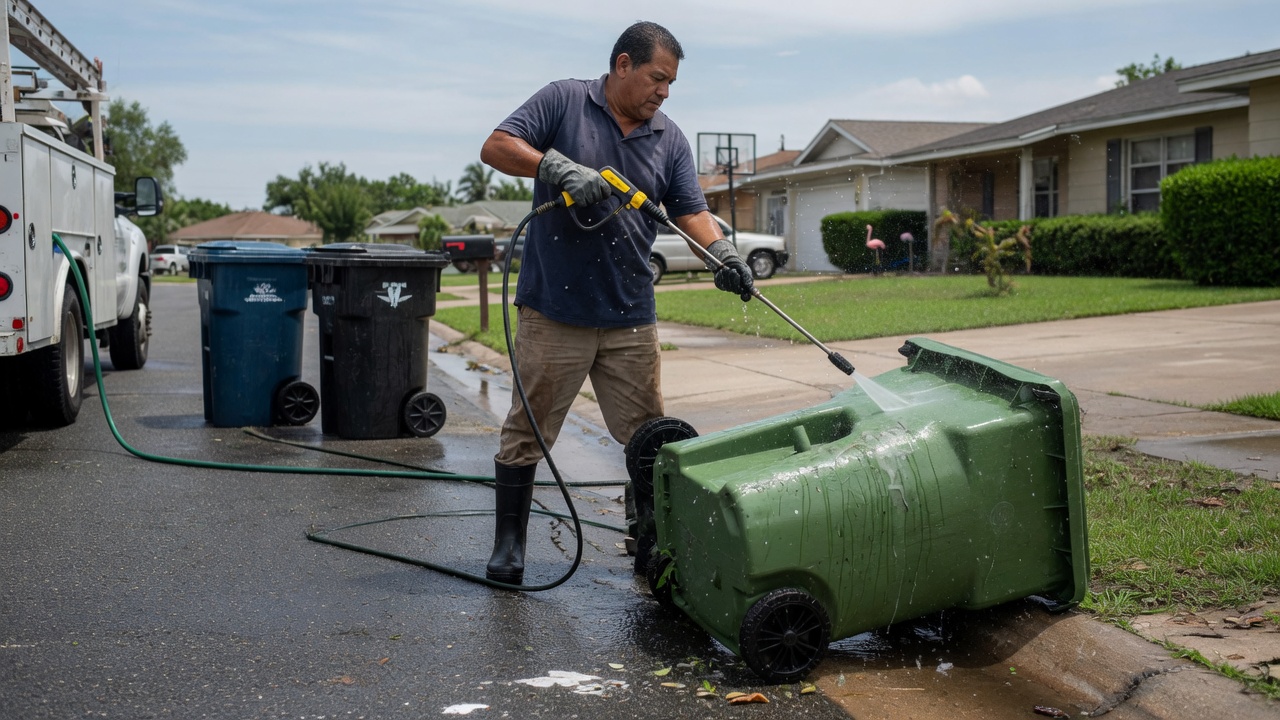
Your calendar was written by the sanitation department. That single fact shapes everything in this course. Curbside trash can cleaning means meeting the bin at the curb on collection day — after the truck has emptied it and before the homeowner rolls it back — lifting it into a wash chamber, blasting it with hot water at high pressure, deodorizing it, setting it back, and capturing every drop of the dirty water so none of it reaches a storm drain. Two to three minutes a bin. About $20 a month. And because the bins have to be empty, you cannot pick your days: a Tuesday-collection neighborhood is a Tuesday business, forever. This course takes you from curiosity to a running route: what the work is, what a rig costs, how to price by bin count, how wastewater capture and disposal actually works (the compliance topic that decides whether this business is legitimate), how to get your first 10 customers on one street, and how to grow without wrecking your margin. These figures are not inherited from the Discover profile for trash can cleaning, so every money example uses one explicit base case stated up front and verified line by line: a rate card of $20 a month for the first bin, $28 for two, $36 for three or more; a typical customer mix that blends to about $26 of revenue per stop per month; about $2.60 of variable cost per stop (fuel, burner fuel, water, sanitizer, wastewater disposal share, and card fees); and about $690 a month in fixed costs (general liability, commercial auto, software, phone, web, marketing, and maintenance reserves). Every stop therefore contributes about $23.40 a month — which means the first thing this course makes you confront is that roughly 30 monthly stops go entirely to your overhead before you earn a dollar. At the base case of 150 monthly stops, that pencils to about $2,820 a month in profit before tax; across a planning envelope of 80 to 250 stops the range is roughly $1,000 to $5,200 a month before tax. Those are estimates under stated assumptions, not promises — no income is guaranteed. Startup runs $6,000 to $30,000 depending on whether you build a rig, buy a used one, or buy new, and that band excludes the truck or SUV you tow or haul it with. This is not the lowest-barrier route business in this catalog; the Pet Waste Removal Blueprint is, and it teaches the same subscription-and-density discipline for a couple hundred dollars of startup — read it if the equipment number here stops you cold. What you get for the extra capital is a service with a visible wow moment, almost no local competition in most towns, and a rig people photograph. Three honest warnings before you spend anything. First, wastewater: the water coming off a bin carries rotting organic waste, and letting it run to the gutter or a storm drain is commonly an illegal discharge — capture is not optional, disposal is location-dependent, and Module 6 treats it as the compliance backbone of the trade. Second, density: at $26 a stop, a scattered route earns roughly $80 an hour of contribution while a clustered one earns roughly $165 for identical work, so the whole business is won or lost by how tightly you cluster your customers inside each collection day. Third, seasonality: hot-water equipment and freezing weather do not mix, and in cold markets you will lose service months and need a plan for them.
What you get
Built for operators who want a clear path — not a pile of generic tips.
The base case
One worked example, not a target
Planning estimates, before tax and before anything you pay yourself — no income is guaranteed. Your own prices, volume and costs will differ; the course walks you through replacing every number here with yours.
Who this fits
- You want a recurring subscription route where the work per customer is short, physical, and highly repeatable — two to three minutes a bin, then the next house
- You can put $6,000 to $30,000 of startup capital at risk (or finance it deliberately) and are comfortable that roughly the first 30 monthly stops pay overhead rather than you
- You already own or can access a pickup or a vehicle rated to tow a loaded trailer, and you are willing to check payload and tow ratings honestly instead of hoping
- You are comfortable being the person responsible for where dirty water goes — calling your city, getting a disposal arrangement in writing, and keeping a log
- You think geographically: you would rather sign five houses on one street than five houses in five neighborhoods, even at the same price
- You like a service with an obvious before-and-after — this business sells itself on a phone video far better than it sells on a flyer
- You can work a fixed weekday calendar set by your city's collection schedule, including early starts behind the truck
Honest risks
- Wastewater compliance is the existential risk of this trade. Rinse water carrying organic waste is commonly barred from storm drains, and discharging to a sanitary sewer often requires the wastewater utility's permission. Operating without a verified, written disposal arrangement risks fines, a stop-work order, and an insurer that declines a claim — and the rules are location-dependent, so verifying them is your job before your first paid bin.
- Fixed costs bite before revenue does. Unlike a bucket-and-rake route business, this one carries insurance, commercial auto, software, and maintenance reserves — roughly $690 a month in the base case. About 30 monthly stops go entirely to covering that. Below breakeven you are funding the business out of pocket every month, and route building takes months.
- Route density decides the margin, and early routes are always scattered. Identical work earns roughly $165 an hour of contribution on a tight block and roughly $80 an hour on a spread-out route. The first year is a race to cluster before drive time eats you.
- The collection calendar caps you. You can only serve a neighborhood on its collection day, so uneven zone sizes, holiday schedule shifts, and cities that collect the whole town on one day can all compress your realistic capacity well below the arithmetic ceiling.
- Equipment failure stops revenue completely. A burner that will not light, a blown pump, or a cracked tank ends the route day, and your customers' collection day does not wait a week for you. Spares, a maintenance reserve, and a relationship with a pressure-washer repair shop are not optional.
- You are handling other people's property. Sun-brittle bins crack, wheels and axles snap, and lids and hinges fail — sometimes during a wash, often just from age. Without a photographed pre-service condition record you will eventually pay for damage you did not cause.
- Cold-climate seasonality is severe. Freezing temperatures take hot-water equipment, hoses, and captured water out of service, and snow-buried bins cannot be washed. Northern markets commonly lose service months, which compresses annual revenue and demands a cash plan.
- It is a discretionary purchase in a category most people have never bought. Churn spikes when household budgets tighten, and cancellation is one text away. Retention habits and an annual prepay option matter more here than in a service customers consider essential.
Who should skip this one
- You cannot fund the equipment without straining. This is not a $200 launch: even the leanest used or self-built rig with insurance and marketing lands near $6,000, and at 60 monthly stops (a realistic month-six number) the roughly $714 a month of profit before tax takes about 17 months to repay a $12,000 rig. If that math frightens you, start with the Pet Waste Removal Blueprint instead — same route discipline, a couple hundred dollars of startup. No income is guaranteed in either one.
- You would let the rinse water run into the street or a storm drain. Wash water off a trash can carries decomposed food waste and bacteria, and discharging it to a storm drain is commonly prohibited by local ordinances implementing federal stormwater rules. If capturing and lawfully disposing of every gallon sounds like paperwork you would skip, this is the wrong trade — that shortcut risks fines, a stop-work order, and your insurance.
- You want to pick your own schedule. Bins have to be empty, so your service days are assigned by your city's collection calendar, not by you. If Tuesday is your neighborhood's day, Tuesday is your workday for as long as you serve it. Operators who need flexible hours are happier in a business where the customer's yard does not have a deadline.
- You will not enforce a service area. At about $26 of revenue per stop a month, drive time is the entire margin. If you say yes to every caller across the metro, the honest arithmetic in Module 5 says you will work the same hours for roughly half the money — and no amount of marketing fixes a scattered route.
- You live in a hard-freeze climate and have no plan for the cold months. Hot-water systems, pumps, and hoses freeze, and bins frozen shut or buried in snow cannot be serviced. Northern operators commonly lose service months; if a two- or three-month revenue gap would sink you, build the buffer or pair this with a winter service first.
Curriculum
10 modules · 39 lessons · 2 hr 15 min of reading
01What a Trash Can Cleaning Business Really Is4 lessons · 14 min
The three-minute product, the calendar the city writes for you, the honest arithmetic of a $26 stop, and a go/no-go test that respects the equipment bill.
- The Three-Minute Product4 min
- The Calendar You Do Not Control3 min
- The Honest Arithmetic of a $26 Stop4 min
- Founder Fit: The Capital-Honest Go/No-Go3 min
02Startup Costs: The $6,000 to $30,000 Decision3 lessons · 11 min
Three honest startup tiers line by line, how to choose between building, buying used, and buying new, and the payback math that tells you which one you can actually afford.
- Three Startup Tiers, Line by Line4 min
- Build It, Buy It Used, or Buy It New3 min
- The Payback Math Nobody Runs4 min
03Equipment: The Rig, the Water, and the Waste Tank4 lessons · 14 min
How a bin wash system works end to end, why hot water is non-negotiable, the tank and refill cycle that quietly caps your route day, and the maintenance that keeps a collection day from being missed.
- How a Bin Wash System Actually Works4 min
- Why Hot Water Is the Whole Trick3 min
- Tanks, Water, and the Refill Cycle That Caps Your Day4 min
- Maintenance, Spares, and the Freeze Problem3 min
04Services and Pricing4 lessons · 15 min
A menu built around monthly service, a rate card priced by bin count, the monthly-versus-quarterly trade-off that most operators get backwards, and the cost-per-stop math behind every number in this course.
- The Service Menu: Monthly Is the Engine3 min
- Setting Your Rate Card by Bin Count4 min
- Monthly vs Quarterly: The Trade-Off Most Operators Get Backwards4 min
- Cost Per Stop and the Full Base Case4 min
05Route Economics: Working the Collection Gridfree sample4 lessons · 15 min
The discipline module: how the collection calendar becomes a route map, the stops-per-hour arithmetic that sets your real pay, minimum viable block density, and an honest look at the seasons.
- Turning the Collection Calendar Into a Route Map4 min
- Stops Per Hour: The Number That Sets Your Real Pay(free sample below)4 min
- Minimum Viable Block Density4 min
- Seasonality and the Honest Annual Picture3 min
06Legal, Insurance, Taxes, and Wastewater Compliance5 lessons · 16 min
Education only, never legal or environmental advice: the business setup basics, the wastewater rules that define whether this trade is legitimate, getting your disposal path in writing, insurance for a rig and other people's property, and the tax set-aside habit.
- Structure and Licensing: What Is Commonly Required3 min
- Wastewater: Where Your Rinse Water May Legally Go4 min
- Getting Your Disposal Arrangement in Writing3 min
- Insurance for a Rig, a Trailer, and Other People's Bins3 min
- Taxes and the Set-Aside Habit3 min
07Branding and Being Findable3 lessons · 9 min
A name that survives being said out loud at a curb, a Google profile and one-page site that convert a curious neighbor, and a rig that markets while it works.
- Naming a Business People Will Photograph3 min
- Google Business Profile and the One-Page Site3 min
- The Rig Is the Billboard3 min
08Your First 10 Customers4 lessons · 14 min
A four-week plan to a first dense block: pick one collection day, run the trash-day demo, work the neighborhood groups and HOAs, and time your door hangers to the truck.
- The First 10 Plan: One Day, One Block4 min
- The Trash-Day Demo: The Highest-Converting Move in This Trade4 min
- Neighborhood Groups, HOAs, and the Block Deal3 min
- Door Hangers Timed to the Truck3 min
09Service Delivery: The Perfect Stop4 lessons · 13 min
The stop routine that never varies, how to protect yourself from bin damage claims, the safety rules that hot water and high pressure demand, and how to handle a missed bin like a professional.
- The Stop Routine, Start to Finish3 min
- Bin Damage, Wheels, Lids, and Other People's Property3 min
- Safety: Hot Water, High Pressure, and the Curb4 min
- Missed Bins, Schedule Shifts, and Recovery3 min
10Reviews, Referrals, and Growth4 lessons · 14 min
The review engine in a category with almost no competition, referrals that tighten your blocks instead of stretching them, commercial and HOA contracts, and the honest decision when your best collection day fills up.
- The Review Engine3 min
- Referrals That Tighten the Block3 min
- Commercial and HOA Contracts4 min
- When a Collection Day Fills: Raise, Add a Day, or Add a Rig4 min
Why people buy this
Built for first-time operators who want a clear path — not generic AI chat.
Honest fit check
Who should start — and who should skip — so you don't waste months on the wrong business.
Do-this-next lessons
Every lesson ends in an action: scripts, checklists, pricing math you can use this week.
One-time purchase
One payment of $59. No course subscription.
Trash Can Cleaning Blueprint is part of the OwnerLaunch founding library. Figures in the course are planning estimates before tax — no income is guaranteed.
Blueprint FAQ
Why $59 for this Blueprint?+
You get a full operator course (10 modules, 39 lessons), a free sample lesson before you buy, downloadable templates after purchase, and a path into a personalized Launch Kit if you want one. It's a one-time payment — not a subscription for the course itself.
What do I get before I pay?+
The full curriculum outline, honest fit/risk lists, money base-case assumptions, a short course preview video when available, and one complete free sample lesson — real course content, not a teaser paragraph.
Is this legal, tax, or financial advice?+
No. OwnerLaunch is educational only. Licensing, insurance, tax, and filing requirements are location-dependent — verify with official sources and licensed professionals.
Can I upgrade to a Launch Kit later?+
Yes. Blueprint owners typically pay only the difference for a personalized Launch Kit (names, brand, pricing, copy, documents, 30-day plan). The course and kit are separate purchases.
Included templates & tools
- 30-Day Launch Checklist — The whole course sequenced into four weeks: market and compliance homework first, equipment and systems second, brand and pricing third, then the demo-and-hanger blitz that lands your first customers.
- Outreach & Block Scripts — Word-for-word scripts for the curb pitch, the trash-day demo ask, the warm-circle message, the neighborhood group post, the block deal, the quote, the waitlist reply, and the HOA or property manager approach.
- New Customer Intake & Service Agreement Template — A fill-in intake covering carts, collection day, access, and cart condition, plus a plain-language service agreement with billing, weather and seasonal pause, damage, and wastewater terms.
- Bin Route Pricing & Density Calculator — Hand-computed formulas from blended revenue per stop through breakeven, four scenarios, drive-time sensitivity, and equipment payback — with a worked example column that sums exactly.
- Wastewater Compliance Verification & Disposal Log — The call script, the questions to ask your wastewater utility and stormwater office, a place to record who told you what and when, and a reusable disposal log.
- Operations, Wastewater & Safety Self-Check — Fourteen questions on the numbers, the collection-day constraint, wastewater rules, and equipment safety — with answers and the module to revisit for anything you miss.
- Route Health & Retention Tracker — A monthly one-page tracker for stop count against breakeven, drive minutes per stop by block, adds and cancels with reasons, seasonal pause management, and the four habits that keep subscriptions alive.
Free sample lesson
Real course content — not a teaser paragraph. The rest unlocks after purchase.
From module: Route Economics: Working the Collection Grid
Stops Per Hour: The Number That Sets Your Real Pay
~4 min read
A two-bin stop is about five and a half minutes of actual work: park and roll the first bin over, wash it, return it and fetch the second, wash it, set it back and get moving. That number barely changes no matter where you are. What changes everything is the drive between stops, and because the revenue per stop is small, drive time is not a nuisance in this business — it is the margin. Run it three ways. On a tight block with three minutes between stops, you are at 8.5 minutes per stop, which is about 7.1 stops per route hour. While you are building, at seven minutes between stops, you are at 12.5 minutes per stop, or about 4.8 stops an hour. On a scattered route with twelve minutes of driving, you are at 17.5 minutes per stop — about 3.4 stops an hour.
Now price those hours. Each stop contributes about $23.40 a month in this course's base case, so a dense route hour generates roughly 7.1 times $23.40, or about $165 of contribution; a building route hour generates about $112; a scattered route hour generates about $80. Identical equipment, identical rate card, identical effort, and less than half the money. Extend it to a day: six route hours out of an eight-hour day, once you account for refills, a disposal run, and lunch, means about 42 stops dense, 29 building, and 21 scattered. That gap is why this course keeps saying no to the customer across town. It is not snobbery about geography — it is the difference between a business that pays you and one that pays your fuel supplier.
- Work per two-bin stop: about 5.5 minutes, nearly constant everywhere
- Drive per stop: 3 minutes dense, 7 building, 12 scattered — total 8.5, 12.5, 17.5 minutes
- Stops per route hour: about 7.1, 4.8, 3.4 — contribution about $165, $112, $80 an hour
- Six route hours a day: about 42, 29, or 21 stops — same day, wildly different pay
Action · task
Time a simulated route
Before you have customers, simulate a route: pick eight addresses in one collection block, drive them in order at your intended service time of day, and record total drive minutes. Divide by eight. Then do the same with eight addresses spread across your metro. Write both numbers down — the gap between them, multiplied by $23.40 per stop, is the money your service-area discipline is worth.
Ready to make it yours?
A Launch Kit turns this Blueprint into your business: personalized name, brand, pricing, website copy, documents, and Action Plan.
Basic
$119 current
Pro
$199 current
Apply your Blueprint credit to Basic for +$60 or Pro for +$140.
More Blueprints
Related course · Home Services
Pet Waste Removal Blueprint
Simple weekly routes with near-zero startup cost.
Related course · Home Services
Pressure Washing Blueprint
Launch a pressure washing business where before/after photos do the selling.
Recommended next · Home Services
Lawn Care Business Blueprint
From honest fit-check to first customer — one short, practical step at a time.
Recommended next · Home Services
Residential Cleaning Business Blueprint
Launch a solo residential cleaning business — from first supply kit to a recurring weekly client base.
Recommended next · Home Services
Mobile Detailing Business Blueprint
Launch a mobile detailing business from your driveway to your first paying route.
These figures are not inherited from the Discover profile for trash can cleaning, so the course states its own base case and every money figure inherits its assumptions: a solo operator with no employees in a typical U.S. market, running monthly curbside bin cleaning from one rig, on collection days set by the municipality. The base rate card is $20 a month for the first bin, $28 for two bins, and $36 for three or more; a customer mix of 40% one-bin, 45% two-bin, and 15% three-plus blends to $26.00 of revenue per stop per month. Variable cost is $2.60 per stop (truck fuel, burner fuel, water, sanitizer, a wastewater disposal share, and card processing at about 3%), leaving $23.40 of contribution per stop. Fixed costs are $690 a month (general liability, commercial auto, route and billing software, phone, website, a marketing baseline, and vehicle and rig maintenance reserves), so roughly the first 30 monthly stops cover overhead before the operator earns anything. At the base case of 150 monthly stops that produces about $2,820 a month in profit before tax; across the planning envelope of 80 to 250 stops the range is roughly $1,000 to $5,200 a month before tax. Startup of $6,000 to $30,000 covers the rig, initial insurance, business setup, disposal arrangements, and first marketing, and explicitly excludes the truck or SUV used to tow or haul the system — add a used vehicle cost separately if you do not already have one. All profit figures are before tax and before anything you pay yourself; ranges are typical outcomes under these assumptions, not guarantees — no income is guaranteed, and your market, rate card, route density, retention, weather, and effort decide where you land. Monthly subscription service is assumed as the revenue backbone; quarterly plans, one-time cleans, commercial dumpster and cart contracts, and add-on services are additive and are not included in the base range. Cold-climate operators should assume lost service months. Wastewater capture and disposal, stormwater rules, business licensing, structure, insurance, and taxes are location-dependent education only — not legal, tax, environmental, or insurance advice. Verify every requirement with your city, county, wastewater utility, insurer, and a tax professional before relying on it.
Educational guidance only — not legal, tax, or financial advice.Details
OwnerLaunch provides educational business guidance, AI-generated drafts, and checklists. It is not a law firm, tax advisor, CPA, registered agent, or government agency. Information may not be complete or current for your specific location. Always verify requirements with official federal, state, city, and county sources and consult qualified professionals when needed.