
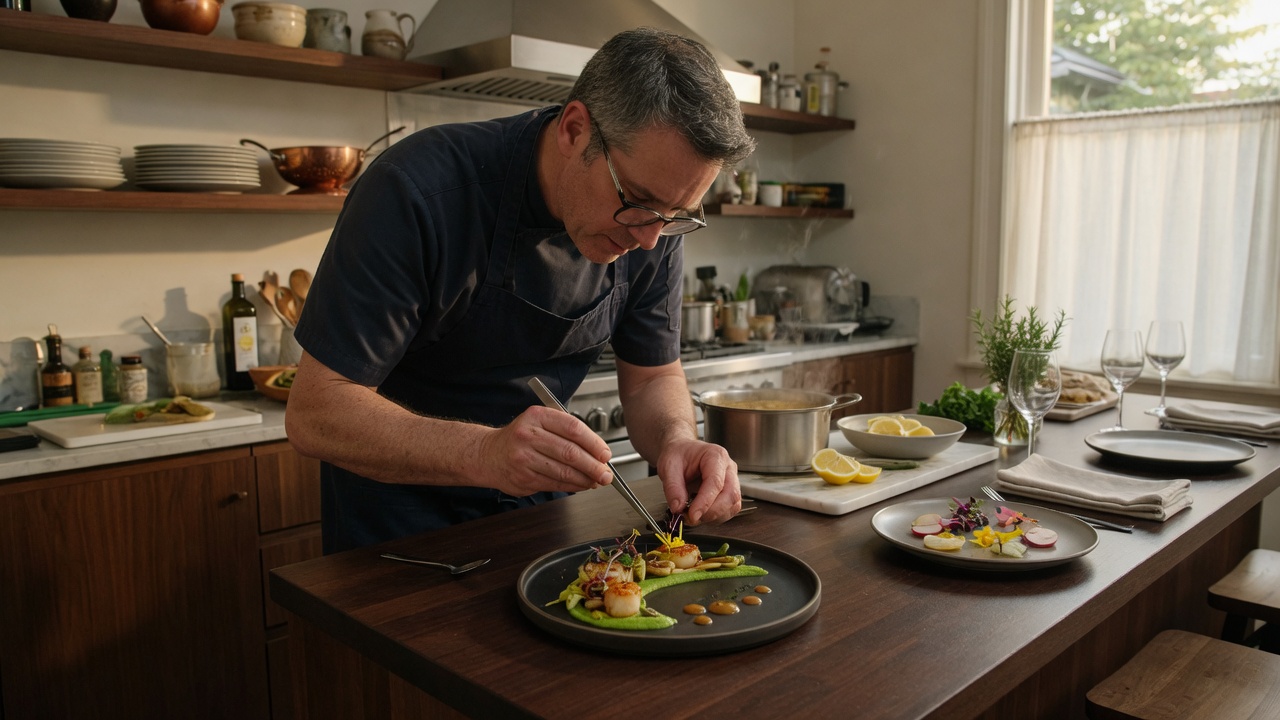
Private Chef & Small-Event Catering Blueprint
Blueprint Course
Private Chef & Small-Event Catering Blueprint
The best-paid seat at the party — once you answer the kitchen question honestly.
Private chef work is cooking for people in their own homes: an intimate dinner for six, a small event for twenty, or a weekly meal-prep visit for a busy household. It is one of the most satisfying food businesses to run and it has one question you must answer before anything else, because it determines your entire cost structure. That question is where you are legally allowed to cook. Cooking in the client's own kitchen, for that client, is generally treated very differently from preparing food off-site and bringing it to them — which typically requires a permitted commercial or commissary kitchen rather than your own. Cottage food programs, which the custom cakes course in this library covers, generally apply to shelf-stable items and not to the cooked, potentially hazardous food this business sells. Rules vary by state, county, and city, and your local health department is the authority. Get that answer first and the rest of the business follows; guess at it and you may build something you have to dismantle. The base case used throughout: a blended fee of about $825 across $650 intimate dinners, $1,400 small events, and $400 meal-prep sessions; about $353 per booking in food at roughly thirty percent of the fee, travel, packaging, card fees, and occasional helper labour; and about $585 a month in fixed costs including insurance, kitchen access, equipment reserve, and marketing. Each booking contributes about $472, so you break even at roughly two bookings a month. At eight bookings a month that pencils to roughly $3,191 a month before tax; across a planning envelope of four to fourteen bookings the range is roughly $1,300 to $6,000 a month before tax. Those are estimates under stated assumptions, not promises, and no income is guaranteed. Startup runs about $2,000 to $8,000. The course covers: whether this is genuinely your business, including the honest fact that cooking well is the smaller half of it; the kitchen question and the licensing that follows from it; food safety, treated as the product rather than as paperwork, with allergens given the weight they deserve; menus and costing, so that thirty percent food cost is a decision rather than an accident; the money model; getting your first ten clients, which happens through people who already trust you; running an event in someone else's kitchen with equipment you did not choose; and a first thirty days. Three honest warnings. First, an allergen mistake is the worst thing that can happen in this trade and it can be life-threatening — this course treats that with the seriousness it deserves rather than as a checkbox. Second, the hours are evenings and weekends, permanently, because that is when people entertain. Third, you will cook in kitchens with blunt knives, one working hob, and no counter space, and doing that calmly is a real skill that has nothing to do with cooking.
What you get
Built for operators who want a clear path — not a pile of generic tips.
The base case
One worked example, not a target
Planning estimates, before tax and before anything you pay yourself — no income is guaranteed. Your own prices, volume and costs will differ; the course walks you through replacing every number here with yours.
Who this fits
- You can cook consistently well under time pressure, in an unfamiliar kitchen, with equipment you did not choose
- You are willing to do the unglamorous half properly — costing menus, sourcing, food safety, and the paperwork that goes with selling food
- You are comfortable working evenings and weekends, because that is when people entertain and that is not going to change
- You are meticulous about allergens and cross-contact, and you would rather refuse a booking than take a risk with someone's health
Honest risks
- An allergen error can be life-threatening. This is the most serious risk in the trade and it is entirely on the person who cooked.
- Preparing food off-site for sale generally requires a permitted commercial or commissary kitchen; operating outside that is a health-department and licensing problem, not a technicality.
- Foodborne illness from a temperature or handling failure can end the business and harm people, and it is usually caused by transport and holding rather than by cooking.
- Food cost drifts silently. A menu costed once and never rechecked quietly erodes the margin on every booking.
- The work is evenings, weekends, and holidays, which is a genuine lifestyle cost that many people underestimate.
- You are working in kitchens you do not control, with equipment that may fail, and the event does not move if it does.
Who should skip this one
- You are not willing to find out where you may legally cook and to follow that answer. Preparing food off-site for sale generally requires a permitted kitchen, and cottage food programs generally do not cover this food.
- You are casual about allergens. An allergen mistake in this trade can be life-threatening, and there is no version of this business where that risk is managed loosely.
- You cannot work evenings and weekends. This is when the work exists, permanently.
- You only want to cook. Menu costing, sourcing, food safety records, insurance and client management are most of the job, and a chef who ignores them loses money while working hard.
- You need predictable weekly income immediately. Bookings cluster around holidays and social seasons and build slowly through referral.
Curriculum
8 modules · 26 lessons · 3 hr 30 min of reading
01Is This Actually Your Business?free sample3 lessons · 25 min
What the job really is beyond cooking, an honest go/no-go, and what the income looks like.
- Cooking Is the Smaller Half8 min
- The Go / No-Go: Should You Start This?(free sample below)9 min
- What the Income Actually Looks Like8 min
02The Kitchen Question and the Legal Line4 lessons · 34 min
Where you may legally cook, why cottage food usually does not apply, certification, and insurance.
- Where You May Legally Cook10 min
- Why Cottage Food Usually Does Not Cover You8 min
- Certification, Permits, and Registration8 min
- Insurance When You Are Feeding People8 min
03Food Safety Is the Product3 lessons · 27 min
Temperature control through transport and holding, allergens, and the client kitchen you do not control.
- Transport and Holding Are the Risk, Not Cooking9 min
- Allergens: The One That Cannot Be Approximate10 min
- Working in a Kitchen You Do Not Control8 min
04Menus and Costing4 lessons · 32 min
A short menu, costing at a target food cost, sourcing, and pricing an event.
- Offer a Short Menu, Not Anything8 min
- Costing to a Target Food Cost9 min
- Sourcing Without Losing the Margin7 min
- Pricing a Booking8 min
05The Money Model3 lessons · 22 min
The monthly arithmetic, what seasonality does to it, and paying yourself.
- The Monthly Math8 min
- Seasonality and the Holiday Peak7 min
- Paying Yourself7 min
06Your First 10 Clients3 lessons · 23 min
Where clients come from, the portfolio that books, and converting an inquiry.
- Where the First 10 Come From8 min
- The Portfolio That Books a Chef7 min
- Converting the Inquiry8 min
07Running the Event3 lessons · 23 min
The week before, the day itself, and the follow-up that produces the next booking.
- The Week Before8 min
- The Day Itself8 min
- The Follow-Up That Gets the Next Booking7 min
08Your First 30 Days3 lessons · 24 min
A week-by-week plan sequenced so the kitchen question is answered first.
- The First Four Weeks9 min
- The Numbers Worth Tracking7 min
- Growing Deliberately8 min
Why people buy this
Built for first-time operators who want a clear path — not generic AI chat.
Honest fit check
Who should start — and who should skip — so you don't waste months on the wrong business.
Do-this-next lessons
Every lesson ends in an action: scripts, checklists, pricing math you can use this week.
One-time purchase
One payment of $59. No course subscription.
Private Chef & Small-Event Catering Blueprint is part of the OwnerLaunch founding library. Figures in the course are planning estimates before tax — no income is guaranteed.
Blueprint FAQ
Why $59 for this Blueprint?+
You get a full operator course (8 modules, 26 lessons), a free sample lesson before you buy, downloadable templates after purchase, and a path into a personalized Launch Kit if you want one. It's a one-time payment — not a subscription for the course itself.
What do I get before I pay?+
The full curriculum outline, honest fit/risk lists, money base-case assumptions, a short course preview video when available, and one complete free sample lesson — real course content, not a teaser paragraph.
Is this legal, tax, or financial advice?+
No. OwnerLaunch is educational only. Licensing, insurance, tax, and filing requirements are location-dependent — verify with official sources and licensed professionals.
Can I upgrade to a Launch Kit later?+
Yes. Blueprint owners typically pay only the difference for a personalized Launch Kit (names, brand, pricing, copy, documents, 30-day plan). The course and kit are separate purchases.
Included templates & tools
- 30-Day Private Chef Launch Checklist — Four weeks sequenced so the kitchen question and insurance come before menus, equipment, or marketing.
- Menu Costing and Booking Price Calculator — Cost a menu ingredient by ingredient, find your true food cost percentage, and price a booking that pays for the whole day.
- Client Scripts: Inquiry, Allergies, and Follow-Up — The messages that convert an inquiry, ask about allergies properly, and turn one dinner into a repeat client.
- Allergen Intake and Kitchen Questionnaire — The two forms that prevent the worst outcome and the most common practical problem, plus the event-day sequence.
- Self-Check Quiz — Eight questions on the kitchen question, allergens, food cost, and what actually causes foodborne illness.
Free sample lesson
Real course content — not a teaser paragraph. The rest unlocks after purchase.
From module: Is This Actually Your Business?
The Go / No-Go: Should You Start This?
~9 min read
Two things disqualify people here, and neither is cooking ability. The first is unwillingness to answer the kitchen question honestly and follow the answer. The second is casualness about allergens — and in this trade that is not a business risk, it is a safety one.
- Will you find out where you may legally cook, and build the business around that answer rather than around what is convenient?
- Are you meticulous about allergens and cross-contact, including when a client is vague and you are busy?
- Can you work evenings, weekends, and holidays — permanently, because that is when people entertain?
- Can you cook calmly in a kitchen with blunt knives, one working hob, and no counter space?
- Are you willing to cost menus properly, or will you cook what you like and hope the money works?
There is also a sensible smaller start. Cooking in clients' own homes typically has a lower regulatory and capital barrier than off-site catering, so many chefs begin there and add catering later once they have a permitted kitchen arrangement. If the licensing looks daunting, that is often the honest sequence rather than a reason to stop.
Action · task
Call your local health department this week
Before spending anything, call or visit your local health department. Ask two questions: what may I do cooking in a client's own home, and what would I need to prepare food off-site to bring to clients? Write down the answers and who told you.
Ready to make it yours?
A Launch Kit turns this Blueprint into your business: personalized name, brand, pricing, website copy, documents, and Action Plan.
Basic
$119 current
Pro
$199 current
Apply your Blueprint credit to Basic for +$60 or Pro for +$140.
More Blueprints
Related course · Events & Creative
Custom Cakes & Treats Blueprint
Home-based baking under your local cottage food rules.
Related course · Events & Creative
Mobile Bartending Service Blueprint
Bring the bar, not the liability — a weekend business built on about fifty Saturdays.
Related course · Events & Creative
Event Planning Blueprint
Logistics brainpower clients happily pay for.
Recommended next · Events & Creative
Event Photography Blueprint
Book, shoot, deliver — a working local photo business.
Recommended next · Events & Creative
Wedding Videography Blueprint
High-ticket weekends built on a reliable process.
Recommended next · Events & Creative
Mobile DJ Blueprint
Read the room, run the night, fill the calendar.
Every money figure in this course is before tax and before anything you pay yourself, and assumes one chef cooking in clients' homes and catering small events in a typical U.S. market. The base case is a blended fee of about $825 (across $650 intimate dinners, $1,400 small events, and $400 meal-prep sessions at a 50/30/20 mix), about $353 per booking in food at roughly thirty percent of the fee plus travel, packaging, card fees and occasional helper labour, and about $585 a month in fixed costs — giving a contribution of about $472 a booking and a breakeven of roughly two bookings a month. Eight bookings a month pencils to roughly $3,191 a month before tax; a planning envelope of four to fourteen gives roughly $1,300 to $6,000 a month before tax. These figures are not inherited from the Discover profile for these numbers: they are OwnerLaunch planning estimates stated so you can replace them with your own. Typical ranges are estimates of common outcomes, not guarantees — no income is guaranteed. Food business licensing, permitted-kitchen requirements, cottage food program scope, food handler certification, and inspection regimes are set at state and local level and vary substantially: everything here on those topics is education, not advice, and your LOCAL HEALTH DEPARTMENT is the authority. Specific food safety temperatures and time limits are set by the Food Code as adopted in your jurisdiction — follow your local requirements rather than a general figure.
Educational guidance only — not legal, tax, or financial advice.Details
OwnerLaunch provides educational business guidance, AI-generated drafts, and checklists. It is not a law firm, tax advisor, CPA, registered agent, or government agency. Information may not be complete or current for your specific location. Always verify requirements with official federal, state, city, and county sources and consult qualified professionals when needed.