
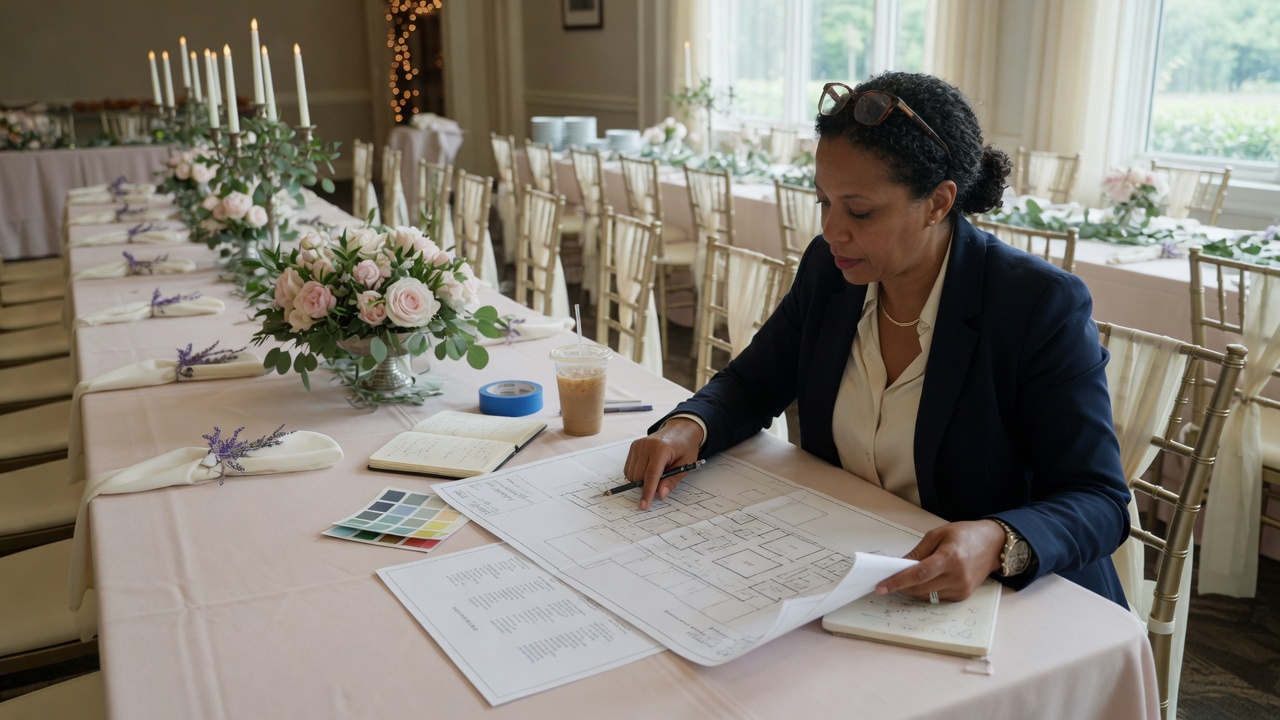
Event Planning Blueprint
Blueprint Course
Event Planning Blueprint
Logistics brainpower clients happily pay for.
This course takes you from organized friend to paid event planner using the lowest-risk entry point in the industry: day-of and month-of coordination. In this model you do not design or produce events from scratch — you take a client's nearly finished plan, build the master timeline and run-sheet, confirm every vendor, and run the day so the client can actually enjoy it. Every money example uses the same explicit base case: day-of / month-of coordination priced $800 to $2,000 per event, partial planning packages at $1,500 to $3,500 once you have a track record, a working solo planner handling 2 to 4 events a month, roughly $50 to $150 per event in variable costs (travel, printing, day-of supplies, emergency-kit restock), $150 to $300 a month in fixed costs (insurance, planning software, phone, website), after a startup budget of just $500 to $1,500 — this business is bought with organization and relationships, not equipment. Those are planning estimates for a typical U.S. market — ranges, not promises; no income is guaranteed. Understand what you are actually selling: coordination. Your vendor network, your timeline templates, and your run-sheets are the product, which is why three full modules build them before you ever price a package. And understand what the job costs your body: event days commonly run 10 to 14 hours on your feet, ending after midnight — this course is honest about that stamina requirement, because a planner who fades at hour nine has no product at all.
What you get
Built for operators who want a clear path — not a pile of generic tips.
The base case
One worked example, not a target
Planning estimates, before tax and before anything you pay yourself — no income is guaranteed. Your own prices, volume and costs will differ; the course walks you through replacing every number here with yours.
Who this fits
- You are the person friends already ask to organize things — trips, showers, fundraisers — and you genuinely enjoy building the plan as much as attending the event
- You stay calm and decisive when plans break: a late caterer or a missing officiant is a problem to solve in four minutes, not a crisis to feel
- You can physically handle event days — commonly 10 to 14 hours on your feet, hauling boxes, ending after midnight, often on weekends
- You like people-wrangling: chasing vendors for confirmations, herding a wedding party, and delivering bad news kindly are the daily work
- You are systems-minded: checklists, timelines, and contact sheets feel like tools to you, not paperwork
Honest risks
- Event days are physically brutal: 10 to 14 hours on your feet, heavy lifting, late nights, and almost always weekends. Planners who cannot sustain that pace cannot deliver the product, no matter how good their spreadsheets are.
- You are accountable for failures you did not cause: when a vendor no-shows or a venue double-books, the client looks at you. Without contracts that define your scope and a deep bench of backup vendors, one bad event can sink your reputation.
- Demand is seasonal and weekend-concentrated — wedding and event season clusters hard from late spring through fall, and you can only run one event per day. No income is guaranteed in any month.
- Cancellations and postponements are a normal part of this industry. Without a written deposit and cancellation policy you can lose weeks of work to a client who changes their mind.
- Undisclosed vendor referral fees can destroy your credibility: if a client learns you steered them to a vendor because of a kickback you never mentioned, you lose the trust the entire business runs on — and in some places nondisclosure creates legal exposure.
- The barrier to entry is low, so markets can be crowded with hobbyist planners competing on price. Your differentiation is professionalism — contracts, timelines, insurance — which this course front-loads.
Who should skip this one
- You cannot or do not want to work 10-to-14-hour days on your feet, most of them Saturdays. Day-of coordination IS the long day — there is no version of this entry service without the stamina, and a planner who fades at hour nine leaves the client exactly where they would have been alone.
- You need dependable income every month right now. Events book months ahead, season hard toward late spring through fall, and cancel or postpone routinely — no income is guaranteed, and the first months are mostly network-building.
- You dislike confrontation and chasing people. Half this job is politely pressuring vendors for confirmations, enforcing timelines on people who ignore them, and telling a client no — if that drains you, every event will.
- You would rather wing it than write it down. Clients are paying for your timeline, your run-sheet, and your contract — a planner without systems is a guest with a clipboard.
- You would take vendor kickbacks quietly rather than disclose them. This business runs on trust; if disclosure feels optional to you, the referral-ethics standard in this course will chafe until it breaks you or your reputation.
Curriculum
10 modules · 36 lessons · 2 hr 1 min of reading
01Is an Event Planning Business Right for You4 lessons · 14 min
What a coordinator actually sells — logistics, not decor — what the money looks like under an honest base case, the unvarnished truth about 10-to-14-hour event days, and a go/no-go decision before you spend a dollar.
- What This Business Really Is4 min
- The Event-Day Reality: 10 to 14 Hours on Your Feet3 min
- What the Money Looks Like4 min
- Your Go / No-Go Decision3 min
02Startup Costs and Setup3 lessons · 10 min
Where the $500–$1,500 actually goes in a business with no equipment to buy — insurance, software, a simple web presence, an emergency kit — and the setup order that gets you legitimate before your first paid event.
- Where $500–$1,500 Actually Goes3 min
- Business Setup Basics — Education, Not Legal Advice4 min
- Your Planning Stack: Free Tiers First3 min
03Your Product: Timelines, Run-Sheets, and the Emergency Kitfree sample3 lessons · 11 min
The three deliverables clients are actually buying — the master timeline, the day-of run-sheet, and the emergency kit — built as reusable templates so every future event starts 80% done.
- The Master Timeline4 min
- The Run-Sheet: Your Event Day, Minute by Minute(free sample below)4 min
- The Emergency Kit and the Vendor Contact Sheet3 min
04Building Your Vendor Network3 lessons · 10 min
The vendor network is the other half of the product — how to build a trusted bench of caterers, DJs, florists, photographers, and rental companies from zero, and how referrals flow both directions once you have one.
- Why the Network Is the Product3 min
- Building the Bench From Zero4 min
- Referrals, Fees, and the Trust You Are Selling3 min
05Services and Pricing4 lessons · 14 min
Package day-of / month-of coordination and partial planning, price per event from your real costs and the market — never from an hourly wage — and structure deposits and payment schedules that protect your calendar.
- Your Service Menu: Two Packages, Not Ten3 min
- Know Your Cost Per Event4 min
- Price Per Event, Never Per Hour4 min
- Deposits and Payment Schedules3 min
06Legal, Insurance, and Taxes (Education Only)4 lessons · 13 min
The contract that defines your scope, deposit, and cancellation terms; vendor-referral disclosure done in writing; the insurance venues expect; and the licensing and tax landscape — all commonly required, all location-dependent, none of it legal advice.
- Your Contract: Scope, Deposits, Cancellations4 min
- Vendor Referral Fees: Disclose or Decline3 min
- The Insurance Venues Expect3 min
- Licenses and Taxes: The Landscape3 min
07Branding and Being Findable3 lessons · 9 min
A trust-first brand for a trust-first trade: a name that survives growth, proof that makes an invisible service visible, and the free local profiles where event clients actually search.
- A Name and a Brand That Sell Calm3 min
- Proof: Making an Invisible Service Visible3 min
- The Free Local Profiles That Feed This Trade3 min
08Marketing: Your First 10 Clients4 lessons · 14 min
The ladder from free practice events to founding-rate bookings: warm-network announcements, venue and vendor referral relationships, community visibility, and a consultation that closes.
- The Ladder: Free, Founding Rate, Full Rate3 min
- Announce to Your Warm Network3 min
- Venues and Vendors as Referral Engines4 min
- The Consultation That Closes4 min
09Service Delivery: Running the Event4 lessons · 14 min
The month-of workflow from signed contract to final walkthrough — the vendor-confirmation audit, the final week, the event day hour by hour, and the triage method for when things break anyway.
- The Month-Of Workflow4 min
- The Final Week3 min
- Event Day, Hour by Hour4 min
- When Things Break: The Triage Method3 min
10Reviews, Referrals, Operations, and Growth4 lessons · 12 min
The 48-hour review-and-thank-you loop that compounds every event into future bookings, the simple weekly operations rhythm, and the three honest growth paths beyond a full solo calendar.
- The 48-Hour Loop After Every Event3 min
- Weekly Operations and the Money Rhythm3 min
- Growth Beyond a Full Solo Calendar4 min
- Your 30-Day Launch2 min
Why people buy this
Built for first-time operators who want a clear path — not generic AI chat.
Honest fit check
Who should start — and who should skip — so you don't waste months on the wrong business.
Do-this-next lessons
Every lesson ends in an action: scripts, checklists, pricing math you can use this week.
One-time purchase
One payment of $59. No course subscription.
Event Planning Blueprint is part of the OwnerLaunch founding library. Figures in the course are planning estimates before tax — no income is guaranteed.
Blueprint FAQ
Why $59 for this Blueprint?+
You get a full operator course (10 modules, 36 lessons), a free sample lesson before you buy, downloadable templates after purchase, and a path into a personalized Launch Kit if you want one. It's a one-time payment — not a subscription for the course itself.
What do I get before I pay?+
The full curriculum outline, honest fit/risk lists, money base-case assumptions, a short course preview video when available, and one complete free sample lesson — real course content, not a teaser paragraph.
Is this legal, tax, or financial advice?+
No. OwnerLaunch is educational only. Licensing, insurance, tax, and filing requirements are location-dependent — verify with official sources and licensed professionals.
Can I upgrade to a Launch Kit later?+
Yes. Blueprint owners typically pay only the difference for a personalized Launch Kit (names, brand, pricing, copy, documents, 30-day plan). The course and kit are separate purchases.
Included templates & tools
- 30-Day Launch Checklist — The whole course sequenced into four weeks of concrete evening-sized tasks, from founder-fit decision to first booked event.
- Vendor and Venue Outreach Scripts — Word-for-word introductions for vendors and venue coordinators, plus the follow-up and the thank-you that turn one meeting into a referral relationship.
- Client Consultation Script — The five-part consultation structure with exact language: the stress question, the problem-solved package pitch, price delivery, and the deposit close.
- Client Intake and Event Brief Template — The fill-in intake form for the kickoff meeting — event basics, every vendor with contract status, decision-makers, and the priorities that shape your run-sheet.
- Coordination Pricing Calculator — Hand-computed worksheet: variable cost per event plus allocated fixed costs against each package price, producing before-tax margin per event and per month.
- Founder-Fit Self-Check Quiz — Twelve honest yes/no questions across stamina, temperament, systems, and money reality — with scoring guidance that respects a no.
Free sample lesson
Real course content — not a teaser paragraph. The rest unlocks after purchase.
From module: Your Product: Timelines, Run-Sheets, and the Emergency Kit
The Run-Sheet: Your Event Day, Minute by Minute
~4 min read
The run-sheet is the single sheet of paper (and phone note) that runs the event day: every timed moment from first vendor arrival to last box out, each with a time, an owner, and a dependency. A wedding-reception fragment reads like: 2:00 venue access — you; 2:15 rentals arrive, count chairs against contract — you; 3:30 caterer load-in, confirm service time — caterer lead; 4:45 DJ sound check complete — DJ; 5:00 dressed and staged, client sees room before guests — you + client; 5:30 doors; 7:10 toasts (mics tested 6:50); 9:45 last dance announced; 10:00 teardown begins — all vendors; 11:30 final walkthrough with venue manager — you.
Three rules make a run-sheet professional. Every line has one named owner — 'someone will handle it' means you will. Buffer everything: vendors get arrival times 15–30 minutes earlier than the plan requires, because the run-sheet absorbs lateness so the client never sees it. And circulate it in advance to every vendor and the client, then carry printed copies — the planner handing a lost DJ a printed timeline at 4 p.m. is the whole job in one image.
Action · worksheet
Write a full run-sheet for a practice event
Pick a real event type (birthday dinner for 40, backyard wedding for 80) and write a complete run-sheet: minimum 20 timed lines from first arrival to final walkthrough, each with an owner. Add 15–30 minute buffers to every vendor arrival. This becomes your second template and a portfolio artifact for Module 7.
Ready to make it yours?
A Launch Kit turns this Blueprint into your business: personalized name, brand, pricing, website copy, documents, and Action Plan.
Basic
$119 current
Pro
$199 current
Apply your Blueprint credit to Basic for +$60 or Pro for +$140.
More Blueprints
Related course · Events & Creative
Wedding Videography Blueprint
High-ticket weekends built on a reliable process.
Related course · Events & Creative
Balloon Décor Blueprint
Installations and garlands for every celebration.
Recommended next · Events & Creative
Event Photography Blueprint
Book, shoot, deliver — a working local photo business.
Recommended next · Events & Creative
Mobile Bartending Service Blueprint
Bring the bar, not the liability — a weekend business built on about fifty Saturdays.
Recommended next · Events & Creative
Mobile DJ Blueprint
Read the room, run the night, fill the calendar.
All money figures in this course are planning estimates, stated as ranges before tax under an explicit base case: day-of / month-of coordination priced $800–$2,000 per event, partial planning $1,500–$3,500, a solo planner running 2–4 events a month, roughly $50–$150 per event in variable costs (travel, printing, day-of supplies), and $150–$300 a month in fixed costs (insurance, planning software, phone, website), after a startup budget of $500–$1,500. Your market, season, network, and effort will produce different results — these are estimates, not promises, and no income is guaranteed. Legal, tax, licensing, insurance, and contract content is education only, always location-dependent, and never a substitute for advice from a qualified professional in your area.
Educational guidance only — not legal, tax, or financial advice.Details
OwnerLaunch provides educational business guidance, AI-generated drafts, and checklists. It is not a law firm, tax advisor, CPA, registered agent, or government agency. Information may not be complete or current for your specific location. Always verify requirements with official federal, state, city, and county sources and consult qualified professionals when needed.