
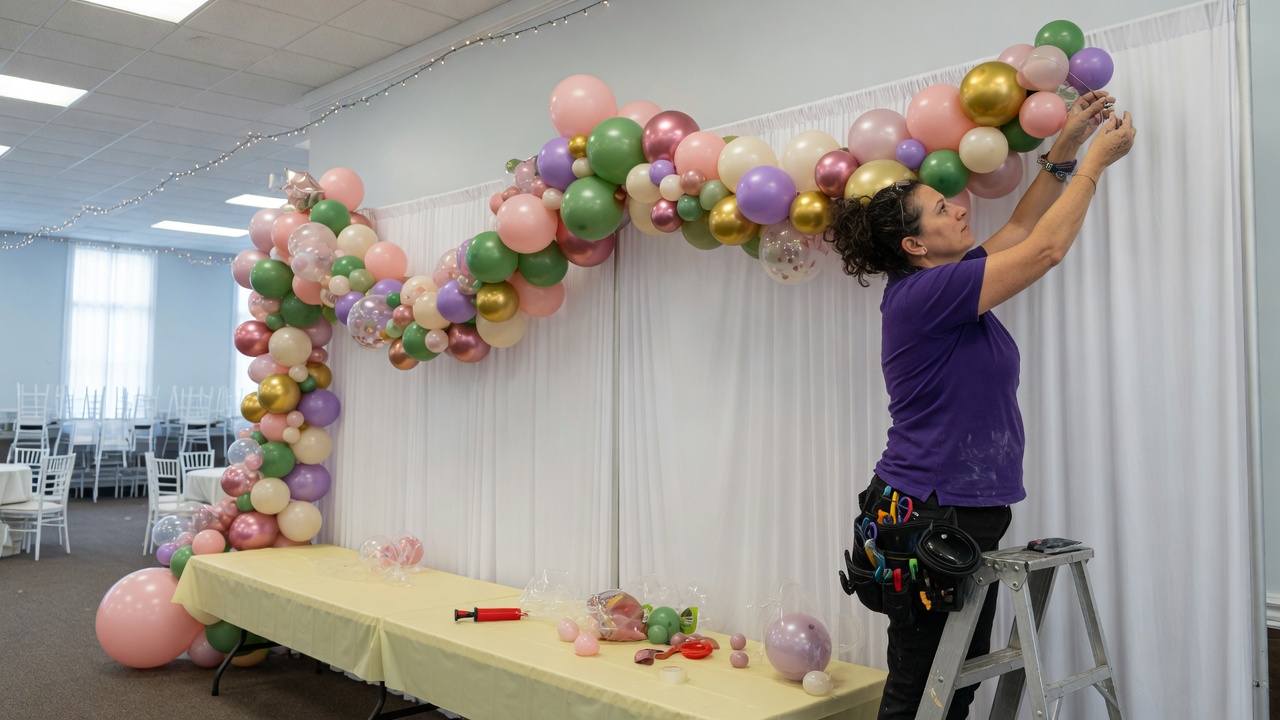
Balloon Décor Blueprint
Blueprint Course
Balloon Décor Blueprint
Installations and garlands for every celebration.
This course takes you from liking balloon garlands on Instagram to running a local balloon décor business that books real installs. Every money example uses the same explicit base case: typical installed pieces — organic garlands, arches, backdrop-and-garland packages — priced $200 to $800, a grab-and-go garland line at $75 to $150 for pickup customers, a working decorator booking 3 to 6 jobs a week at steady state, materials running 15 to 25 percent of the price you charge, roughly $100 to $200 a month in fixed costs (insurance, website, software), after a startup investment of $500 to $1,200 in inflators, stands, and starter inventory. Those are planning estimates for a typical U.S. market — ranges, not promises; no income is guaranteed. The number that decides whether this business works is not the price of balloons — it is what the other 75 to 85 percent of the price has to cover: your consult, build, transport, install, and strike hours. Decorators who price by 'balloons plus a little' stay busy and broke; decorators who price total hours build businesses. This course also tells the truth about helium — a finite, price-volatile resource — and builds your menu around air-filled designs, which look just as good, last days instead of hours, and protect your margin. And it treats outdoor installs with the respect weather deserves: heat, sun, and wind all attack latex, so your policies get written before your first backyard party. Balloon décor is largely an unlicensed trade — no state board stands between you and your first paid arch — so the legal module focuses on what is commonly required everywhere: general business licensing, insurance venues ask about, and taxes, all framed the honest way: location-dependent, verified locally.
What you get
Built for operators who want a clear path — not a pile of generic tips.
The base case
One worked example, not a target
Planning estimates, before tax and before anything you pay yourself — no income is guaranteed. Your own prices, volume and costs will differ; the course walks you through replacing every number here with yours.
Who this fits
- You are crafty and precise with your hands — garland work is repetitive, physical assembly where the difference between amateur and pro is sizing discipline and color placement
- You can handle logistics without drama: a finished garland is a bulky, fragile product that must be built, transported, installed on-site, and struck on a client's schedule, not yours
- You are comfortable with weekend and morning work — parties cluster on Saturdays and Sundays, and outdoor installs happen early, before heat and wind pick up
- You have (or can borrow) a vehicle with real cargo space and a place to build — a 10-foot garland fills the back of an SUV
- You can sell visually: this business is won on portfolio photos, and you will need to post, pitch venues, and ask for tags and reviews without cringing
Honest risks
- Underpricing is the classic failure: materials are only 15–25% of a correctly priced job, and decorators who charge 'cost of balloons plus a little' end up earning less than minimum wage per total hour once build, delivery, install, and strike time are counted.
- Demand is event-driven and seasonal — graduation season, holidays, and wedding months boom while January is quiet, and a strong week of 3–6 jobs is a steady-state target, not a first-month expectation. No income is guaranteed in any month.
- Weather can destroy an outdoor install: direct sun oxidizes latex in hours, heat pops balloons, and wind shreds arches. Working outdoors without a written weather policy and client sign-off invites refund disputes on jobs you executed perfectly.
- Helium is a finite, price-volatile input with recurring supply squeezes — a menu built around helium-filled pieces has fragile margins and same-day delivery pressure that air-filled designs avoid.
- Deflated and popped latex is a serious choking hazard for young children, and several states restrict balloon releases — a decorator who ignores safety and disposal basics risks real harm and local fines, not just bad reviews.
- The product is fragile in transit: a garland built too large for your vehicle, or transported in a hot car, can arrive damaged with no time to rebuild before the event.
Who should skip this one
- You want a business you can run entirely from a desk. Balloon décor is physical assembly, ladder work, cargo loading, and on-site installs — if hauling a 10-foot garland up a client's driveway at 7 a.m. sounds miserable, this is the wrong trade.
- You need dependable income every month right now. Bookings are event-driven, seasonal, and slow to build; the first weeks are mostly portfolio installs — no income is guaranteed.
- You will not hold your prices. This market is full of hobbyists charging materials-plus-$50; if you cannot quote $400 for a garland knowing the balloons cost $80 — because the other $320 buys five hours of your skilled labor — you will race them to the bottom.
- You refuse weekend and early-morning work. Parties happen on Saturdays, and outdoor installs happen before the heat — a weekday-afternoons-only decorator is choosing a hobby.
Curriculum
10 modules · 35 lessons · 1 hr 53 min of reading
01Is a Balloon Décor Business Right for Youfree sample4 lessons · 15 min
What the job actually is — a build-and-logistics business with a creative face — what the money looks like under an honest base case, why the materials-to-price gap is the lesson that decides everything, and a go/no-go decision before you spend a dollar.
- What This Business Really Is4 min
- The Margin Lesson: Balloons Are 15–25% of the Price(free sample below)4 min
- The Money: An Honest Week and Month4 min
- Founder Fit: The Go/No-Go Decision3 min
02Startup Costs and Setup: $500–$1,2003 lessons · 9 min
Where the startup budget actually goes — inflators, stands, and a disciplined starter inventory — why buying materials per booking beats stockpiling, and the workspace and vehicle reality check most beginners skip.
- Where the $500–$1,200 Actually Goes3 min
- Start Lean: Buy Materials Per Booking3 min
- Workspace and Vehicle: The Reality Check3 min
03Equipment, Balloons, and the Helium Question4 lessons · 13 min
The tools that earn their keep, why professional-grade latex beats party-store stock, the honest economics of helium — and why air-filled designs are this course's default — plus the install go-bag that saves every on-site job.
- Inflators, Stands, and Tools That Earn Their Keep3 min
- Balloon Quality: Why Pro-Grade Latex Wins3 min
- The Helium Question: Why Air-Filled Is the Default4 min
- The Install Go-Bag3 min
04Services and Pricing: Charge for Hours, Not Balloons4 lessons · 14 min
A clean menu built on air-filled installs and a grab-and-go line, prices built from materials plus total hours plus fixed costs — with the time-per-install clock made explicit — and the deposit and policy structure that protects every booking.
- Your Service Menu3 min
- Price From Costs, Never From Guilt4 min
- Time Per Install: The Real Clock4 min
- Deposits, Contracts, and Booking Policies3 min
05Legal, Insurance, and Taxes (Education, Not Advice)3 lessons · 9 min
Balloon décor is largely an unlicensed trade — so this module covers what is commonly required anyway: general business licensing and registration, the insurance venues ask about, and the tax habits that keep a seasonal business calm. Everything here is education, location-dependent, and verified locally.
- Licensing: A Largely Unlicensed Trade — With Paperwork Anyway3 min
- Insurance and the COI Venues Ask For3 min
- Taxes and Bookkeeping for a Seasonal Business3 min
06Branding and Being Findable3 lessons · 9 min
In a visual trade, your portfolio photos are the brand — this module builds the name, the photo habit, the Google Business Profile that catches local searches, and the inquiry flow that turns lookers into booked dates.
- Your Name and the Photo Habit3 min
- Google Business Profile and Instagram3 min
- The Inquiry Flow: From DM to Booked Date3 min
07Marketing: Your First 10 Customers4 lessons · 13 min
Two engines start this business: portfolio installs that trade a discount for photos, reviews, and tags, and the venue-and-vendor referral network that sends event work forever — plus the local-group playbook and the tracker that gets you to ten.
- Portfolio Installs: Your First Three Jobs3 min
- Venues and Vendors: The Referral Network4 min
- Local Groups and Seasonal Offers3 min
- Tracking to Ten3 min
08Service Delivery: Build, Deliver, Install, Strike4 lessons · 13 min
The professional workflow end to end — section builds and sizing discipline, the transport rules that get fragile pieces there intact, on-site installs with the weather honesty outdoor jobs demand, and the strike-and-disposal standard that makes venues invite you back.
- The Build Workflow3 min
- Delivery and Transport Logistics3 min
- On-Site Installs — and the Truth About Weather4 min
- Strike, Teardown, and Disposal3 min
09Reviews, Referrals, and Repeat Clients3 lessons · 9 min
The review engine that compounds every install, the referral loop that keeps partners sending work, and the repeat-client moves — corporate accounts and standing seasonal orders — that smooth a seasonal calendar.
- The Review Engine3 min
- The Referral Loop3 min
- Repeat Clients, Corporate Accounts, and Standing Orders3 min
10Operations, Money, and Growth3 lessons · 9 min
The weekly rhythm that keeps builds, bookings, and inventory calm, the monthly money review that watches your materials percentage and feeds the tax set-aside, and the growth paths — volume grab-and-go, an assistant, classes — once the calendar fills.
- The Weekly Rhythm and Inventory Pars3 min
- The Monthly Money Review3 min
- Growth Paths: Where This Goes3 min
Why people buy this
Built for first-time operators who want a clear path — not generic AI chat.
Honest fit check
Who should start — and who should skip — so you don't waste months on the wrong business.
Do-this-next lessons
Every lesson ends in an action: scripts, checklists, pricing math you can use this week.
One-time purchase
One payment of $59. No course subscription.
Balloon Décor Blueprint is part of the OwnerLaunch founding library. Figures in the course are planning estimates before tax — no income is guaranteed.
Blueprint FAQ
Why $59 for this Blueprint?+
You get a full operator course (10 modules, 35 lessons), a free sample lesson before you buy, downloadable templates after purchase, and a path into a personalized Launch Kit if you want one. It's a one-time payment — not a subscription for the course itself.
What do I get before I pay?+
The full curriculum outline, honest fit/risk lists, money base-case assumptions, a short course preview video when available, and one complete free sample lesson — real course content, not a teaser paragraph.
Is this legal, tax, or financial advice?+
No. OwnerLaunch is educational only. Licensing, insurance, tax, and filing requirements are location-dependent — verify with official sources and licensed professionals.
Can I upgrade to a Launch Kit later?+
Yes. Blueprint owners typically pay only the difference for a personalized Launch Kit (names, brand, pricing, copy, documents, 30-day plan). The course and kit are separate purchases.
Included templates & tools
- 30-Day Launch Checklist — The whole course sequenced into four weeks — from reality check and gear to portfolio installs, partner pitches, and your first paid bookings.
- Partner Outreach and Inquiry Reply Scripts — Word-for-word scripts: the venue/vendor partnership pitch, the 7-day follow-up, the inquiry reply that quotes fast, and the 48-hour booking nudge.
- Client Agreement + Intake Template — A fill-in booking form and plain-language agreement: event details, design approval, deposit and reschedule terms, the outdoor weather clause, strike choice, and photo permission.
- Garland and Install Pricing Calculator — A hand-computed worksheet: materials per foot, total-hours labor, fixed-cost share, and before-tax margin per price point — the Module 4 math with blanks to fill.
- Course Self-Check Quiz — Ten questions covering the margin lesson, time-per-install, helium honesty, weather policy, safety, and money habits — with answers and the module to reread.
Free sample lesson
Real course content — not a teaser paragraph. The rest unlocks after purchase.
From module: Is a Balloon Décor Business Right for You
The Margin Lesson: Balloons Are 15–25% of the Price
~4 min read
Here is the number that decides whether this business feeds you: in a correctly priced job, materials — balloons, glue dots, fishing line, hooks, a frame's share — run 15 to 25 percent of the price. A $400 installed garland uses roughly $60 to $100 of materials. Beginners look at that gap and feel guilty. Professionals look at it and see what it actually is: the other $300 to $340 has to buy every hour of skilled labor the job takes — the consult and design, two to three hours of inflating, sizing, and assembly, loading, driving, an hour on a ladder installing, and often a return trip to strike it — plus your share of insurance, website, and gear replacement.
Run the honest clock on that $400 garland: half an hour of consult and design, 2.5 hours of build, half an hour loading, an hour of round-trip driving, an hour installing — about 5.5 hours before any strike trip. That is roughly $73 an hour gross, and after $80 of materials and a share of fixed costs, meaningfully less — all before tax. A real business. Now price the same job the hobbyist way — $150, 'to cover the balloons and my time' — and the same 5.5 hours pay about $27 an hour before materials — about $13 an hour once the $80 of materials comes out. Same work, same skill, same client smiling at the same arch. The only difference is which decorator did the math.
- Rule of thumb: quoted price ≈ materials × 4 to × 6 — if materials are more than 25% of your quote, the price is too low or the design too expensive
- Every price in this course is built on total hours: consult + build + load + drive + install + strike
- The market has hobbyists charging materials-plus-$50; you are not competing with them — clients who want a professional install, on time, that survives the party, pay professional prices
- Grab-and-go garlands ($75–$150) are the honest budget option: same craft, near-zero logistics, so the lower price still pays your build hour fairly
Action · worksheet
Price one garland both ways
Take a 10-foot organic garland. Estimate materials at $8 per foot ($80). Price it the hobbyist way (materials + $50) and the professional way (materials × 5). For each price, divide by 5.5 total hours (consult, build, load, drive, install) to see the gross hourly rate before materials and tax. Write both numbers where you will see them every time you quote.
Ready to make it yours?
A Launch Kit turns this Blueprint into your business: personalized name, brand, pricing, website copy, documents, and Action Plan.
Basic
$119 current
Pro
$199 current
Apply your Blueprint credit to Basic for +$60 or Pro for +$140.
More Blueprints
Related course · Events & Creative
Event Planning Blueprint
Logistics brainpower clients happily pay for.
Recommended next · Events & Creative
Event Photography Blueprint
Book, shoot, deliver — a working local photo business.
Recommended next · Events & Creative
Wedding Videography Blueprint
High-ticket weekends built on a reliable process.
Recommended next · Events & Creative
Mobile Bartending Service Blueprint
Bring the bar, not the liability — a weekend business built on about fifty Saturdays.
All figures in this course are planning estimates for a typical U.S. market under a stated base case: typical installs $200–$800, grab-and-go garlands $75–$150, 3–6 jobs a week at steady state, materials 15–25% of price, fixed costs roughly $100–$200 a month, and a startup budget of $500–$1,200 for inflators, stands, and starter inventory. These figures are not inherited from the Discover profile for this trade, so these numbers are stated here and flagged for verification in the sources list — verify them against real supplier prices and decorators' published rates in your market. All profit figures are before tax. Your results depend on your market, season, pricing, and effort; these are estimates, not promises, and no income is guaranteed.
Educational guidance only — not legal, tax, or financial advice.Details
OwnerLaunch provides educational business guidance, AI-generated drafts, and checklists. It is not a law firm, tax advisor, CPA, registered agent, or government agency. Information may not be complete or current for your specific location. Always verify requirements with official federal, state, city, and county sources and consult qualified professionals when needed.