
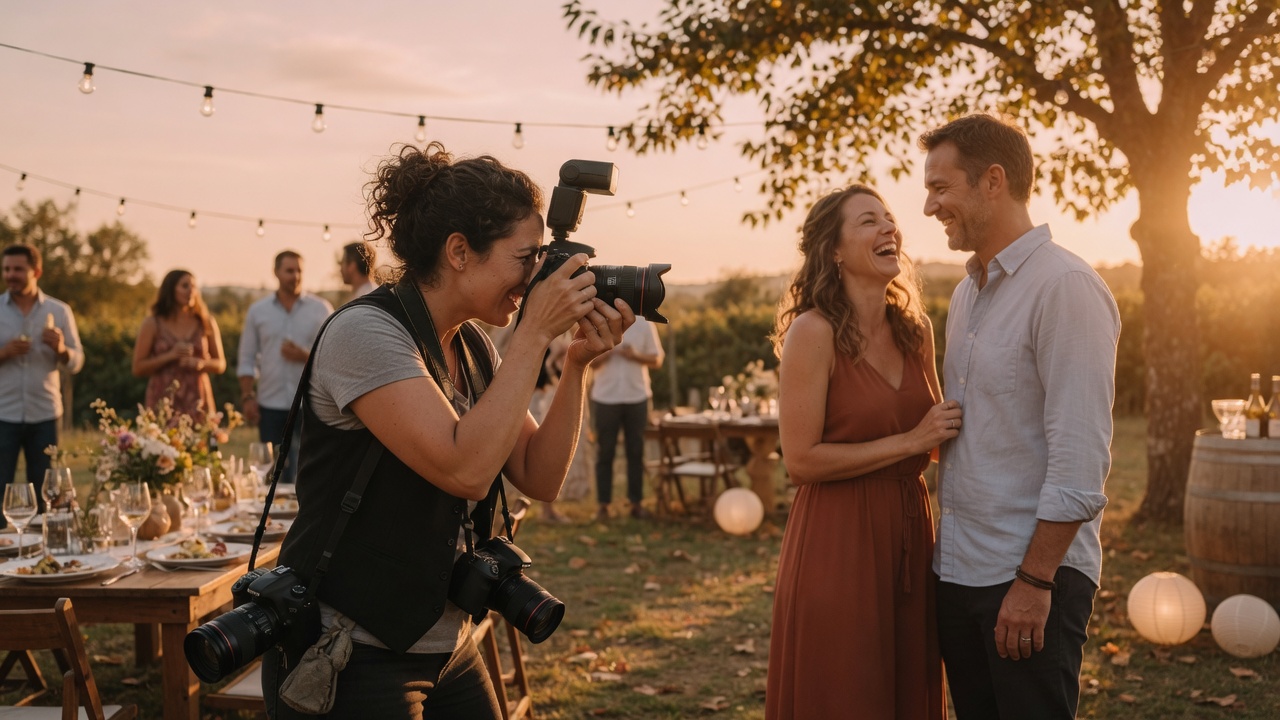
Event Photography Blueprint
Blueprint Course
Event Photography Blueprint
Book, shoot, deliver — a working local photo business.
This course takes you from owning a camera to running a local photography business built on two service lines: family portrait sessions and small events like birthdays, corporate gatherings, and intimate weddings. Every money example uses the same explicit base case: family sessions priced $200 to $450, small events $400 to $900, a working photographer booking 3 to 6 jobs a week mixing both, roughly $20 to $40 per booking in variable costs (online galleries, prints, travel), $250 to $400 a month in fixed costs (insurance, editing software, cloud storage, website), after a startup investment of $2,000 to $5,000 in camera, lenses, and lighting — with a heavily emphasized used-gear path that can land you at the bottom of that range. Those are planning estimates for a typical U.S. market — ranges, not promises; no income is guaranteed. One number shapes this entire business more than any other: editing time. For most photographers, post-processing runs about twice the shoot time, so a one-hour session is really a three-hour job and a three-hour event is really a nine-hour job. Photographers who price camera hours go broke politely; photographers who price total hours build businesses. Photography is generally an unlicensed trade — no state board stands between you and your first paid shoot — which means the things that actually protect you are the contract you sign, the model release you collect, and the copyright you own. The legal module leads with exactly that, and treats general business licensing the way it deserves: location-dependent, verified locally.
What you get
Built for operators who want a clear path — not a pile of generic tips.
The base case
One worked example, not a target
Planning estimates, before tax and before anything you pay yourself — no income is guaranteed. Your own prices, volume and costs will differ; the course walks you through replacing every number here with yours.
Who this fits
- You already take photos people ask for — friends request you at gatherings, and your phone or camera work draws real compliments from strangers, not just family
- You genuinely like directing people — warming up shy kids, wrangling groups, and making awkward subjects relax is a people job before it is a camera job
- You can sit through editing: for every hour behind the camera there are roughly two hours at the computer, and that ratio never fully goes away
- You are organized enough to run contracts, shot lists, backups, and delivery deadlines — a lost card or a missed gallery date is a business event, not an oops
- You can handle weekend-heavy work: family sessions and events cluster on Saturdays and Sundays, especially in fall and around holidays
Honest risks
- Editing time is the hidden cost that sinks new photographers: post-processing typically runs about 2x shoot time, so underpricing by camera hours means working near minimum wage on paper-profitable bookings.
- Demand is seasonal and weekend-heavy — fall family sessions and spring/summer events cluster hard, and a rainy Saturday can wipe out a week's revenue. No income is guaranteed in any month.
- One equipment failure at a one-time event (a wedding, a retirement party) cannot be reshot. Working without backup camera, cards, and batteries risks a refund, a public bad review, and possibly a claim.
- Working without a signed contract and model release invites the classic disasters: clients who dispute deliverables, refuse payment, or object to your portfolio use of their images.
- Startup gear costs are real and it is easy to overspend: new full-frame kits run far past $5,000, while the used market covers professional needs for much less — discipline decides which path you take.
- Data loss is an existential risk: shooting to a single card with no backup workflow means one corrupted card can destroy an unrepeatable event and the business's reputation with it.
Who should skip this one
- You want to be paid for shooting but resent editing. Post-processing is roughly two-thirds of the working hours in this business; if you will not do it (or budget to outsource it), the math never works.
- You need dependable income every month right now. Bookings are seasonal, weekend-weighted, and slow to build — no income is guaranteed, and the first months are mostly portfolio-building.
- You are unwilling to work weekends. Families and events book Saturdays and Sundays; a weekday-only photographer in this niche is choosing a hobby.
- You would skip the boring protections — contracts, model releases, backup cards, insurance — to get shooting faster. In a business where events cannot be reshot, that shortcut eventually costs more than the business earned.
Curriculum
10 modules · 35 lessons · 2 hr 6 min of reading
01Is an Event Photography Business Right for Youfree sample4 lessons · 15 min
What the job actually is — a people business with a camera in it, weekend-heavy and editing-heavy — what the money looks like under an honest base case, why editing time is the hidden cost that decides everything, and a go/no-go decision before you spend a dollar.
- What This Business Really Is4 min
- The Hidden Cost: Editing Is Two-Thirds of the Job(free sample below)4 min
- The Money: An Honest Week and Month4 min
- Founder Fit: The Go/No-Go Decision3 min
02Startup Costs and the Used-Gear Path3 lessons · 10 min
Where the $2,000–$5,000 actually goes, why the used market is the smart photographer's default, and the non-gear business basics people forget to budget.
- Where the $2,000–$5,000 Actually Goes3 min
- The Used-Gear Path: Pro Results at Half Price4 min
- Business Basics: The Non-Gear Setup3 min
03Gear That Earns: Cameras, Light, and Backup3 lessons · 12 min
The working kit for sessions and small events — body and lenses, the flash skills events demand, and the backup gear and data workflow that make one-time moments safe to sell.
- The Working Kit: Body and Lenses4 min
- Light: The Skill That Separates Event Pros4 min
- Backup Gear and the 3-2-1 Data Rule4 min
04Services and Pricing: Charge for Total Hours4 lessons · 14 min
Define the two service lines, compute the true cost of a booking including the 2x editing multiplier, price from costs instead of vibes or hourly-wage framing, and package with deposits that protect your calendar.
- Your Two Service Lines3 min
- The True Cost of a Booking4 min
- Setting and Saying Your Prices4 min
- Deposits, Minimums, and Calendar Protection3 min
05Legal: Contracts, Releases, Copyright, and Insurance4 lessons · 15 min
Photography is generally unlicensed — so the contract, the model release, and the copyright you own are what actually protect you. Plus the location-dependent basics: business licenses, sales tax on prints, insurance, and self-employment taxes. Education only, never legal advice.
- Why the Contract Is Your Real License4 min
- Model Releases: Permission to Show Your Work3 min
- Copyright: You Own What You Shoot4 min
- Licenses, Insurance, and Taxes — Location-Dependent4 min
06Branding and Being Findable3 lessons · 10 min
A clear niche promise, a portfolio site that books instead of just displays, and the local search presence that puts you in front of people typing 'family photographer near me.'
- Your Brand Is a Promise, Not a Logo3 min
- A Portfolio Site That Books, Not Just Displays4 min
- Local Search: Where 'Photographer Near Me' Gets Answered3 min
07Your First 10 Clients4 lessons · 14 min
The two engines that start a photography business from zero: portfolio-building sessions that trade a discount for images and reviews, and the second-shooter path that pays you to learn events — plus warm outreach and the vendor network that keeps referrals coming.
- Portfolio-Building Sessions: Trade Discounts for Proof4 min
- The Second-Shooter Path: Get Paid to Learn Events4 min
- Warm Outreach: Your Network Is the First Market3 min
- The Vendor Network: Referrals on Repeat3 min
08Shoot Day: Sessions and Events That Run Themselves4 lessons · 15 min
The pre-shoot communication that prevents most problems, a repeatable session flow that gets keepers from real families, and the event playbook — shot lists, timelines, and staying calm when the schedule slips.
- The Pre-Shoot Routine That Prevents Problems3 min
- Running a Family Session People Enjoy4 min
- Running a Small Event Without Missing the Moment4 min
- Culling and Editing on a Clock4 min
09Delivery, Reviews, and the Referral Engine3 lessons · 10 min
A gallery delivery that feels like a gift, the review ask built into the happiest moment, print and product income, and the repeat-client system that makes each year easier than the last.
- Delivery Is a Moment, Not a Link3 min
- The Review and Referral Engine3 min
- Prints, Products, and the Repeat-Client Calendar4 min
10Operations, Money, and Growth3 lessons · 11 min
The weekly operating rhythm that keeps editing debt from burying you, money management with a before-tax mindset and a seasonal cushion, and the honest growth paths once the calendar fills.
- The Weekly Rhythm: Managing a 3x Business3 min
- Money: Before-Tax Discipline and the Seasonal Cushion4 min
- Growth: Four Honest Paths From a Full Calendar4 min
Why people buy this
Built for first-time operators who want a clear path — not generic AI chat.
Honest fit check
Who should start — and who should skip — so you don't waste months on the wrong business.
Do-this-next lessons
Every lesson ends in an action: scripts, checklists, pricing math you can use this week.
One-time purchase
One payment of $59. No course subscription.
Event Photography Blueprint is part of the OwnerLaunch founding library. Figures in the course are planning estimates before tax — no income is guaranteed.
Blueprint FAQ
Why $59 for this Blueprint?+
You get a full operator course (10 modules, 35 lessons), a free sample lesson before you buy, downloadable templates after purchase, and a path into a personalized Launch Kit if you want one. It's a one-time payment — not a subscription for the course itself.
What do I get before I pay?+
The full curriculum outline, honest fit/risk lists, money base-case assumptions, a short course preview video when available, and one complete free sample lesson — real course content, not a teaser paragraph.
Is this legal, tax, or financial advice?+
No. OwnerLaunch is educational only. Licensing, insurance, tax, and filing requirements are location-dependent — verify with official sources and licensed professionals.
Can I upgrade to a Launch Kit later?+
Yes. Blueprint owners typically pay only the difference for a personalized Launch Kit (names, brand, pricing, copy, documents, 30-day plan). The course and kit are separate purchases.
Included templates & tools
- 30-Day Launch Checklist — The whole course sequenced into four weeks: gear and setup, legal and pricing, portfolio round and outreach, first deliveries and the review engine.
- Outreach and Second-Shooter Scripts — Word-for-word scripts: the portfolio-round offer, warm network messages with the referral ask, the second-shooter pitch, and the review and referral asks.
- Session Agreement and Model Release Template — A fill-in-the-blank starter photography agreement: deliverables, payment and retainer, cancellation, copyright and personal-use license, and a portfolio-use model release with minors consent. Educational starting point — not legal advice.
- Pricing Calculator: Total-Hours Edition — Hand-computed formulas that turn variable costs, fixed-cost share, and the 2x editing multiplier into an honest before-tax per-hour figure for any session or event price.
- Shoot-Day Worksheet: Prep, Run-Sheet, and Event Shot List — One printable page per booking: pre-shoot prep and packing checks, the family-session run-sheet, and the small-event shot list with VIPs, must-haves, and the final check.
- Launch Readiness Quiz — Ten self-check questions covering the ideas that protect you most: the editing multiplier, pricing math, contracts, releases, copyright, backups, and the money habits.
Free sample lesson
Real course content — not a teaser paragraph. The rest unlocks after purchase.
From module: Is an Event Photography Business Right for You
The Hidden Cost: Editing Is Two-Thirds of the Job
~4 min read
Here is the single most important number in this course, and it never appears on an invoice: for most photographers, post-processing takes about twice the shoot time. A one-hour family session means roughly two hours of importing, backing up, culling several hundred frames down to 40–60 keepers, color-correcting, retouching, exporting, and building the gallery — a three-hour job. A three-hour birthday event means around six hours at the computer: a nine-hour job.
Now watch what that does to your real rate. A $300 session sounds like $300 an hour to a beginner. It is actually $300 for about three hours of labor — $100 an hour before subtracting the $20–$40 of variable costs and any share of your $250–$400 monthly fixed costs, all before tax. A $600 event at nine total hours is roughly $67 an hour before those same costs. Still a real business — but only if you priced knowing the ratio. Photographers who quote by camera hours discover the truth in month three, when they are fully booked, exhausted, and somehow broke.
- Rule of thumb: total job hours ≈ 3x shoot hours (1 shooting + 2 editing) — measure your own ratio and re-price if it's worse
- Every price in this course is built on total hours, never camera hours
- Ways to bend the ratio later: tighter shooting (fewer frames to cull), presets, batch editing, culling software, eventually outsourcing edits
- Ratio discipline is also calendar discipline: 5 bookings a week ≈ 15–40 total hours depending on the session/event mix, not 10 camera hours
Action · worksheet
Time your own edit ratio
Take any recent set of photos you've shot (even phone photos of a family outing). Time yourself doing a real edit pass: pick the best 20, adjust exposure/color/crop on each, and export them. Divide editing minutes by shooting minutes to get YOUR ratio, and write it down — this number, not the course's 2x default, is what you'll price from in Module 4.
Ready to make it yours?
A Launch Kit turns this Blueprint into your business: personalized name, brand, pricing, website copy, documents, and Action Plan.
Basic
$119 current
Pro
$199 current
Apply your Blueprint credit to Basic for +$60 or Pro for +$140.
More Blueprints
Related course · Beauty & Personal Care
Freelance Makeup Artist Blueprint
Events, weddings, and shoots on your own rates.
Recommended next · Events & Creative
Wedding Videography Blueprint
High-ticket weekends built on a reliable process.
Recommended next · Events & Creative
Mobile Bartending Service Blueprint
Bring the bar, not the liability — a weekend business built on about fifty Saturdays.
Recommended next · Events & Creative
Mobile DJ Blueprint
Read the room, run the night, fill the calendar.
All money figures in this course are planning estimates, stated as ranges before tax under an explicit base case: family portrait sessions $200–$450, small events $400–$900, 3–6 bookings a week mixing both, roughly $20–$40 per booking in variable costs (galleries, prints, travel), $250–$400 a month in fixed costs (insurance, software, storage, website), and a startup budget of $2,000–$5,000 with used gear emphasized. Editing time is assumed at roughly 2x shoot time. Your market, skill, season, and effort will produce different results — these are estimates, not promises, and no income is guaranteed. Legal, tax, licensing, and insurance content is education only, always location-dependent, and never a substitute for advice from a qualified professional in your area.
Educational guidance only — not legal, tax, or financial advice.Details
OwnerLaunch provides educational business guidance, AI-generated drafts, and checklists. It is not a law firm, tax advisor, CPA, registered agent, or government agency. Information may not be complete or current for your specific location. Always verify requirements with official federal, state, city, and county sources and consult qualified professionals when needed.