
Photo Booth Rental Blueprint
Blueprint Course
Photo Booth Rental Blueprint
An asset that earns while you host.
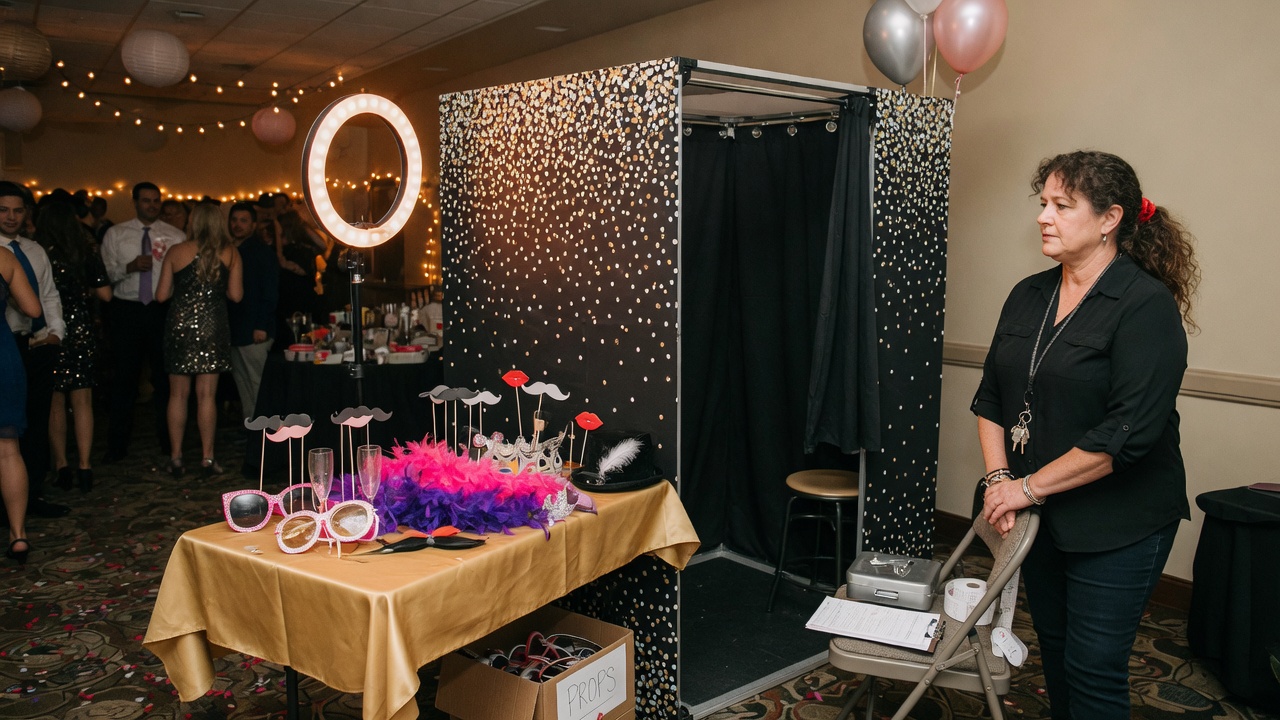
This course teaches you to run a local photo booth rental business: you own one booth setup, you rent it into weddings, birthdays, corporate parties, and school events in 4-hour packages, and you get paid for showing up with a working machine and a good attitude. Every money example uses the same explicit base case: 4-hour event packages priced $400 to $800, a working operator booking 2 to 4 events a week (heavily weekend-weighted), roughly $40 to $80 per event in variable costs (prints, props wear, fuel, and attendant time if you hire one), $150 to $250 a month in fixed costs (insurance, software subscriptions, storage, website), after a startup investment of $2,500 to $6,000 for one booth — camera, printer, stand, lighting, and props, or an all-in-one unit. Those are planning estimates for a typical U.S. market — ranges, not promises; no income is guaranteed. What makes this business different from service trades is that you bought a machine, and the machine has to pay for itself. That is the financial centerpiece of this course: the payback table. Counting variable costs AND a fixed-cost share — not the flattering version that ignores them — a booth at these numbers pays for itself in roughly 4 to 21 events, with most operators landing around 8 to 12: roughly two to six weeks of steady weekend work at the base 2-to-4-events-a-week band. After payback, the same events keep happening at the same prices, and the margin belongs to the business. The operational half of the course is equally blunt: this is a logistics and reliability trade. Load-in, power, space, timing, and backup equipment decide your reputation, because an event cannot be re-run. Photo booth rental is largely an unlicensed trade — the legal module leads with contracts, deposits, and the certificate of insurance venues actually ask for, and treats standard business licensing the way it deserves: location-dependent, verified locally.
What you get
Built for operators who want a clear path — not a pile of generic tips.
The base case
One worked example, not a target
Planning estimates, before tax and before anything you pay yourself — no income is guaranteed. Your own prices, volume and costs will differ; the course walks you through replacing every number here with yours.
Who this fits
- You want a business built on an asset, not just your hours — the booth earns per event, and after it pays for itself the same bookings keep coming at the same prices
- You are reliable with logistics: arriving early, loading in, finding power, testing prints, and tearing down on schedule matters more here than any creative skill
- You genuinely enjoy hosting — a booth attendant who warms up shy guests and keeps the line moving turns a gadget into the highlight of the party
- You can work weekends without resentment: parties, weddings, and corporate events cluster on Friday and Saturday nights, especially in spring and December
- You like the idea of starting part-time: 2 to 4 events a week fits alongside a job, and the booth does not care that you have one
Honest risks
- The booth is a machine, and machines fail: a dead printer or frozen screen mid-event cannot be re-run. Operating without backup equipment and a tested failure plan risks a refund, a public bad review, and a venue that never refers you again.
- Demand is seasonal and weekend-heavy — wedding season and December parties boom, January and February are quiet, and a slow month still owes the same $150–$250 in fixed costs. No income is guaranteed in any month.
- Payback math only works if the booth actually books: a $6,000 setup that goes out twice a month takes far longer to pay for itself than the flattering spreadsheet promised. Utilization, not ownership, is the business.
- This is a commodity market in many cities — competitors advertise cheap booths, and operators who compete on price alone race each other to margins that never repay the equipment.
- Every event is a physical delivery job: hauling cases up stairs, tight load-in windows, distant parking, and late-night teardowns. Underestimating the labor around the 4 booked hours is the most common surprise.
- Deposits, contracts, and venue insurance requirements are not optional paperwork — working without them invites cancellations you eat, disputes you lose, and venues that will not let you through the door.
Who should skip this one
- You want passive income without operations. The booth is an asset, but every dollar it earns arrives attached to a load-in, four hours of hosting, and a midnight teardown — this is a logistics business that happens to own a machine.
- You need dependable income every month right now. Bookings are seasonal, weekend-weighted, and slow to build; the first months are mostly marketing and portfolio events, and no income is guaranteed.
- You are unwilling to work Friday and Saturday nights. That is when the events are; a weekday-only photo booth operator has bought an expensive closet ornament.
- You would skip the boring protections — signed contracts, deposits, liability insurance, backup equipment — to get booking faster. In a business where the event cannot be re-run, one skipped protection can cost more than the booth did.
Curriculum
10 modules · 35 lessons · 1 hr 55 min of reading
01Is a Photo Booth Business Right for You?4 lessons · 13 min
What the business actually is — a logistics trade that owns an earning asset — the honest base-case money, and a go/no-go decision before you spend $2,500–$6,000 on a booth.
- What This Business Really Is3 min
- The Base Case: The Numbers This Course Runs On3 min
- The Money: An Honest Week and Month4 min
- Founder Fit: The Go/No-Go Decision3 min
02Startup Costs: Build, Buy, and the Business Skeleton3 lessons · 10 min
Where the $2,500–$6,000 actually goes, the build-a-booth vs. all-in-one decision, and the boring business setup that has to exist before your first paid event.
- Where the $2,500–$6,000 Actually Goes3 min
- Build a Booth vs. Buy an All-in-One4 min
- Business Basics: The Non-Booth Setup3 min
03The Booth That Earns: Gear, Props, and Backups4 lessons · 14 min
The working rig piece by piece — capture, printing, lighting, software — the prop and backdrop kit that makes it a party, and the backup equipment that makes one-time events safe to sell.
- The Working Rig: Camera, Printer, Stand, Light4 min
- Props and Backdrops: The Party Layer3 min
- Backup Equipment: The Non-Negotiable Kit4 min
- Software, Sharing, and the Digital Gallery3 min
04Packages, Pricing, and the Payback Tablefree sample4 lessons · 14 min
Price 4-hour packages from real costs — never from hope — then compute the course's financial centerpiece honestly: how many events until the booth has paid for itself.
- Price From Costs, Not From Competitors' Ads4 min
- The Payback Table: When the Booth Has Paid for Itself(free sample below)4 min
- Designing the Package Ladder3 min
- Add-Ons: Where the Margin Hides3 min
05Legal, Insurance, and Taxes — Education, Not Advice4 lessons · 13 min
What actually protects a booth operator — contracts, deposits, and the certificate of insurance venues demand — plus location-dependent licensing and the tax habits that keep spring calm.
- The Licensing Reality: Largely Unlicensed, Locally Variable3 min
- Contracts and Deposits: The Paper That Saves the Weekend4 min
- Insurance and the COI Venues Ask For3 min
- Taxes and Records: The 15-Minute Weekly Habit3 min
06Branding and Being Findable3 lessons · 9 min
A name and look that photograph well, a booking-ready web presence, and the free local listings that put you in front of hosts the week they search.
- A Brand That Photographs Well3 min
- A Web Presence That Books3 min
- Local Listings and the Social Proof Loop3 min
07Marketing: Your First 10 Bookings3 lessons · 10 min
Portfolio events that buy you photos and reviews, the DJ/planner/venue partnership channel that fills calendars for years, and the follow-up habits that turn inquiries into deposits.
- Bookings 1–3: Portfolio Events That Pay in Proof3 min
- Bookings 4–8: The DJ, Planner, and Venue Channel4 min
- Bookings 9–10: Turning Inquiries Into Deposits3 min
08Event Day: Logistics, Hosting, and the Run Sheet4 lessons · 13 min
The pre-event logistics call, the load-in and setup sequence that makes you the vendor venues love, four hours of hosting done well, and the teardown-to-gallery finish.
- The Pre-Event Logistics Call3 min
- Load-In and the 60-Minute Setup Sequence4 min
- Hosting: The Four Hours That Earn the Review3 min
- Teardown, Gallery, and the 24-Hour Finish3 min
09Reviews, Referrals, and Repeat Clients3 lessons · 9 min
The gallery-moment review ask, the vendor referral engine that compounds, and the corporate repeat clients who book the same booth every year.
- The Review Engine: Ask at the Gallery Moment3 min
- The Referral Flywheel: Guests, Hosts, and Vendors3 min
- Corporate Clients: The Bookings That Repeat Themselves3 min
10Operations, Cash Flow, and Growth3 lessons · 10 min
Running the calendar through feast-and-famine seasons, keeping cash honest after payback, and the second-booth decision — the same payback math, applied with discipline.
- Seasonality: Feast, Famine, and the Smoothing Moves3 min
- After Payback: Where the Margin Goes3 min
- The Second Booth: Same Math, Stricter Test4 min
Why people buy this
Built for first-time operators who want a clear path — not generic AI chat.
Honest fit check
Who should start — and who should skip — so you don't waste months on the wrong business.
Do-this-next lessons
Every lesson ends in an action: scripts, checklists, pricing math you can use this week.
One-time purchase
One payment of $59. No course subscription.
Photo Booth Rental Blueprint is part of the OwnerLaunch founding library. Figures in the course are planning estimates before tax — no income is guaranteed.
Blueprint FAQ
Why $59 for this Blueprint?+
You get a full operator course (10 modules, 35 lessons), a free sample lesson before you buy, downloadable templates after purchase, and a path into a personalized Launch Kit if you want one. It's a one-time payment — not a subscription for the course itself.
What do I get before I pay?+
The full curriculum outline, honest fit/risk lists, money base-case assumptions, a short course preview video when available, and one complete free sample lesson — real course content, not a teaser paragraph.
Is this legal, tax, or financial advice?+
No. OwnerLaunch is educational only. Licensing, insurance, tax, and filing requirements are location-dependent — verify with official sources and licensed professionals.
Can I upgrade to a Launch Kit later?+
Yes. Blueprint owners typically pay only the difference for a personalized Launch Kit (names, brand, pricing, copy, documents, 30-day plan). The course and kit are separate purchases.
Included templates & tools
- 30-Day Photo Booth Launch Checklist — The whole course sequenced into four weeks: setup and gear in week one, pricing and legal in week two, brand and outreach in week three, portfolio events and first paid bookings in week four.
- Outreach Scripts: Portfolio Events, Partners, and Inquiry Replies — Copy-and-personalize scripts for the three conversations that build your first calendar: portfolio-event offers, DJ/planner/venue partnership pitches, and inquiry replies with follow-ups.
- Booking and Event Details Sheet (Fill-In Template) — The one sheet per event that captures booking terms and the pre-event logistics call — package, payments, load-in, power, space, timeline — so event day runs from answers, not assumptions.
- Payback and Package Pricing Calculator — The course's financial centerpiece as a fill-in worksheet: contribution per event from real costs, the honest booth-payback count, and a before-tax monthly profit picture at three volumes.
- Self-Check: The Photo Booth Operator's Quiz — Ten questions covering the numbers, the logistics, and the protections — with answers keyed to the modules to reread before your first paid event.
Free sample lesson
Real course content — not a teaser paragraph. The rest unlocks after purchase.
From module: Packages, Pricing, and the Payback Table
The Payback Table: When the Booth Has Paid for Itself
~4 min read
This is the financial centerpiece of the business, so compute it honestly. Contribution per event = package price − variable cost − fixed-cost share. Payback events = booth cost ÷ contribution per event. The dishonest version skips the variable and fixed costs and announces the booth 'pays for itself in four events!' The honest version, at a $600 package, $60 variable, and a $25 fixed share, contributes $515 — so a $4,000 booth pays back in about 8 events. At 2–4 events a week, that is two to four weeks of weekend work. Everything after that, the same events keep happening and the margin belongs to the business.
- Best case: $2,500 booth ÷ ($800 − $40 − ~$17) ≈ 4 events — cheap build, premium price, busy calendar
- Base case: $4,000 booth ÷ ($600 − $60 − ~$25) ≈ 8 events — two to four weeks of steady weekends at 2–4 events a week
- Slow case: $6,000 booth ÷ ($400 − $80 − ~$28) ≈ 21 events — expensive unit, low price, thin calendar: 2–3 months
- Every figure is a before-tax planning estimate; your labor isn't in these numbers, and no booking volume is guaranteed
Read the table backwards and it becomes your buying discipline: every extra $1,000 of booth costs roughly two more events of pure payback at base-case contribution, and every $100 you can hold on price shortens payback for free. Utilization is the third lever — a booth that books 12 events a month at $500 pays back faster than one that books 3 at $800. You are not buying a booth; you are buying a payback schedule, and you choose all three numbers on it.
Action · worksheet
Compute YOUR payback number
Take your Module 2 startup total and last lesson's contribution per event (price − variable − fixed share). Divide: that's your payback event count. Then divide by your realistic events per month for the date the booth is paid off. Write both numbers where you'll see them — every booking until that date is buying back your machine, before tax.
Ready to make it yours?
A Launch Kit turns this Blueprint into your business: personalized name, brand, pricing, website copy, documents, and Action Plan.
Basic
$119 current
Pro
$199 current
Apply your Blueprint credit to Basic for +$60 or Pro for +$140.
More Blueprints
Related course · Events & Creative
Mobile DJ Blueprint
Read the room, run the night, fill the calendar.
Related course · Events & Creative
Event Photography Blueprint
Book, shoot, deliver — a working local photo business.
Recommended next · Events & Creative
Wedding Videography Blueprint
High-ticket weekends built on a reliable process.
Recommended next · Events & Creative
Mobile Bartending Service Blueprint
Bring the bar, not the liability — a weekend business built on about fifty Saturdays.
Recommended next · Events & Creative
Private Chef & Small-Event Catering Blueprint
The best-paid seat at the party — once you answer the kitchen question honestly.
All figures in this course are planning estimates, not measurements, stated before tax: 4-hour event packages at $400–$800, 2–4 events a week (weekend-heavy), roughly $40–$80 per event in variable costs (prints, props wear, fuel, attendant time if hired), $150–$250 a month in fixed costs (insurance, software, storage, website), and a startup budget of $2,500–$6,000 for one booth setup. These figures are not inherited from the Discover profile for this trade, so these base-case numbers are assembled from published operator pricing and equipment-vendor guides and flagged for verification — check them against competitors' published packages and current equipment prices in your market. Payback figures (roughly 4–21 events across the ranges) depend entirely on your actual price, costs, and booking volume. Your results depend on your market, pricing, effort, and season; no income is guaranteed. Legal, tax, licensing, and insurance content is education only and location-dependent — verify locally; this course is not legal, tax, or financial advice.
Educational guidance only — not legal, tax, or financial advice.Details
OwnerLaunch provides educational business guidance, AI-generated drafts, and checklists. It is not a law firm, tax advisor, CPA, registered agent, or government agency. Information may not be complete or current for your specific location. Always verify requirements with official federal, state, city, and county sources and consult qualified professionals when needed.