
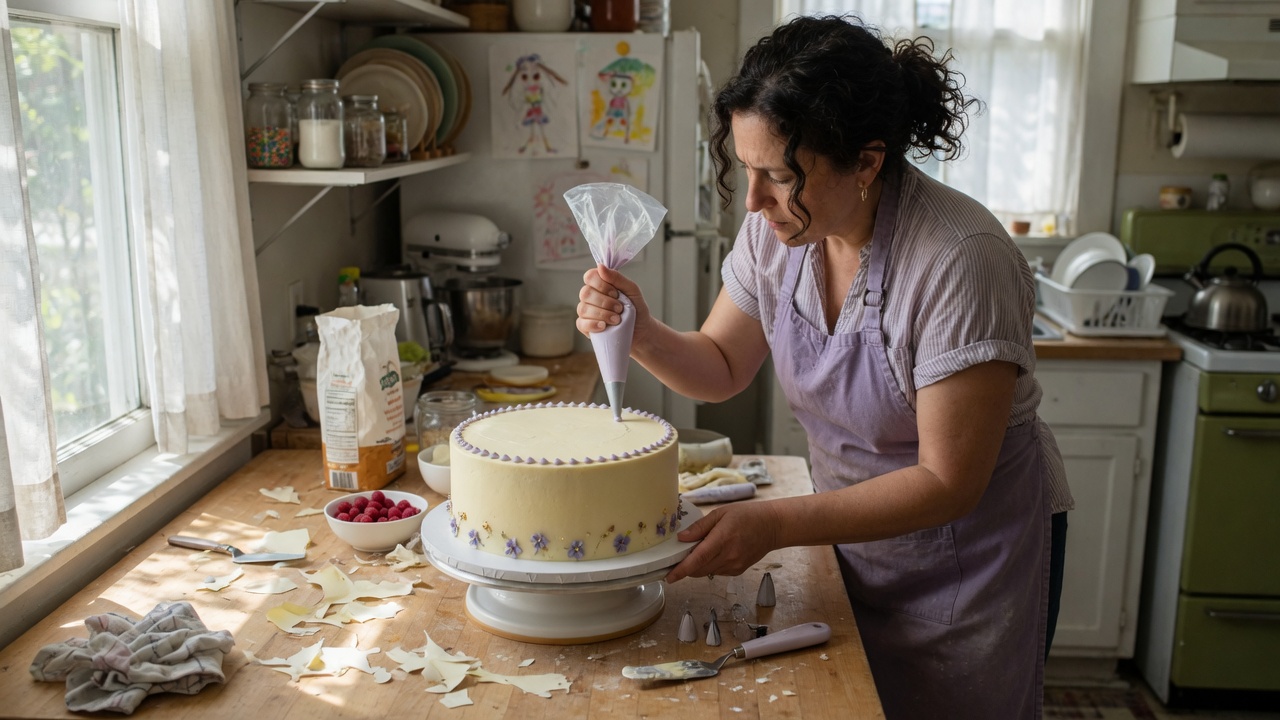
Custom Cakes & Treats Blueprint
Blueprint Course
Custom Cakes & Treats Blueprint
Home-based baking under your local cottage food rules.
This course takes you from baking for friends to running a real home-based custom cake and treats business — legally, under your state's cottage food law, and profitably, priced on the hours a decorated cake actually takes. Every money example uses the same explicit base case: celebration cakes at $75 to $250, wedding tiers at $300 to $800 and up, a working baker filling 3 to 6 orders a week, ingredients running 20 to 30 percent of the price, roughly $100 to $200 a month in fixed costs (insurance, website, boxes and boards, software), after a startup budget of $500 to $1,500 — because most of the equipment is probably already in your kitchen. Those are planning estimates for a typical U.S. market: ranges, not promises, always before tax, and no income is guaranteed. Two truths shape everything here. First, hours: a decorated custom cake is 4 to 10 hours of real work — baking, filling, crumb-coating, decorating, boxing, and the consultation messages around it — so a $150 cake that takes 8 hours pays very differently than it looks, and the pricing module makes you count every hour before you quote a single order. Second, law: selling food made in a home kitchen is governed by your state's cottage food statute, and those statutes differ enormously — which foods are allowed (cream-filled and refrigerated items commonly are not), how much you can sell per year, exactly what your label has to say, and whether registration, a kitchen inspection, or a food-handler card is expected first. The legal module is the heart of this course: education only, always location-dependent, always verified with your own state's health or agriculture department before your first sale.
What you get
Built for operators who want a clear path — not a pile of generic tips.
The base case
One worked example, not a target
Planning estimates, before tax and before anything you pay yourself — no income is guaranteed. Your own prices, volume and costs will differ; the course walks you through replacing every number here with yours.
Who this fits
- You already bake cakes people ask to pay for — birthdays, showers, and office parties come to you, and your decorating photos get shared without you asking
- You have the patience for slow, detailed handwork: smoothing buttercream, stacking tiers, and piping for hours is meditative to you, not maddening
- You can run a schedule backwards from a hard deadline — a cake due Saturday at noon has no grace period, so you plan baking, chilling, and decorating days in advance
- You are willing to read your state's cottage food law and follow it exactly — allowed foods, labels, caps, and all — before taking your first paid order
- You can handle weekend-heavy work: pickups and deliveries cluster on Fridays and Saturdays, and wedding season stacks them
Honest risks
- Hours-per-cake is the trap that sinks new bakers: a decorated custom cake takes 4–10 hours of real work, so pricing by ingredient cost alone means earning very little per hour before tax on orders that look profitable.
- Cottage food law limits what you can legally sell from home — cream-filled, custard, and refrigerated items are commonly not allowed, and some states cap annual sales — so part of the popular menu may be off the table until you rent licensed kitchen space. Rules are location-dependent; verify with your state before your first sale.
- A cake is due at a fixed hour for an unrepeatable event. A collapsed tier, a delivery mishap, or an oven failure the night before a wedding cannot be rescheduled — it becomes a refund, a public review, and possibly a claim.
- Demand is seasonal and weekend-weighted: wedding and graduation season stacks spring and summer Saturdays while January is quiet, and no income is guaranteed in any month.
- Allergens are a safety and liability risk: home kitchens routinely contain wheat, eggs, milk, and nuts, and most cottage food labels are expected to disclose ingredients precisely — a mislabeled allergen is the worst-case scenario in this trade.
- Underpriced 'friend prices' are hard to raise: the first ten customers set the anchor, and a book full of $60 cakes that take 6 hours each is a busy hobby, not a business.
Who should skip this one
- You want to skip the legal homework. Cottage food law is not optional paperwork — it decides what you may sell, how you label it, and whether you can sell at all. If reading your state's statute and following it exactly sounds like something you'd 'get to later', this business will start with a violation, not a sale.
- You cannot give up your evenings and weekends around order deadlines. Cakes are due Friday and Saturday, decorating happens the night before, and wedding season stacks them — a strictly weekday, strictly daytime baker in this niche is choosing a hobby.
- You need dependable income every month right now. Orders build slowly through referrals and season heavily; the base case is a range under stated assumptions, and no income is guaranteed — especially in the first months.
- You would keep charging friend prices to avoid awkward conversations. If quoting $185 for 8 hours of work makes you round down to $80, the hours math in Module 4 will show you exactly what that costs — but only you can decide to charge it.
- Your signature ideas are all cream-filled, custard, or refrigerated desserts and you're unwilling to adapt. Those items are commonly not allowed under cottage food law; if the menu can't flex to shelf-stable bakes (or you won't rent licensed kitchen space), the legal fit isn't there. Verify your state's allowed-foods list first.
Curriculum
10 modules · 36 lessons · 2 hr 3 min of reading
01Is a Custom Cake Business Right for You3 lessons · 11 min
What home baking for money actually is — deadline-driven handwork governed by your state's cottage food law — what the money looks like under an honest base case, why hours-per-cake decides everything, and a go/no-go decision before you spend a dollar.
- What This Business Really Is4 min
- The Hours-per-Cake Truth4 min
- Your Go/No-Go Decision3 min
02Startup Costs and Home Kitchen Setup3 lessons · 11 min
The real $500–$1,500 startup budget line by line, how to set up a home kitchen for production (and what some states expect it to look like), and the monthly fixed costs that quietly decide your break-even.
- The $500–$1,500 Startup Budget, Line by Line4 min
- Setting Up Your Home Kitchen for Production4 min
- Your Monthly Fixed Costs and Break-Even3 min
03Equipment, Ingredients, and Supplies3 lessons · 10 min
The tools that earn their keep versus the ones that don't, how to buy ingredients at 20–30% of price instead of 40, and the boxes-boards-and-transport kit that keeps finished cakes alive.
- The Tools That Earn Their Keep4 min
- Buying Ingredients at 20–30%, Not 403 min
- Boxes, Boards, and the Transport Kit3 min
04Menu and Pricing: Charge for Every Hourfree sample4 lessons · 15 min
A tight starter menu, the total-hours pricing method that is the backbone of this course, the underpricing trap dressed up as 'ingredients times three', and how to quote weddings without losing the weekend.
- A Starter Menu That Prints Money Quietly3 min
- The Pricing Method: Total Hours or Bust(free sample below)5 min
- The Friend-Price Trap and How to Escape It3 min
- Quoting Weddings and Multi-Tier Work4 min
05Legal: Cottage Food Law, Insurance, and Taxes5 lessons · 20 min
The heart of the course: how state cottage food laws govern home food sales — allowed foods, sales caps, labels, registration, and food-handler cards — plus insurance and the before-tax money habit. Education only, and everything here is location-dependent: verify with your state before your first sale.
- Cottage Food Law: The Rules That Make This Legal5 min
- Allowed Foods — and the Cream-Filling Problem4 min
- Labels, Sales Caps, and Registration4 min
- Food-Handler Cards and Kitchen Safety Habits3 min
- Insurance, Taxes, and Business Structure4 min
06Branding and Being Findable3 lessons · 10 min
A name and look that photograph well, the Instagram-plus-Google setup that makes a home bakery findable, and cake photography good enough to sell the next order.
- A Name and Look That Sell Cake3 min
- Instagram Is Your Storefront, Google Is Your Front Door4 min
- Photograph Every Cake Like It's the Ad (It Is)3 min
07Your First 10 Customers4 lessons · 12 min
The warm-circle announcement that fills the first order book, the tasting-box move that turns strangers into believers, order-form follow-up that closes politely, and keeping the first ten from anchoring you at hobby prices.
- The Announcement That Starts Everything3 min
- The Tasting-Box Move3 min
- Closing Inquiries Without Being Weird About It3 min
- Ten Real Orders Without Hobby-Price Anchors3 min
08Orders, Consultations, and Delivery Day4 lessons · 12 min
An intake-to-pickup order system that never drops a date, consultations that end in deposits, and the delivery-day protocol that gets fragile cargo to the party intact.
- One Order System, Zero Dropped Cakes3 min
- Consultations That End in Deposits3 min
- Scheduling the Bake Backwards3 min
- The Delivery-Day Protocol3 min
09Production Week: Consistency and Quality3 lessons · 9 min
Standardized recipes that behave the same every time, the quality checklist that catches problems while they're fixable, and honest recovery when a bake goes wrong anyway.
- Standardize Everything: Your Recipes Are the Factory3 min
- The Quality Checklist That Catches It in Time3 min
- When a Bake Goes Wrong Anyway3 min
10Reviews, Referrals, and Growing Past Your Oven4 lessons · 13 min
The pickup-moment review system, referral loops that fill next month from this month's parties, reading your numbers honestly, and the growth decision points — raising prices, sales caps, and the licensed-kitchen question.
- The Review Engine Runs at Pickup3 min
- Referral Loops: Every Party Is a Showroom3 min
- Reading Your Numbers Honestly3 min
- Growth: Raising Prices, Caps, and the Licensed-Kitchen Question4 min
Why people buy this
Built for first-time operators who want a clear path — not generic AI chat.
Honest fit check
Who should start — and who should skip — so you don't waste months on the wrong business.
Do-this-next lessons
Every lesson ends in an action: scripts, checklists, pricing math you can use this week.
One-time purchase
One payment of $59. No course subscription.
Custom Cakes & Treats Blueprint is part of the OwnerLaunch founding library. Figures in the course are planning estimates before tax — no income is guaranteed.
Blueprint FAQ
Why $59 for this Blueprint?+
You get a full operator course (10 modules, 36 lessons), a free sample lesson before you buy, downloadable templates after purchase, and a path into a personalized Launch Kit if you want one. It's a one-time payment — not a subscription for the course itself.
What do I get before I pay?+
The full curriculum outline, honest fit/risk lists, money base-case assumptions, a short course preview video when available, and one complete free sample lesson — real course content, not a teaser paragraph.
Is this legal, tax, or financial advice?+
No. OwnerLaunch is educational only. Licensing, insurance, tax, and filing requirements are location-dependent — verify with official sources and licensed professionals.
Can I upgrade to a Launch Kit later?+
Yes. Blueprint owners typically pay only the difference for a personalized Launch Kit (names, brand, pricing, copy, documents, 30-day plan). The course and kit are separate purchases.
Included templates & tools
- 30-Day Launch Checklist — The whole course sequenced into four weeks — from cottage-food homework and kitchen setup to your announcement, tasting boxes, and first paid orders.
- Launch Announcement + Inquiry Reply Scripts — Copy-paste scripts for the personal launch text, the public post, and the three inquiry replies that close orders without awkwardness.
- Cake Order Form & Booking Agreement Template — A fill-in order form that captures everything a quote needs, plus the booking terms — deposit, holds, allergens, and the care-after-handoff line — in plain language.
- Cake Pricing Calculator Worksheet — The total-hours pricing math from Module 4 as a fill-in worksheet: cost per cake + fixed costs + your hourly rate → a before-tax margin check at three price points.
- Cottage Food Compliance Checklist — A one-page verify-locally worksheet: the questions your state's cottage food statute answers, with space to record YOUR state's actual rules before your first sale.
- Launch Readiness Self-Check Quiz — Fifteen honest questions across pricing, cottage food law, and operations — if you can't answer one, it tells you which module to reread before your first paid order.
Free sample lesson
Real course content — not a teaser paragraph. The rest unlocks after purchase.
From module: Menu and Pricing: Charge for Every Hour
The Pricing Method: Total Hours or Bust
~5 min read
The most common pricing advice in baking groups — 'charge three times ingredients' — is how talented bakers end up working for less than they'd make frosting cakes at a supermarket. Watch it fail: an 8-inch custom cake with $35 of ingredients gets priced at $105. It takes 7 real hours (Module 1's number, and yes, messages and boxing count). $105 minus $35 leaves $70 before tax, and $70 across 7 hours is $10 an hour before tax — before boxes, before your $100 to $200 of monthly fixed costs, before the set-aside for self-employment tax. The cake looked profitable. The hour was underpaid the moment you quoted it.
Price from total hours instead, in four steps. One: estimate total hours honestly — for a decorated custom cake, 4 to 10 depending on complexity; use your own timed numbers, not optimism. Two: choose your target hourly rate before tax — pick a number you can say out loud; many custom bakers build quotes on $20 to $35 an hour before tax, and yours should reflect your skill and market (verify against what decorated cakes actually sell for near you). Three: add real costs — ingredients at your costed number from Module 3, plus box, board, and delivery time. Four: the quote is hours × rate + costs, rounded to a clean number. That same $35-ingredient cake at 7 hours and $25 an hour quotes at $210 to $220 — which is exactly what comparable custom work sells for in many markets, because everyone still in business is counting hours.
Action · worksheet
Price your three menu cakes
Using the four steps and the pricing calculator resource, price each size on your starter menu: honest total hours × your chosen before-tax hourly rate + costed ingredients + box/board. Compare against the three local bakers from Module 1. If your numbers feel scary, check the hours before you check the rate.
Ready to make it yours?
A Launch Kit turns this Blueprint into your business: personalized name, brand, pricing, website copy, documents, and Action Plan.
Basic
$119 current
Pro
$199 current
Apply your Blueprint credit to Basic for +$60 or Pro for +$140.
More Blueprints
Related course · Events & Creative
Event Planning Blueprint
Logistics brainpower clients happily pay for.
Related course · Events & Creative
Freelance Floral Design Blueprint
Event florals without a storefront lease.
Recommended next · Events & Creative
Event Photography Blueprint
Book, shoot, deliver — a working local photo business.
Recommended next · Events & Creative
Wedding Videography Blueprint
High-ticket weekends built on a reliable process.
Recommended next · Events & Creative
Mobile Bartending Service Blueprint
Bring the bar, not the liability — a weekend business built on about fifty Saturdays.
All money figures in this course are planning estimates, stated as ranges before tax under an explicit base case: celebration cakes $75–$250, wedding tiers $300–$800+, 3–6 orders a week, ingredients running 20–30% of price, roughly $100–$200 a month in fixed costs, and a startup budget of $500–$1,500. A decorated custom cake is assumed to take 4–10 hours of total work. Your market, skill, speed, season, and effort will produce different results — these are estimates, not promises, and no income is guaranteed. Cottage food rules, licensing, labeling, tax, and insurance content is education only, deeply location-dependent, and never a substitute for your own state's statute or advice from a qualified professional in your area.
Educational guidance only — not legal, tax, or financial advice.Details
OwnerLaunch provides educational business guidance, AI-generated drafts, and checklists. It is not a law firm, tax advisor, CPA, registered agent, or government agency. Information may not be complete or current for your specific location. Always verify requirements with official federal, state, city, and county sources and consult qualified professionals when needed.