
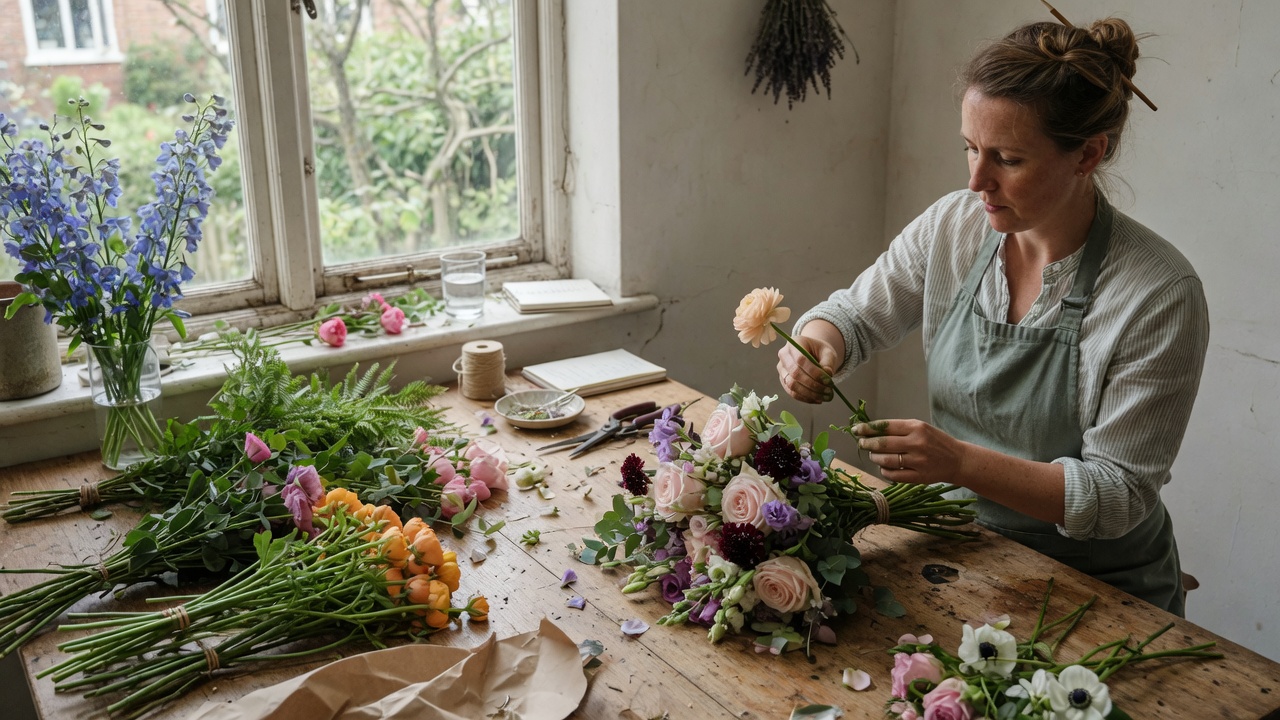
Freelance Floral Design Blueprint
Blueprint Course
Freelance Floral Design Blueprint
Event florals without a storefront lease.
This course takes you from arranging flowers for friends to running a home-studio event floral business that books real weddings — without ever signing a retail lease. Every money example uses the same explicit base case: weddings priced $1,500 to $4,000, small events and individual arrangements at $75 to $300, a working florist booking 2 to 4 event jobs a month plus weekly arrangement orders at steady state, flowers costing 30 to 40 percent of the price you charge, roughly $150 to $300 a month in fixed costs (insurance, website, software, cooler electricity), after a startup investment of $800 to $2,000 in tools, cooling, and buckets. Those are planning estimates for a typical U.S. market — ranges, not promises; no income is guaranteed. Two ideas carry the whole course. First, the margin lesson: flowers are only 30 to 40 percent of a correctly priced job, and everything above the flower cost pays for your sourcing, processing, design hours, hard goods, delivery, install, and strike — florists who price by 'flowers plus a little' work weekends for free. Second, perishability as your business model: unlike almost every product business, you hold zero inventory. Flowers are ordered per event, arrive days before, and leave your studio the day of — which means the order-to-event timeline is the operating skill that separates professionals from hobbyists, and a missed order date is a crisis no talent can fix. You will also learn the unglamorous doors into the trade: opening wholesale accounts (a resale certificate and business registration commonly get you real wholesale pricing), riding the event calendar (wedding season plus the Valentine's and Mother's Day spikes that move wholesale prices), and delivering bulky, fragile, water-filled product to venues on someone else's schedule. Floral design is largely an unlicensed trade — no exam stands between you and your first paid wedding in most states — but Louisiana famously licenses retail florists, and running a business from your home touches cottage/home-occupation zoning rules, so the legal module frames everything the honest way: commonly required, location-dependent, verified locally.
What you get
Built for operators who want a clear path — not a pile of generic tips.
The base case
One worked example, not a target
Planning estimates, before tax and before anything you pay yourself — no income is guaranteed. Your own prices, volume and costs will differ; the course walks you through replacing every number here with yours.
Who this fits
- You have a designer's eye and a laborer's back — floral work is color, shape, and proportion decisions stacked on hours of stem processing, bucket hauling, and ladder time
- You can plan backwards from a date without flinching: every event is a countdown of order deadlines, delivery windows, and processing days, and the timeline is unforgiving
- You are comfortable with weekend and early-morning work — weddings happen on Saturdays, and installs happen in the venue's window, not yours
- You have (or can create) a workable home studio space: a cool room, a place for buckets and a work table, and a vehicle that can carry water-filled containers safely
- You can sell with a portfolio: this business is won on photos and planner relationships, and you will need to pitch venues, ask for image rights, and follow up without cringing
Honest risks
- Underpricing is the classic failure: flowers are only 30–40% of a correctly priced job, and florists who charge 'flower cost plus a little' end up earning less than minimum wage per total hour once sourcing, processing, design, delivery, install, and strike time are counted.
- Perishability punishes sloppy planning: flowers ordered late may not arrive in time, flowers ordered early die in your cooler, and a missed wholesale order deadline before a wedding is a crisis money cannot always fix. The order-to-event timeline is a discipline, not a suggestion.
- Demand is event-driven and seasonal — wedding season and holidays boom while deep winter can be quiet, and 2–4 events a month is a steady-state target, not a first-month expectation. No income is guaranteed in any month.
- Wholesale flower prices are volatile: Valentine's Day and Mother's Day can spike the cost of roses and other staples dramatically, weather and shipping disrupt supply, and a fixed-price contract signed months ahead absorbs that swing unless your proposal language plans for substitutions.
- Delivery and install risk is real: water-filled containers tip in vehicles, arrangements wilt in hot cars, venues restrict install windows, and a damaged centerpiece an hour before a ceremony has no do-over.
- Home-studio legality is location-dependent: home-occupation zoning rules, HOA restrictions on client visits and deliveries, and (in Louisiana) a state retail-florist license can all apply — operating without checking local rules invites fines and shutdowns.
Who should skip this one
- You want passive or flexible-anytime income. Event floral is deadline work: weddings land on specific Saturdays, wholesale orders have hard cutoffs days before, and processing happens when the flowers arrive — the calendar owns you during event weeks, and no income is guaranteed.
- You cannot absorb physical work. Processing hundreds of stems, hauling water buckets, loading vehicles, and installing arch pieces on ladders is repetitive manual labor — if that sounds miserable, this is the wrong trade.
- You will not hold your prices. This market is full of hobbyists charging flower-cost-plus-$50; if you cannot quote $2,500 for a wedding knowing the flowers cost $900 — because the other $1,600 buys your sourcing, processing, design days, delivery, install, and strike — you will race them to the bottom.
- You need dependable income every month right now. Bookings build slowly through portfolio work and planner relationships, wedding leads often book months out, and the first weeks are mostly practice and outreach — no income is guaranteed.
- Your living situation cannot host the work. If you have no cool space for flowers, nowhere to stage buckets and a work table, or zoning/HOA rules that clearly prohibit home business activity you are unwilling to solve, start by fixing that constraint first.
Curriculum
10 modules · 36 lessons · 2 hr of reading
01Is a Freelance Floral Design Business Right for You4 lessons · 14 min
What a home-studio event florist actually does — a perishable-logistics business with a creative face — what the money looks like under an honest base case, why you specifically do NOT want a retail shop, and a go/no-go decision before you spend a dollar.
- What This Business Really Is4 min
- Why You Do NOT Want a Retail Shop3 min
- The Money, Honestly4 min
- Go or No-Go3 min
02Startup Costs and Your Home Studio3 lessons · 10 min
Where the $800–$2,000 actually goes — tools, cooling, buckets, hard goods — how to set up a home studio in a spare room or garage corner, and how to keep flowers alive without a commercial cooler.
- The $800–$2,000 Startup Budget4 min
- Setting Up the Studio Space3 min
- Cooling Without a Commercial Cooler3 min
03Supplies, Sourcing, and Wholesale Access4 lessons · 13 min
The working toolkit and hard-goods system, how wholesale flower buying actually works, what it commonly takes to open a wholesale account — and the farm-direct and cash-and-carry fallbacks while you get there.
- The Working Toolkit and Hard Goods3 min
- How Wholesale Flower Buying Works4 min
- Opening a Wholesale Account3 min
- Processing and Conditioning Basics3 min
04Services and Pricing: The 30–40% Flower Rulefree sample4 lessons · 14 min
The margin lesson that decides everything — flowers must land at 30–40% of the price you charge — plus recipe-based wedding pricing, arrangement and weekly-order pricing, and the delivery, install, and strike fees hobbyists forget.
- The Margin Lesson: Flowers Are the Small Slice(free sample below)4 min
- Pricing Weddings by Recipe4 min
- Arrangements, Dailies, and Weekly Accounts3 min
- Delivery, Install, and Strike Are Line Items3 min
05Legal, Insurance, and Taxes (Education, Not Advice)4 lessons · 14 min
What is commonly required to run a home-studio floral business — business registration, the resale certificate that opens wholesale doors, home-occupation zoning, the Louisiana licensing exception, insurance, and taxes — all location-dependent education, never legal or tax advice.
- Business Registration, EIN, and the Resale Certificate4 min
- Home Studios, Zoning, and Cottage Rules3 min
- Is Floristry Licensed? (Mostly No — Famously, Louisiana)3 min
- Insurance, Taxes, and Simple Books4 min
06Branding and Being Findable3 lessons · 9 min
A portfolio-first brand: a defined design style, a simple website with your menu and minimums, a Google Business Profile that works without a storefront, and an Instagram habit that turns every event into marketing.
- Pick a Lane: Your Design Style Is Your Brand3 min
- Website and Google Business Profile3 min
- Building a Portfolio Before You Have Clients3 min
07Marketing: Your First 10 Customers4 lessons · 13 min
The warm-network launch, the planner and venue relationships that feed event florists for years, the weekly-account pitch that builds baseline income, and the consult process that turns inquiries into deposits.
- Customers 1–3: The Warm-Network Launch3 min
- Customers 4–7: Planners, Venues, and Vendors4 min
- Customers 8–10: Weekly Accounts and Small Events3 min
- Consults That Convert to Deposits3 min
08Service Delivery: The Order-to-Event Timeline4 lessons · 14 min
The operating skill of the whole trade — running every event on a strict countdown from order deadline to strike — plus design-day workflow, transport that keeps water upright, and install/strike execution at the venue.
- The Countdown: Working Backwards From Event Day4 min
- Design Day Workflow3 min
- Transport: Water, Heat, and Physics3 min
- Install, Strike, and the Substitution Standard4 min
09Seasonality: Riding the Event Calendar3 lessons · 9 min
How wedding season and the flower holidays shape your year — including the wholesale price spikes around Valentine's and Mother's Day — and how deposits, a booking calendar, and off-season products smooth the swings.
- The Floral Year: Peaks, Spikes, and Quiet3 min
- Deposits and the Booking Calendar3 min
- Off-Season Revenue: Filling the Quiet Months3 min
10Reviews, Referrals, and Growing the Studio3 lessons · 10 min
Turning every event into the next three — reviews and photo rights, the planner referral engine, the weekly numbers that steer the business, and the honest growth paths for a home-studio florist.
- Reviews and Photo Rights: The Compounding Assets3 min
- The Referral Engine3 min
- Weekly Numbers and Honest Growth Paths4 min
Why people buy this
Built for first-time operators who want a clear path — not generic AI chat.
Honest fit check
Who should start — and who should skip — so you don't waste months on the wrong business.
Do-this-next lessons
Every lesson ends in an action: scripts, checklists, pricing math you can use this week.
One-time purchase
One payment of $59. No course subscription.
Freelance Floral Design Blueprint is part of the OwnerLaunch founding library. Figures in the course are planning estimates before tax — no income is guaranteed.
Blueprint FAQ
Why $59 for this Blueprint?+
You get a full operator course (10 modules, 36 lessons), a free sample lesson before you buy, downloadable templates after purchase, and a path into a personalized Launch Kit if you want one. It's a one-time payment — not a subscription for the course itself.
What do I get before I pay?+
The full curriculum outline, honest fit/risk lists, money base-case assumptions, a short course preview video when available, and one complete free sample lesson — real course content, not a teaser paragraph.
Is this legal, tax, or financial advice?+
No. OwnerLaunch is educational only. Licensing, insurance, tax, and filing requirements are location-dependent — verify with official sources and licensed professionals.
Can I upgrade to a Launch Kit later?+
Yes. Blueprint owners typically pay only the difference for a personalized Launch Kit (names, brand, pricing, copy, documents, 30-day plan). The course and kit are separate purchases.
Included templates & tools
- 30-Day Floral Studio Launch Checklist — The whole course sequenced into four weeks of concrete actions — from go/no-go and studio setup to wholesale access, pricing, and your first booked work.
- Launch, Planner, Venue, and Weekly-Account Scripts — Copy-and-personalize scripts for the warm-network launch, planner and venue pitches, the photographer styled-shoot trade, and the weekly-account walk-in.
- Wedding Consult and Event Intake Form — The fill-in intake form that runs your consults: date and venue feasibility, vision and palette, item counts, the budget conversation, and the proposal handoff.
- Floral Pricing Calculator Worksheet — The by-hand pricing math: recipe cost, the flowers ÷ 0.30–0.40 rule, labor and delivery lines, per-job before-tax margin, and a monthly break-even check.
- Order-to-Event Timeline Worksheet — The countdown that runs every event: fill in real dates backwards from event day, anchored to your wholesaler's actual order deadline.
- Self-Check: Are You Pricing and Planning Like a Pro? — A quick self-quiz on the margin rule, the countdown, wholesale access, and the legal basics — with answers keyed to course modules.
Free sample lesson
Real course content — not a teaser paragraph. The rest unlocks after purchase.
From module: Services and Pricing: The 30–40% Flower Rule
The Margin Lesson: Flowers Are the Small Slice
~4 min read
Here is the ratio that separates florists who profit from florists who quietly pay to work weddings: in a correctly priced job, the flowers cost 30–40% of what the client pays. A $2,500 wedding means roughly $750–$1,000 of wholesale flowers — and $1,500–$1,750 that is NOT flowers. That gap is not padding. It buys your consult and proposal hours, your ordering and will-call run, two to four hours of processing, a full design day, hard goods, the delivery vehicle and fuel, the install window at the venue, the strike trip after midnight, your insurance, your cooler electricity, and the business's before-tax profit. The matching flower-cost ratio is roughly 2.5x to 3.33x before separately accounting for labor: flower cost divided by 0.40 to 0.30 equals the client-price floor before the labor model is checked.
Hobbyists price the opposite way: flower cost plus a little, because 'it's just my time.' Run their math once: $900 of flowers sold at $1,200 leaves $300 to cover 25+ hours of sourcing, processing, design, delivery, install, and strike — under minimum wage before a single fixed cost. They are not your competition; they are a warning. When a prospect says a hobbyist quoted half your price, the honest answer is that you are both charging about the same for flowers — you are the only one charging for the twenty-five hours that make the flowers show up alive, on time, and installed.
Action · worksheet
Price one real piece both ways
Pick one arrangement you could make this week. Write its recipe, price the stems at wholesale (use a farm-direct site if you lack an account), then compute: (a) the hobbyist price (flowers + $30) and (b) the professional price (flowers ÷ 0.35). Under each, list every hour of work the price must cover and the before-tax hourly rate it implies. Keep this sheet — it is your pricing spine.
Ready to make it yours?
A Launch Kit turns this Blueprint into your business: personalized name, brand, pricing, website copy, documents, and Action Plan.
Basic
$119 current
Pro
$199 current
Apply your Blueprint credit to Basic for +$60 or Pro for +$140.
More Blueprints
Related course · Events & Creative
Event Planning Blueprint
Logistics brainpower clients happily pay for.
Related course · Events & Creative
Balloon Décor Blueprint
Installations and garlands for every celebration.
Recommended next · Events & Creative
Event Photography Blueprint
Book, shoot, deliver — a working local photo business.
Recommended next · Events & Creative
Wedding Videography Blueprint
High-ticket weekends built on a reliable process.
Recommended next · Events & Creative
Mobile Bartending Service Blueprint
Bring the bar, not the liability — a weekend business built on about fifty Saturdays.
All figures in this course are planning estimates for a typical U.S. market under a stated base case: a home-studio event florist (not a retail shop) booking weddings at $1,500–$4,000, small events and arrangements at $75–$300, 2–4 event jobs a month plus weekly arrangement orders at steady state, flowers costing 30–40% of the price charged, fixed costs of roughly $150–$300 a month, and a startup budget of $800–$2,000 for tools, cooling, and buckets. These figures are not inherited from the Discover profile for this trade, so these numbers are stated here and flagged for verification in the sources list — verify them against real wholesale prices and florists' published rates in your market. Wholesale flower costs are seasonal and spike around holidays. All profit figures are before tax. Legal, licensing, zoning, tax, and insurance content is education only and location-dependent — verify locally. Your results depend on your market, season, pricing, and effort; these are estimates, not promises, and no income is guaranteed.
Educational guidance only — not legal, tax, or financial advice.Details
OwnerLaunch provides educational business guidance, AI-generated drafts, and checklists. It is not a law firm, tax advisor, CPA, registered agent, or government agency. Information may not be complete or current for your specific location. Always verify requirements with official federal, state, city, and county sources and consult qualified professionals when needed.