
Party Equipment Rentals Blueprint
Blueprint Course
Party Equipment Rentals Blueprint
Tables, chairs, bounce houses — rent the fun.
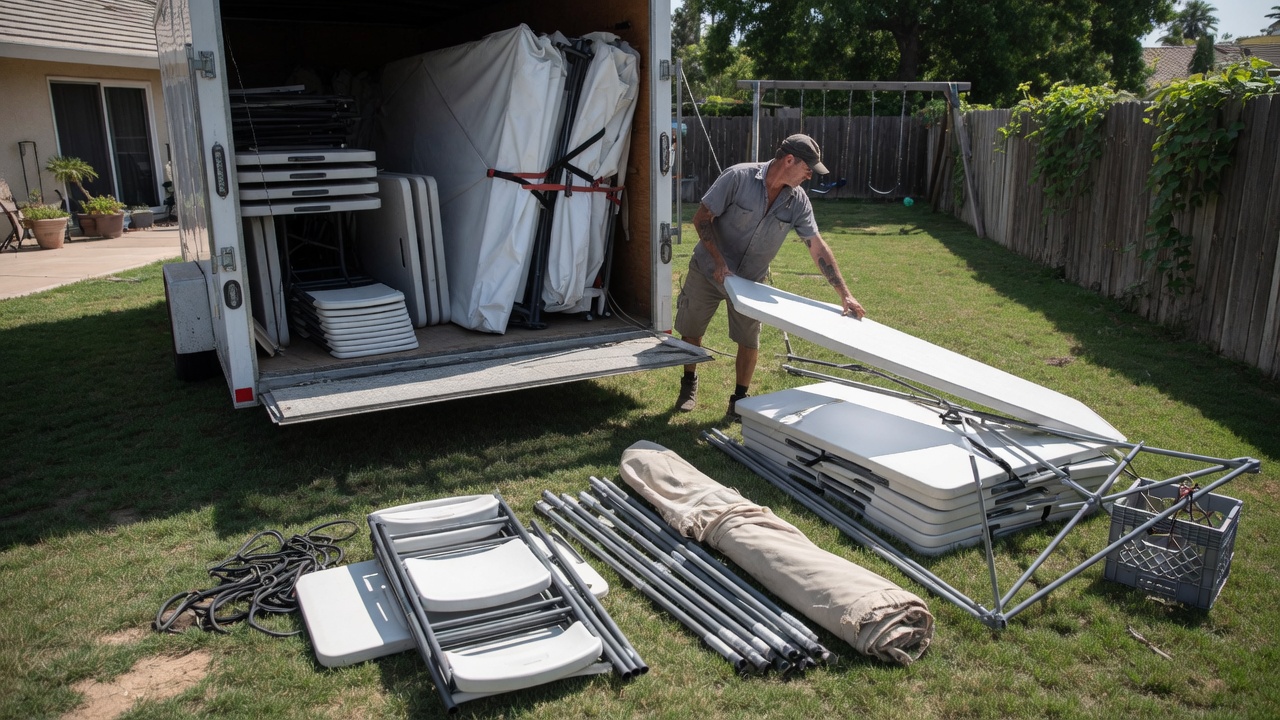
This course builds a local party equipment rental business the low-capital way: tables, chairs, linens, and canopies first, inflatables later — if ever. Every money example uses the same explicit base case: event packages priced $150 to $500, a working operation delivering 3 to 6 events a week (heavily clustered on weekends), roughly $30 to $60 per event in variable costs (fuel, helper pay, laundering, breakage), $200 to $350 a month in fixed costs (storage, insurance, vehicle), after a startup investment of $2,000 to $5,000 in starter inventory — commercial-grade folding tables, stacks of chairs, linens, and one or two pop-up canopies. Those are planning estimates for a typical U.S. market — ranges, not promises; no income is guaranteed. Two ideas run through every module. First, the real recurring cost of this business is not the inventory — it is the delivery, setup, and pickup labor attached to every single order; the inventory mostly sits bought-and-paid-for while your Saturdays do the earning. Second, every item you own is a small machine with a payback count: a $70 table that earns $10 per event pays for itself in seven rentals and then prints margin for years, while an item that rents once a month is storage-unit decoration. You will learn to run that utilization and payback math before every purchase. Bounce houses get their own module, on purpose, as a separate and genuinely higher-liability upgrade: they can be the best payback numbers in the catalog, but they come with anchoring and wind rules (the industry safety standard is ASTM F2374), supervision requirements, state regulation in some places, and an insurance market where some carriers simply exclude inflatables. This course teaches you to earn that upgrade with a boring, profitable table-and-chair operation first.
What you get
Built for operators who want a clear path — not a pile of generic tips.
The base case
One worked example, not a target
Planning estimates, before tax and before anything you pay yourself — no income is guaranteed. Your own prices, volume and costs will differ; the course walks you through replacing every number here with yours.
Who this fits
- You can physically move things: a rental weekend is loading, hauling, carrying, and stacking hundreds of pounds of tables and chairs — often up driveways, across lawns, and into backyards
- Your weekends are available and you want them working: birthdays, graduations, weddings, and quinceañeras book Fridays through Sundays, and Saturday is the whole ballgame
- You like systems more than spotlight — this business is checklists, counts, load sheets, and turnaround routines, not event-day creativity
- You have (or can borrow or rent) access to a truck, van, or trailer and somewhere dry to store inventory — a garage bay works at the start
- You want a business where the asset math is visible: you can literally count how many rentals pay off each item you buy
Honest risks
- Delivery and pickup labor is the real cost, and it is easy to ignore: a $150 package that takes four total hours of loading, driving, setup, and pickup can quietly pay you less than a shift job. Every price in this course is built on total labor hours, not just the rental fee.
- Demand is intensely weekend-heavy and seasonal — spring graduations through fall weddings cluster hard, and winter can go quiet in cold climates. No income is guaranteed in any month.
- Damaged, stained, and missing items are a constant tax: linens get wine and wax, chairs get left in the rain, counts come back short. Without deposits, inspection routines, and a damage policy, margin leaks away.
- Inflatables raise the stakes sharply: improperly anchored bounce houses have been blown loose in wind gusts and caused serious injuries. Anchoring, wind limits, and supervision rules (ASTM F2374 practices) are not paperwork — they are the product.
- Insurance for inflatables is its own market: some general liability carriers exclude inflatables entirely, and specialized coverage can cost more per year than a bounce house earns in its first months. Adding them without confirmed coverage is betting the business.
- Growth eats cash: every new revenue line is another inventory purchase, more storage space, and more Saturday labor. Buying inventory the market has not asked for is the classic way this business dies with a full storage unit.
Who should skip this one
- You cannot or will not do repetitive heavy lifting. There is no version of this business where tables and chair stacks move themselves; a bad back or a no-lifting preference rules out the core work.
- Your weekends are not available. Nearly all demand lands Friday afternoon through Sunday evening; a weekday-only party rental company is a storage unit with a logo.
- You need dependable income every month right now. Bookings are seasonal and weekend-weighted, the first months are mostly inventory payback, and no income is guaranteed.
- You want to start with bounce houses because they look like the fun, high-margin part. Starting at the highest-liability end — before you have insurance confirmed in writing, anchoring and supervision practices down, and operating discipline proven on low-stakes items — is the most expensive mistake in this trade.
- You have nowhere dry and secure to store inventory and no realistic vehicle plan. Storage and transport are structural requirements, not details to solve after the first booking.
Curriculum
10 modules · 37 lessons · 1 hr 58 min of reading
01Is a Party Rental Business Right for You4 lessons · 13 min
What the job actually is — a logistics and lifting business that happens to serve parties — what the money looks like under an honest base case, why delivery labor (not inventory) is the real cost, and a go/no-go decision before you spend a dollar.
- What This Business Really Is3 min
- The Real Cost Is Your Saturday, Not the Inventory4 min
- Weekend-Heavy, Season-Heavy: the Calendar You Are Signing Up For3 min
- Your Go/No-Go Decision3 min
02Startup Costs: the $2,000–$5,000 Starter Inventory3 lessons · 10 min
Exactly where the startup budget goes — a table-chair-linen-canopy starter kit sized to real party orders — what you should refuse to buy in month one, and the storage and vehicle plan that makes delivery possible.
- Where the $2,000–$5,000 Actually Goes4 min
- What Not to Buy Yet3 min
- Storage, Vehicle, and the Fixed Costs Under Everything3 min
03Inventory and the Payback Mathfree sample4 lessons · 13 min
How to buy tables, chairs, linens, and canopies like an operator — commercial grade, used-first — and the centerpiece of this course: payback counts and utilization, the two numbers that should approve or veto every purchase you ever make.
- Buying Tables and Chairs Like an Operator3 min
- Linens, Canopies, and the Care Routine That Protects Margin3 min
- The Payback Question: What One Table Earns(free sample below)4 min
- Utilization: the Scoreboard You Check Monthly3 min
04Packages and Pricing From Real Costs4 lessons · 12 min
Building the $150–$500 package menu from actual costs — labor hours, variable costs, and fixed-cost coverage — plus delivery fees and radius rules, and the deposit and damage policies that protect the margin you priced.
- Price Packages From Costs, Never From Vibes4 min
- Delivery Fees, Radius, and Saying No to Far Away3 min
- Deposits, Damage Policies, and Protecting the Margin3 min
- Add-Ons That Raise the Ticket Without a New Trip2 min
05Legal, Insurance, and Taxes (Education, Not Advice)4 lessons · 12 min
The business backbone nobody photographs: entity and EIN basics, the general liability insurance conversation, the rental agreement that does your arguing for you, and how rental taxes commonly work — all education, all location-dependent, all verified locally.
- Entity, EIN, and Getting Legitimate3 min
- General Liability: the Coverage Conversation3 min
- The Rental Agreement That Argues For You3 min
- Taxes: Sales Tax on Rentals and the Before-Tax Habit3 min
06Bounce Houses: the Higher-Liability Upgrade Path4 lessons · 15 min
The honest, safety-first treatment of inflatables as a separate business decision: payback numbers that look brilliant, the anchoring, wind, and supervision practices (ASTM F2374) that are the actual product, the insurance market's real answer, and a gate checklist that decides not-yet versus go.
- Should You Add Inflatables? Run the Real Math First4 min
- Anchoring and Wind Rules: the Part That Is Not Optional4 min
- Supervision, Rider Rules, and Who Watches the Bounce House3 min
- The Insurance Truth, and the Gate Checklist4 min
07Branding and Being Findable3 lessons · 9 min
A trustworthy name and look, the free Google Business Profile that catches 'party rentals near me,' and clean listing photos that do your selling — the minimum viable brand for a trade where reliability is the product.
- A Name That Says What You Do, and Photos That Prove It3 min
- Google Business Profile: Your Free Storefront3 min
- Be Where Parties Are Planned3 min
08Marketing: Your First 10 Customers4 lessons · 12 min
Filling the first weekends without an ad budget: a warm-network launch that produces real bookings, group and Marketplace outreach done right, venue and planner partnerships that compound, and the follow-up habit that converts quotes into signatures.
- Customers 1–3: the Warm-Network Launch3 min
- Customers 4–7: Groups and Marketplace, Done Right3 min
- Customers 8–10: Venues, Planners, and Referral Partners3 min
- The Follow-Up Habit That Converts Quotes to Bookings3 min
09Delivery Day: the Workflow That Earns Reviews4 lessons · 12 min
The booking-to-pickup operating system: load sheets and confirmations that prevent Saturday surprises, a delivery and setup routine that looks professional in eight minutes, and the pickup inspection that protects your count and your margin.
- From Booking to Load Sheet: No Saturday Surprises3 min
- The Delivery-and-Setup Routine3 min
- Pickup, Inspection, and the Damage Conversation3 min
- Helpers: Buying Back Your Saturday Capacity3 min
10Reviews, Repeat Business, and Growing the Fleet3 lessons · 10 min
Turning delivered events into rankings and referrals, the monthly operating rhythm that keeps the machine honest, and the growth decision framework — more of what rents, new categories on evidence, and the inflatable gates when the numbers say so.
- The Review-and-Referral Engine3 min
- The Monthly Rhythm: Numbers, Maintenance, and Cash3 min
- Growth Paths — and Your Next 30 Days4 min
Why people buy this
Built for first-time operators who want a clear path — not generic AI chat.
Honest fit check
Who should start — and who should skip — so you don't waste months on the wrong business.
Do-this-next lessons
Every lesson ends in an action: scripts, checklists, pricing math you can use this week.
One-time purchase
One payment of $59. No course subscription.
Party Equipment Rentals Blueprint is part of the OwnerLaunch founding library. Figures in the course are planning estimates before tax — no income is guaranteed.
Blueprint FAQ
Why $59 for this Blueprint?+
You get a full operator course (10 modules, 37 lessons), a free sample lesson before you buy, downloadable templates after purchase, and a path into a personalized Launch Kit if you want one. It's a one-time payment — not a subscription for the course itself.
What do I get before I pay?+
The full curriculum outline, honest fit/risk lists, money base-case assumptions, a short course preview video when available, and one complete free sample lesson — real course content, not a teaser paragraph.
Is this legal, tax, or financial advice?+
No. OwnerLaunch is educational only. Licensing, insurance, tax, and filing requirements are location-dependent — verify with official sources and licensed professionals.
Can I upgrade to a Launch Kit later?+
Yes. Blueprint owners typically pay only the difference for a personalized Launch Kit (names, brand, pricing, copy, documents, 30-day plan). The course and kit are separate purchases.
Included templates & tools
- 30-Day Party Rental Launch Checklist — The whole course sequenced into four weeks: setup and sourcing, pricing and paperwork, marketing and first bookings, and your first delivered weekend.
- Inquiry, Quote, and Partner Outreach Scripts — Copy-paste scripts for answering inquiries fast, quoting with add-ons, the two follow-ups that close stalled quotes, and the venue/planner partnership pitch.
- Rental Quote + Agreement Template — A fill-in quote sheet and plain-language rental agreement skeleton: items and counts, deposit and cancellation terms, damage price list, delivery/pickup responsibilities, and weather policy. Have it reviewed locally before first use.
- Package Pricing + Inventory Payback Calculator — The two worksheets that run this business by hand: package price floors from labor hours and variable costs, and per-item payback counts with monthly utilization — before-tax margin at each price point.
- Inflatable Readiness Self-Check — A 10-question self-check on the Module 6 material: anchoring, wind rules, supervision, insurance exclusions, and the five gates — take it before you spend a dollar on a bounce house.
Free sample lesson
Real course content — not a teaser paragraph. The rest unlocks after purchase.
From module: Inventory and the Payback Math
The Payback Question: What One Table Earns
~4 min read
Here is the way an operator sees a folding table, and it is the most important idea in this course. A commercial 6-ft table costs about $70. In a package, it earns an attributed $8–$12 per event (you will set exact attribution in Module 4's pricing). At $10 per rental, the table pays for itself in seven rentals. If it goes out three times a month, that is under three months to payback — and then that table earns roughly $360 a year, before tax, for a decade, minus almost nothing in upkeep. A $20 chair earning $2 per event pays back in ten rentals. A $15 linen renting for $12 pays back in two. A $500 canopy renting for $100 pays back in five.
Two numbers, and you must know both for everything you own. Payback count = item cost ÷ what it earns per rental — how many rentals until the item is free. Utilization = rentals per item per month — how fast those rentals actually arrive. A bounce house with a payback count of ten looks brilliant next to a chair's ten — until you add insurance costs and learn its utilization in your market is once a month. A chair that goes out weekly beats a glamour item that goes out quarterly, every time. This is the whole secret of the trade: buy boring things that leave the storage unit constantly.
Action · worksheet
Run payback on your entire starter kit
For every line in your Module 2 shopping list, compute: item cost ÷ attributed per-rental earning = payback count. Use $10/table, $2/chair, $12/linen, $100/canopy as starting attributions (adjust to your market's prices). Then write your utilization guess — rentals per month per item — and the calendar month each item becomes pure margin. Keep this sheet; it is the first page of the pricing calculator resource.
Ready to make it yours?
A Launch Kit turns this Blueprint into your business: personalized name, brand, pricing, website copy, documents, and Action Plan.
Basic
$119 current
Pro
$199 current
Apply your Blueprint credit to Basic for +$60 or Pro for +$140.
More Blueprints
Related course · Events & Creative
Event Planning Blueprint
Logistics brainpower clients happily pay for.
Recommended next · Events & Creative
Event Photography Blueprint
Book, shoot, deliver — a working local photo business.
Recommended next · Events & Creative
Wedding Videography Blueprint
High-ticket weekends built on a reliable process.
Recommended next · Events & Creative
Mobile Bartending Service Blueprint
Bring the bar, not the liability — a weekend business built on about fifty Saturdays.
All money figures in this course are planning estimates, stated as ranges before tax under an explicit base case: event packages $150–$500, 3–6 events a week (weekend-heavy), roughly $30–$60 per event in variable costs (fuel, helper pay, laundering, breakage), $200–$350 a month in fixed costs (storage, insurance, vehicle), and a startup budget of $2,000–$5,000 in starter inventory of tables, chairs, linens, and canopies. Per-item prices and payback counts are illustrative estimates. Your market, season, pricing, and effort will produce different results — these are estimates, not promises, and no income is guaranteed. Bounce houses and inflatables are presented as a separate, higher-liability upgrade with additional insurance and safety requirements; safety content summarizes common practices (including ASTM F2374) for education and is not a substitute for the standard itself, manufacturer instructions, or local law. Legal, tax, licensing, and insurance content is education only, always location-dependent, and never a substitute for advice from a qualified professional in your area.
Educational guidance only — not legal, tax, or financial advice.Details
OwnerLaunch provides educational business guidance, AI-generated drafts, and checklists. It is not a law firm, tax advisor, CPA, registered agent, or government agency. Information may not be complete or current for your specific location. Always verify requirements with official federal, state, city, and county sources and consult qualified professionals when needed.