
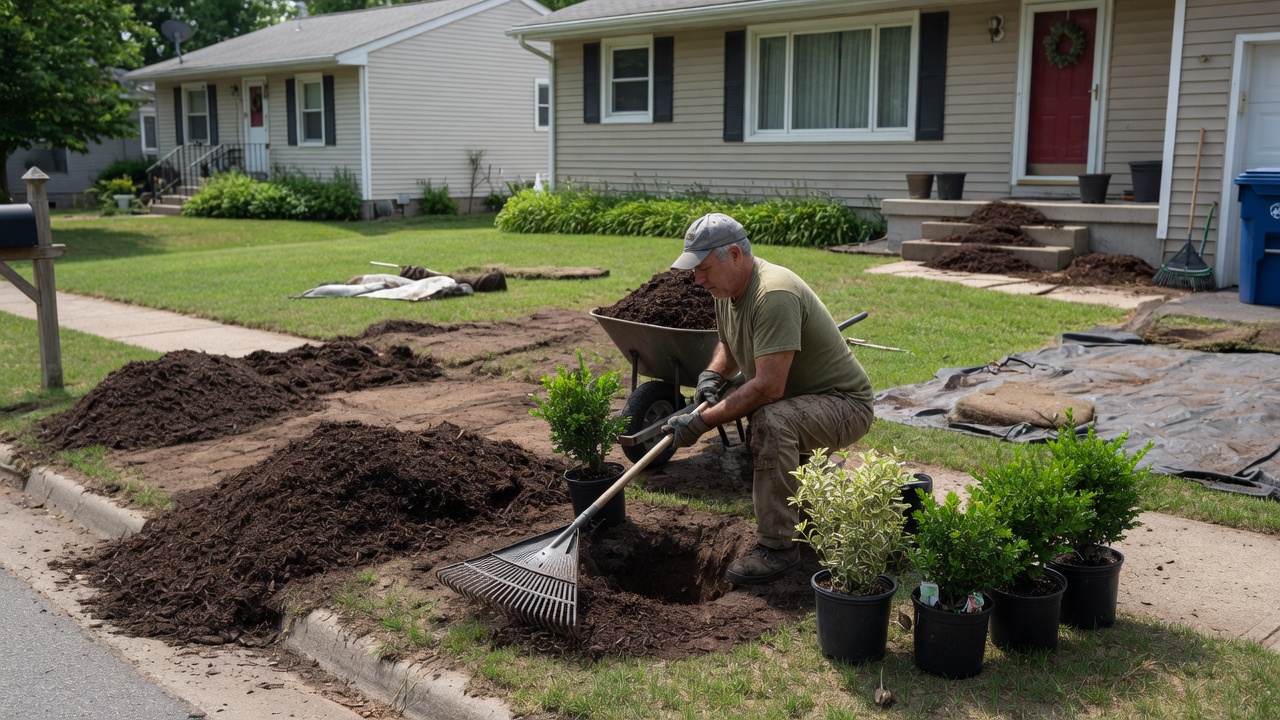
Landscaping & Yard Makeover Blueprint
Blueprint Course
Landscaping & Yard Makeover Blueprint
Project-based outdoor transformations beyond mowing.
This course builds a project-based landscaping business: mulch installs, bed renovations and fresh edging, sod, small dry-laid hardscape, and seasonal cleanups. You are not building a mowing route — you are selling one-time transformations that people photograph and show their neighbors. Every money example uses one base case: 6 projects a month at a $1,150 average project price, about $520 per project in materials, disposal, rentals, and helper hours, and about $310 a month in fixed costs. That works out to roughly $3,470 a month before tax in a good working-season month, with typical season months landing anywhere from about $950 to $3,470 before tax depending on how many projects you land. Those are ranges under stated assumptions, not promises — no income is guaranteed. You will learn to measure and quote by the unit, collect deposits so you never float a customer's materials, and get through a job day without wrecking your back.
What you get
Built for operators who want a clear path — not a pile of generic tips.
The base case
One worked example, not a target
Planning estimates, before tax and before anything you pay yourself — no income is guaranteed. Your own prices, volume and costs will differ; the course walks you through replacing every number here with yours.
Who this fits
- You like finishing things — a yard that looked one way this morning and another way tonight
- You can measure, do arithmetic, and write a quote without guessing
- You are physically capable of moving several tons of material in a week and want to be smart about how
- You would rather sell a $1,200 project once than chase $50 a week forever
- You can talk a homeowner out of a bad idea and into the version you can actually build
Honest risks
- Project work is lumpy. A month with three signed jobs and a month with none both happen, and your bills do not care which one you are having.
- You buy materials before you get paid. Mulch, sod, and pavers are cash out the door days before the check comes in — under-collected deposits are the fastest way to run out of money while technically profitable.
- Estimating errors are permanent. A quote that is 30% short is not a lesson you can re-invoice for; you eat it and finish the job.
- Physical injury is the real business risk. Cubic yards of wet mulch, pallets of sod, and repetitive shoveling put your back and shoulders on the line, and an injured solo operator has zero revenue.
- Blades and small engines cause serious injuries: string trimmers throw debris, edger and sod-cutter blades do not care what they hit, and plate compactors crush feet.
- Digging without locating utilities can strike a gas, electric, water, or fiber line — a catastrophic-cost mistake and, in most places, a legal one.
- Seasonality is severe. In a four-season climate you may have eight working months and four near-zero ones, so the season has to fund the winter.
- Scope creep from friendly customers ('while you're here...') quietly converts a profitable project into an unpaid weekend.
Who should skip this one
- You need steady weekly income starting now — project work is lumpy by nature, the first signed job can be six weeks out, and no income is guaranteed.
- You cannot safely move heavy material. This business runs on cubic yards and pallets; if lifting is already a problem, the injury is not a risk, it is a schedule.
- You will not measure and write quotes. Eyeballing a mulch job is how you buy a customer's yard improvements with your own money.
- You have no cash cushion for materials. If you cannot buy $500 of mulch before a customer pays you, you will be trapped taking only tiny jobs.
- You want recurring, predictable revenue with the same customers every week — that is the lawn care route business, and lawn-care-blueprint teaches it properly.
- You plan to build retaining walls, do grading, or run equipment on day one. This course keeps hardscape deliberately small and tells you where your limit is.
Curriculum
10 modules · 40 lessons · 2 hr 30 min of reading
01What This Business Really Is: Projects, Not Routesfree sample4 lessons · 15 min
The transformation business explained honestly — what you sell, what a month of it pays before tax, what the season does to your bank account, and whether you actually want it.
- The Transformation You Sell(free sample below)4 min
- The Math of a Makeover Month4 min
- The Shape of a Season: Eight Months of Money, Twelve Months of Bills4 min
- Founder Fit: The Honest Go/No-Go3 min
02Startup Costs and Setup: $2,600 Required, $4,150 Typical3 lessons · 12 min
Exactly what the money buys, the hauling reality nobody mentions until the trailer is overloaded, and the boring money plumbing that keeps a project business solvent.
- The Required List, Line by Line4 min
- Truck, Trailer, and the Weight You Actually Haul4 min
- Money Plumbing for a Project Business4 min
03Equipment, Materials, and Working Without Getting Hurt4 lessons · 15 min
The core kit and what to rent instead, how to buy material by the yard and the square foot without over-ordering, and the safety system that keeps a solo operator earning.
- The Core Kit — and What to Rent Instead3 min
- Buying Material by the Yard, the Roll, and the Ton4 min
- The Body Is the Machine: Lifting, Loading, and Lasting4 min
- Blades, Engines, and What Is Buried Under the Yard4 min
04Services and Pricing5 lessons · 19 min
The five services you sell, unit pricing that survives contact with a real yard, the 45% job-cost rule, how to estimate without losing your shirt, and the deposit policy that keeps you solvent.
- The Five Services You Sell4 min
- Price by the Unit, Quote by the Project4 min
- The 45% Rule: What Every Project Actually Costs You4 min
- Estimating Without Losing Your Shirt4 min
- Deposits: Never Float a Customer's Materials3 min
05Legal, Insurance, and Taxes4 lessons · 16 min
Education only, never advice: structure and licensing, the contractor-license line that catches hardscape work, the coverage a dirt-moving business carries, and the tax habits that keep April boring.
- Structure and Licensing: What Is Commonly Required4 min
- The Contractor License Line — Where Hardscape Gets Regulated4 min
- Insurance a Dirt-Moving Business Actually Carries4 min
- Taxes and the Set-Aside Habit4 min
06Branding and Being Findable3 lessons · 11 min
A name that fits a project business, the photo portfolio that does your selling for you, and the free listings and yard signs that make you the obvious local call.
- Naming a Project Business3 min
- The Before-and-After Portfolio That Sells For You4 min
- Free Listings, Yard Signs, and the Three-Sentence Pitch4 min
07Marketing: Your First 10 Customers5 lessons · 18 min
A concrete sequence to ten paid projects — warm circle, two portfolio jobs, the neighbor cluster while you are already on the street, referral partners, and the seasonal timing that fills spring.
- The First 10 Plan4 min
- The Two Portfolio Projects3 min
- The Warm Circle Announcement3 min
- The Neighbor Cluster: Selling the Street You Are Already On4 min
- Referral Partners and Selling Spring in February4 min
08Service Delivery: Running a Makeover Project5 lessons · 19 min
From the walkthrough and written scope to the job-day sequence, the quality standards customers actually notice, where your hardscape limit is, and the reveal that gets you paid.
- The Walkthrough and the Written Scope4 min
- Job Day: Sequence, Staging, and Site Protection4 min
- The Quality Standards Customers Actually Notice4 min
- Small Hardscape: Base, Slope, and Knowing Your Limit4 min
- The Reveal, the Punch List, and Getting Paid3 min
09Reviews, Referrals, and Repeat Work3 lessons · 11 min
How a one-time project business builds compounding demand: reviews collected at the peak, a yard plan that turns one project into three, and when to hand a customer to the recurring sibling business.
- The Review Engine3 min
- Turning One Project Into a Yard Plan4 min
- The Recurring Sibling: When to Add Maintenance4 min
10Growth, Pricing Power, and the Off-Season4 lessons · 14 min
When a helper actually pays for itself, how to raise prices and shed bad jobs without drama, how to survive the months with no revenue, and the commitment that turns this course into a business.
- Your First Helper and When the Math Works4 min
- Raising Prices and Shedding the Wrong Jobs3 min
- The Off-Season Plan4 min
- Your Launch Commitment3 min
Why people buy this
Built for first-time operators who want a clear path — not generic AI chat.
Honest fit check
Who should start — and who should skip — so you don't waste months on the wrong business.
Do-this-next lessons
Every lesson ends in an action: scripts, checklists, pricing math you can use this week.
One-time purchase
One payment of $59. No course subscription.
Landscaping & Yard Makeover Blueprint is part of the OwnerLaunch founding library. Figures in the course are planning estimates before tax — no income is guaranteed.
Blueprint FAQ
Why $59 for this Blueprint?+
You get a full operator course (10 modules, 40 lessons), a free sample lesson before you buy, downloadable templates after purchase, and a path into a personalized Launch Kit if you want one. It's a one-time payment — not a subscription for the course itself.
What do I get before I pay?+
The full curriculum outline, honest fit/risk lists, money base-case assumptions, a short course preview video when available, and one complete free sample lesson — real course content, not a teaser paragraph.
Is this legal, tax, or financial advice?+
No. OwnerLaunch is educational only. Licensing, insurance, tax, and filing requirements are location-dependent — verify with official sources and licensed professionals.
Can I upgrade to a Launch Kit later?+
Yes. Blueprint owners typically pay only the difference for a personalized Launch Kit (names, brand, pricing, copy, documents, 30-day plan). The course and kit are separate purchases.
Included templates & tools
- 30-Day Launch Checklist — The whole course compressed into four weeks: setup and safety, pricing and presence, portfolio projects, then your first paid makeovers.
- Estimate & Outreach Scripts — Word-for-word scripts for portfolio asks, the warm-circle announcement, the six-door neighbor knock, referral partners, the quote call, change orders, and the reveal.
- Project Scope & Agreement Template — The one-page written scope you send before ordering material: measurements, inclusions, exclusions, deposit and balance terms, dates, and the change-order line.
- Project Pricing Calculator — Hand-computed pricing: unit prices, a fully worked $1,330 example that sums line by line, the five job-cost buckets, and the monthly roll-up to the base case.
- Material Quantity Worksheet — The three conversion formulas you use in every driveway — mulch by the cubic yard, sod by the square foot, base gravel by the ton — worked out with checkable arithmetic.
- Yard Makeover Launch Readiness Quiz — Twelve questions on quantities, pricing, deposits, safety, licensing, and the base-case math — with a full answer key.
Free sample lesson
Real course content — not a teaser paragraph. The rest unlocks after purchase.
From module: What This Business Really Is: Projects, Not Routes
The Transformation You Sell
~4 min read
A yard makeover business sells change, not upkeep. A homeowner looks at tired beds, a soft mushy edge, bare dirt where grass gave up, and a walkway of wobbling stepping stones — and they want it to stop looking like that. You show up, spend a day or two, and hand back a yard that looks intentional. They pay once, for the result, and then they show it to everyone who visits.
That is a completely different business from mowing. Mowing is a route: the same customers, the same lot, every week, priced per visit. Makeover work is a project: a new customer, a fresh measurement, a written quote, materials bought up front, and a finish line. Route work rewards density and reliability. Project work rewards estimating and finishing. If you have read the lawn care blueprint, hold that model in one hand and this one in the other — they are siblings, not the same job.
- Mulch installs — the bread and butter, priced by the cubic yard installed
- Bed renovation and fresh edging — cleanout, a crisp cut edge, new mulch; the highest-impact-per-dollar job you sell
- Sod installs — small patches and small lawns, priced by the square foot
- Small dry-laid hardscape — stepping stones, a short paver walkway, a fire-pit surround; kept small on purpose
- Seasonal cleanups — spring and fall, the jobs that fill the calendar around the big projects
Action · task
Walk three yards and name the projects
Walk your own yard and two others you can see from the street. For each one, write down the single project that would change how the yard reads from the curb — new edge and mulch, a sod patch, a cleanout, stepping stones. One project per yard, no wish lists. You are training the eye that writes quotes.
Ready to make it yours?
A Launch Kit turns this Blueprint into your business: personalized name, brand, pricing, website copy, documents, and Action Plan.
Basic
$119 current
Pro
$199 current
Apply your Blueprint credit to Basic for +$60 or Pro for +$140.
More Blueprints
Related course · Home Services
Lawn Care Business Blueprint
From honest fit-check to first customer — one short, practical step at a time.
Related course · Home Services
Junk Removal Blueprint
Launch a junk removal business — from your first trailer load to a repeatable local operation.
Related course · Home Services
Snow Removal Blueprint
Winter revenue for cold-climate service businesses.
Recommended next · Home Services
Residential Cleaning Business Blueprint
Launch a solo residential cleaning business — from first supply kit to a recurring weekly client base.
Recommended next · Home Services
Mobile Detailing Business Blueprint
Launch a mobile detailing business from your driveway to your first paying route.
Recommended next · Home Services
Pressure Washing Blueprint
Launch a pressure washing business where before/after photos do the selling.
Every figure assumes a solo U.S. operator with access to a pickup truck, hiring occasional day-rate help, doing residential yard projects with no employees on payroll. The base case throughout is 6 projects a month at a $1,150 average project price, about $520 per project in materials, disposal, rentals, and helper hours, and about $310 a month in fixed costs, which leaves about $3,470 a month before tax. All money figures are estimates under stated assumptions, always before tax, and always before anything you pay yourself; outcomes depend on your market, your prices, your mix, and your effort, and no income is guaranteed. These figures are not inherited from the Discover profile for this niche, so all market prices here are OwnerLaunch planning estimates to verify locally. Legal, licensing, insurance, and tax lessons are education only, not professional advice — requirements vary by state, county, and city, and OwnerLaunch does not file anything for you.
Educational guidance only — not legal, tax, or financial advice.Details
OwnerLaunch provides educational business guidance, AI-generated drafts, and checklists. It is not a law firm, tax advisor, CPA, registered agent, or government agency. Information may not be complete or current for your specific location. Always verify requirements with official federal, state, city, and county sources and consult qualified professionals when needed.