
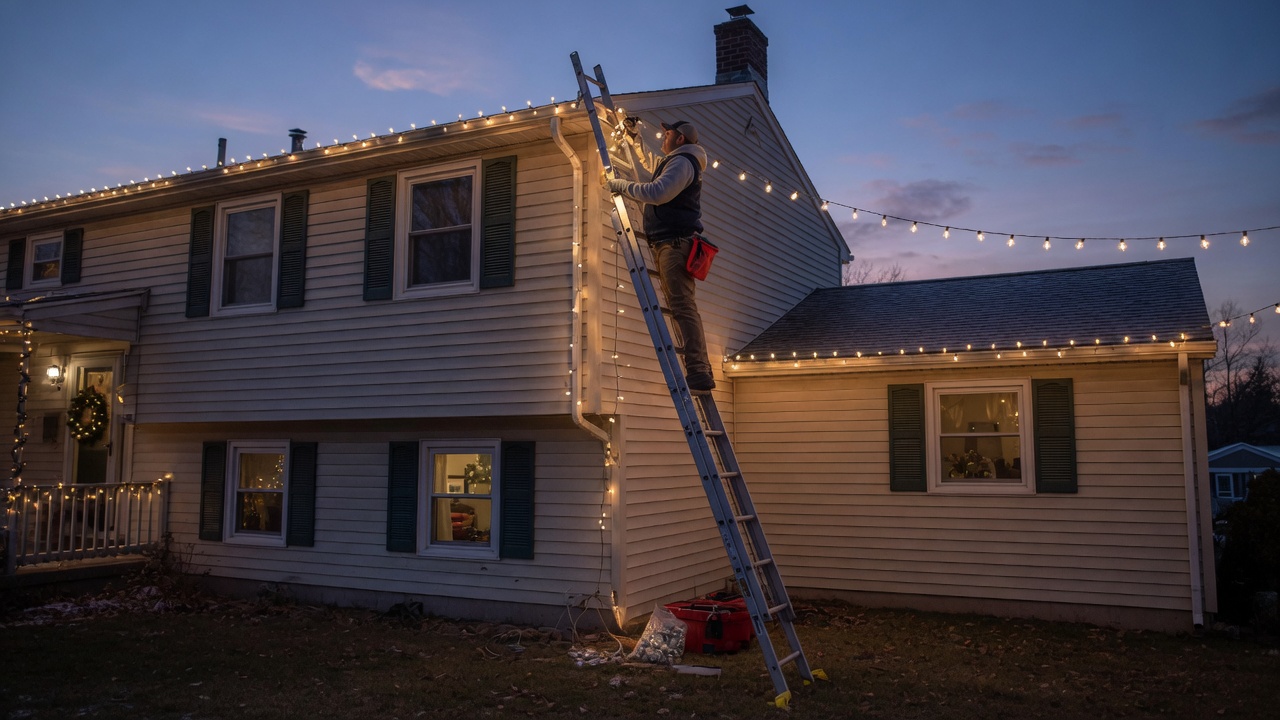
Holiday Light Installation Blueprint
Blueprint Course
Holiday Light Installation Blueprint
Short season, strong tickets, early-bird bookings.
This course takes you from zero to a working holiday light installation business: what the work really is, why the whole year compresses into about eight selling weeks, how to buy commercial-grade lights and decide whether to lease or sell them, how to work safely on ladders and rooflines with electricity in the mix, how to price install-plus-takedown packages instead of hours, how to land your first 10 customers before Halloween, and what to do with the other eight months of the year. It is built for a solo operator starting with roughly $1,500 to $3,500 — most of it initial commercial-grade light inventory, clips, outdoor-rated cords, timers, an extension ladder, and first insurance. Every money example uses the same explicit base case, because these figures are not inherited from the Discover profile for this course: 2 to 4 installs per week during the roughly 8-week October-to-early-December install peak, at $500 to $1,500 per house for a package that includes the lights (leased or sold), installation, a mid-season service promise, January takedown, and storage-ready labeling. That pencils out to roughly $4,000 to $15,000 in profit before tax for a typical first season under the base case — earned almost entirely between October and January, with near-zero revenue February through September. These are planning estimates, not local facts: verify pricing against your own market before you set yours. Your results depend on your market, your pricing, your weather window, and your effort; no income is guaranteed.
What you get
Built for operators who want a clear path — not a pile of generic tips.
The base case
One worked example, not a target
Planning estimates, before tax and before anything you pay yourself — no income is guaranteed. Your own prices, volume and costs will differ; the course walks you through replacing every number here with yours.
Who this fits
- You are steady and methodical on ladders and comfortable working along rooflines in cold weather
- You want a high-ticket seasonal business you can run alongside a job or another service business, not a year-round replacement income
- You can front $1,500–$3,500 for light inventory and equipment weeks before the first customer pays
- You are organized enough to run a compressed calendar: quoting in September and October, installing hard through early December, taking down in January
- You already run (or plan to run) a complementary service like gutter cleaning, window cleaning, or pressure washing and want a strong Q4 revenue leg
Honest risks
- Falling is the defining physical risk: installs mean hours on an extension ladder at rooflines, often in cold, wind, or early darkness. One shortcut — bad ladder angle, overreaching, frosty rungs, stepping onto a steep or wet roof — can end the business and worse. The safety rules in Modules 3 and 4 are non-negotiable.
- Electricity is the second defining risk: you are stringing powered lines across wet rooflines for weeks at a time. Skipping GFCI protection, overloading circuits, or using indoor-rated cords outdoors risks shock and fire — for you during install and for the customer all season.
- Extreme seasonality is structural, not a surprise: roughly eight install weeks decide the whole year. Weather, illness, or a slow start in that window cannot be made up later, and revenue is near zero February through September. Operators who spend December income like a monthly average go broke by spring.
- Cash flows backward at the start: you buy $1,500–$3,500 of lights and equipment in September and October, before customers pay. Underpricing the package or overbuying inventory can consume the whole season's margin.
- Property damage is easy at height: dented gutters, cracked roof tiles, crushed shrubs, staples through wiring (never staple), and clip damage to shingles all come out of your pocket or your insurance — and one bad claim can erase a season.
- Mid-season service calls are part of the product: a section going dark on December 20th is your problem at your cost. Price the package to include service, or watch margin disappear one outage at a time.
Who should skip this one
- You need steady, year-round income from this one business — holiday lighting earns essentially all of its money October through January and close to nothing February through September. A strong December tells you nothing about April, and no income is guaranteed.
- You are uneasy on ladders, unwilling to follow roof-work limits, or tempted to push on in wind, rain, or ice — this is ladder and roofline work in the worst weather months, and falls from ladders are a leading cause of serious work injuries.
- You will not treat electricity with respect — every installation must run through GFCI protection with outdoor-rated cords and connections, and if load math and weatherproofing sound like optional details, this business will eventually burn you or a customer.
- You cannot float the startup cash — commercial-grade lights, clips, cords, and a ladder cost $1,500–$3,500 up front, purchased in early fall before a single customer has paid you.
- You want to wing the calendar — miss the September–October booking window and the season is simply gone until next year; there is no catching up in January.
Curriculum
10 modules · 31 lessons · 1 hr 43 min of reading
01Is Holiday Light Installation Right for You?free sample3 lessons · 10 min
What the work actually looks like, the honest math of an eight-week season, and a clear go/no-go decision before you spend a dollar on lights.
- What the Work Really Is3 min
- The Math of an 8-Week Season(free sample below)4 min
- Who This Fits — and the Go/No-Go Call3 min
02Startup Costs and Setup3 lessons · 11 min
The real $1,500–$3,500 budget line by line, the lease-versus-sell decision that shapes your whole business, and the boring setup that makes October possible.
- The $1,500–$3,500 Startup Budget, Line by Line4 min
- Lease or Sell the Lights: Your Business Model4 min
- The Boring Setup That Makes October Work3 min
03Equipment, Lights, and Ladder & Roof Safety4 lessons · 13 min
Commercial-grade lights versus store lights, the clip-and-cord kit, and the ladder and roof rules that keep you alive through an eight-week season at height.
- Commercial-Grade vs. Store Lights3 min
- Clips, Cords, and Timers: The Attachment Kit3 min
- Ladder Safety: The Non-Negotiables4 min
- Roof Work Limits and Walk-Away Rules3 min
04Electrical Safety and Load Planning3 lessons · 10 min
GFCI protection, outdoor-rated everything, the load math that prevents tripped breakers and fires, and weatherproofing that survives a wet December.
- GFCI and Outdoor-Rated Everything3 min
- Load Math Before You Hang4 min
- Weatherproofing Connections for a Wet Season3 min
05Packages and Pricing3 lessons · 10 min
Price the package from real costs — never by the hour — build three tiers customers can choose between, and structure deposits, takedown, and next-year rebooking into every quote.
- Price the Package, Not the Hour4 min
- Three Tiers, Deposits, and the Quote That Closes3 min
- Takedown, Storage, and the Rebooking Engine3 min
06Legal, Insurance, and Taxes3 lessons · 9 min
Education only — the licenses and registrations commonly required, the insurance that makes ladder work survivable, and the seasonal-income tax habits that prevent an April disaster. Everything here is location-dependent: verify locally.
- Business Basics: Registration and Licenses3 min
- Insurance: Non-Negotiable at Height3 min
- Taxes When All Your Income Lands in Q43 min
07Branding and Being Findable3 lessons · 9 min
A trustworthy seasonal brand, a Google Business Profile that works while you sleep, and the September-to-November marketing calendar that fills an eight-week season.
- A Brand Customers Trust With Their Roofline3 min
- Your Google Business Profile: The Free Storefront3 min
- The Early-Bird Marketing Calendar3 min
08Your First 10 Customers3 lessons · 11 min
The anchor-house play, warm-network and neighborhood outreach that fills October, and a doorstep quote process that turns walkthroughs into deposits the same day.
- Start With an Anchor House3 min
- Warm Network First, Then the Right Doors4 min
- The Quote Walkthrough That Closes Same-Day4 min
09Service Delivery: Install Day to Season's End3 lessons · 10 min
A repeatable install-day runbook, the mid-season service system that protects your reviews, and a takedown operation that sets up next year.
- The Install-Day Runbook4 min
- Mid-Season Service: The Promise That Sells the Package3 min
- Takedown and Storage Operations3 min
10Reviews, Rebooking, and the Other Eight Months3 lessons · 10 min
The review engine that compounds season over season, the rebooked route that beats all marketing, and the honest answer to February through September: pair this business or plan around it.
- The Review Engine3 min
- The Rebooked Route Beats All Marketing3 min
- The Other Eight Months: Pair It or Plan It4 min
Why people buy this
Built for first-time operators who want a clear path — not generic AI chat.
Honest fit check
Who should start — and who should skip — so you don't waste months on the wrong business.
Do-this-next lessons
Every lesson ends in an action: scripts, checklists, pricing math you can use this week.
One-time purchase
One payment of $59. No course subscription.
Holiday Light Installation Blueprint is part of the OwnerLaunch founding library. Figures in the course are planning estimates before tax — no income is guaranteed.
Blueprint FAQ
Why $59 for this Blueprint?+
You get a full operator course (10 modules, 31 lessons), a free sample lesson before you buy, downloadable templates after purchase, and a path into a personalized Launch Kit if you want one. It's a one-time payment — not a subscription for the course itself.
What do I get before I pay?+
The full curriculum outline, honest fit/risk lists, money base-case assumptions, a short course preview video when available, and one complete free sample lesson — real course content, not a teaser paragraph.
Is this legal, tax, or financial advice?+
No. OwnerLaunch is educational only. Licensing, insurance, tax, and filing requirements are location-dependent — verify with official sources and licensed professionals.
Can I upgrade to a Launch Kit later?+
Yes. Blueprint owners typically pay only the difference for a personalized Launch Kit (names, brand, pricing, copy, documents, 30-day plan). The course and kit are separate purchases.
Included templates & tools
- 30-Day Preseason Launch Checklist — The whole course sequenced into four weeks of concrete tasks — designed to be started in September so you enter October ready to sell and install.
- Early-Bird Outreach & Sales Scripts — Word-for-word scripts for the warm-network text, neighborhood post, doorstep pitch, quote follow-up, urgency message, and the takedown rebooking ask — edit into your own voice.
- On-Site Quote Sheet Template — A fill-in-the-blanks quote sheet for the 15-minute walkthrough: measurements, outlet checks, design notes, three-tier presentation, and the deposit close — doubles as the start of the customer's job sheet.
- Package Pricing Calculator — The by-hand worksheet that builds each tier's price from real costs: materials per house, install + takedown labor, service reserve, fixed-cost share, and your before-tax margin at each price point.
- Ladder & Electrical Safety Self-Check — Ten questions covering the non-negotiables from Modules 3 and 4 — take it before your first install and again before your first week of season. Answers at the bottom; anything missed means re-reading the lesson, not guessing again.
Free sample lesson
Real course content — not a teaser paragraph. The rest unlocks after purchase.
From module: Is Holiday Light Installation Right for You?
The Math of an 8-Week Season
~4 min read
Here is the base case this whole course uses — and because these figures are not inherited from the Discover profile for it, treat every number as a planning estimate to check against your own area. Install season runs roughly mid-October to early December: about 8 workable weeks. You complete 2 to 4 installs per week at $500 to $1,500 per house, where the package includes commercial-grade lights (leased or sold into the price), installation, mid-season service, and January takedown. Call the middle of that 3 installs at $900: about $2,700 a week, or roughly $21,600 across the season. Revenue is not profit.
- Season revenue: 2–4 installs/week × ~8 weeks × $500–$1,500 = roughly $8,000–$48,000
- Variable costs: roughly $200–$450 per job in year one (lights and clips allocated to the job, cords, fuel) = $3,200–$14,400
- Fixed costs: about $200/month across the ~4 active months (insurance, phone, marketing) = about $800
- Left over: a typical first season lands roughly $4,000–$15,000 before tax — the top of the revenue range takes premium pricing AND a full calendar AND smooth weather
Now the part most new operators skip: that is the whole year. January is takedowns you already priced into the package. February through September, revenue is near zero — no averaging, no smoothing, no catching up. Spread $4,000–$15,000 across twelve months and this is clearly a strong seasonal leg, not a livelihood. That is exactly why Module 10 pairs it with off-season services like gutter cleaning, window cleaning, or pressure washing, and why year two is better than year one: leased lights are already paid for, and rehangs for returning customers cost you a fraction of a new install. Verify local package prices before believing any line above. No income is guaranteed.
Action · worksheet
Build your own season math
Copy the four lines above and change the inputs: how many install days per week can you actually work in October and November given your job, daylight, and weather? Search for professional holiday lighting prices in your area (or the nearest metro) and replace the $500–$1,500 range with what you find. Recalculate one season, before tax. Then divide by 12 and look at the monthly number honestly. Keep this sheet — you will refine it with the Package Pricing Calculator resource in Module 5.
Ready to make it yours?
A Launch Kit turns this Blueprint into your business: personalized name, brand, pricing, website copy, documents, and Action Plan.
Basic
$119 current
Pro
$199 current
Apply your Blueprint credit to Basic for +$60 or Pro for +$140.
More Blueprints
Related course · Home Services
Gutter Cleaning Blueprint
Launch a gutter cleaning business built around two big seasons and a repeat route.
Related course · Home Services
Window Cleaning Blueprint
Launch a residential window cleaning route with a few hundred dollars of gear and a repeatable safety routine.
Recommended next · Home Services
Lawn Care Business Blueprint
From honest fit-check to first customer — one short, practical step at a time.
Recommended next · Home Services
Residential Cleaning Business Blueprint
Launch a solo residential cleaning business — from first supply kit to a recurring weekly client base.
Recommended next · Home Services
Mobile Detailing Business Blueprint
Launch a mobile detailing business from your driveway to your first paying route.
This course independently states the following seasonal planning estimates: an October-to-January business selling install + takedown packages at $500–$1,500 per house including commercial-grade lights (leased or sold into the package), 2 to 4 installs per week across the roughly 8-week October-to-early-December install peak, about $200–$450 in variable cost per job in year one and about $200 per active month in fixed costs, penciling out to roughly $4,000–$15,000 in profit before tax for a typical first season — with near-zero revenue February through September, so annual and monthly averages land far below peak weeks. Startup runs roughly $1,500–$3,500, mostly initial light inventory, clips, cords, timers, an extension ladder, and first insurance. All figures are estimates to verify against your own market (local competitor package prices, current supplier prices, real insurance quotes) before you rely on them; actual results vary with market, season length, weather, pricing, and effort, and no income is guaranteed. Legal, licensing, insurance, electrical-code, and tax content in this course is location-dependent education, not legal, tax, electrical, or professional advice — verify requirements locally, and refer hardwired or house-wiring work to a licensed electrician.
Educational guidance only — not legal, tax, or financial advice.Details
OwnerLaunch provides educational business guidance, AI-generated drafts, and checklists. It is not a law firm, tax advisor, CPA, registered agent, or government agency. Information may not be complete or current for your specific location. Always verify requirements with official federal, state, city, and county sources and consult qualified professionals when needed.