
Window Cleaning Blueprint
Blueprint Course
Window Cleaning Blueprint
Launch collection candidateLaunch a residential window cleaning route with a few hundred dollars of gear and a repeatable safety routine.
This course takes you from zero to a working residential window cleaning business: what the work really is, what it costs to start, what to buy, how to price per pane instead of per hour, how to land your first 10 customers, and how to work on ladders without getting hurt. It is built for a solo operator starting with roughly $300 to $800 — a professional squeegee kit at the low end, an entry-level water-fed pole added at the high end. Because these figures are not inherited from the Discover profile for this trade, every money example uses one explicit base case: 4 to 6 houses a week at a $120–$180 average ticket, about $10 in fuel and supplies per job, and about $150 a month in fixed costs. Run full, that pencils out to a typical range of roughly $1,700 to $4,200 a month in profit before tax — a planning estimate and a range, never a promise. Your results depend on your market, your prices, and your effort; no income is guaranteed. One thing this course will not compromise on: ladder work is the defining risk of this business, and the safety module is not optional reading.
What you get
Built for operators who want a clear path — not a pile of generic tips.
The base case
One worked example, not a target
Planning estimates, before tax and before anything you pay yourself — no income is guaranteed. Your own prices, volume and costs will differ; the course walks you through replacing every number here with yours.
Who this fits
- You are comfortable working on ladders and can stay calm and methodical at height
- You like repeat route work — the same houses on a 2–6 month cadence — more than one-off jobs
- You are detail-obsessed enough to chase a single streak across a picture window
- You want one of the cheapest startups in home services: a few hundred dollars, not thousands
- You can hold a friendly two-minute conversation at a stranger's front door
Honest risks
- Falls from ladders are the defining risk: window cleaning routinely puts you 10–20 feet up on other people's uneven lawns and hard driveways. Falls from height are a leading cause of serious injury in ladder trades, and an injury stops all revenue.
- Property damage claims: a slipped scraper scratches glass, a ladder foot gouges a deck, wash water stains cedar siding. Insurance is non-negotiable.
- Weather runs your calendar — rain, wind, and freezing temperatures cancel or compress route days, and winter demand drops in cold climates.
- Low startup cost means low barrier to entry: competitors with a bucket and a squeegee can undercut you, so you win on reliability and reviews, not price.
- It is physical work: climbing, carrying a ladder, and repetitive overhead arm work all day wears on shoulders and knees.
- Route income takes months to build — the model only gets comfortable once repeat customers are stacked on a cadence.
Who should skip this one
- You are afraid of heights or freeze up on a ladder — most residential routes include second-story glass, and a hesitant climber is a dangerous climber. This is a genuine disqualifier, not a skill gap you push through.
- You will not carry general liability insurance from job one — you are working with ladders and water against other people's glass, siding, and landscaping, and one cracked pane or ladder gouge can erase a month of profit before tax.
- You need dependable income immediately — the first-10-customers plan takes weeks of unpaid door-knocking and no income is guaranteed.
- You will skip the setup routine when you are tired or behind schedule — ladder accidents happen on the fifth house of the day, not the first, and this business punishes shortcuts with injuries.
Curriculum
10 modules · 32 lessons · 1 hr 43 min of reading
01Is Window Cleaning Right for Youfree sample3 lessons · 10 min
Before you buy a squeegee, understand the job: route work, ladder work, and detail work — and whether all three fit you.
- What the Work Really Is(free sample below)4 min
- The Money: An Honest Look3 min
- Go or No-Go3 min
02Startup Costs and Setup3 lessons · 9 min
What the $300–$800 actually buys, what you can skip at the start, and the boring setup steps that make you a real business.
- Where the $300–$800 Goes3 min
- The Setup That Makes You Real3 min
- Lean Start or Full Kit?3 min
03Equipment and Supplies3 lessons · 10 min
The exact kit that cleans glass streak-free: hand tools, the ladder decision, the water-fed pole, and the consumables that quietly run out.
- The Core Hand Kit4 min
- Ladders and Water-Fed Poles4 min
- Consumables and the Restock Habit2 min
04Services and Pricing4 lessons · 13 min
Build a simple menu, price per pane and per job from your real costs — never by the hour — and quote with confidence at the door.
- Your Service Menu3 min
- Price Per Pane, Not Per Hour4 min
- Quoting at the Door3 min
- Minimums, Cadence, and Upsells3 min
05Legal, Insurance, and Taxes3 lessons · 10 min
Education only — what is commonly required, why insurance comes before your first ladder, and how to not get surprised by taxes. Verify everything locally.
- Licenses and Registration3 min
- Insurance Before the First Ladder4 min
- Taxes and the Set-Aside3 min
06Branding and Being Findable3 lessons · 9 min
A trustworthy name and look, a Google Business Profile that collects your reviews, and photos of glass that actually sell.
- A Name and Look That Books Jobs3 min
- Your Google Business Profile3 min
- Photos That Sell Glass3 min
07Marketing: Your First 10 Customers4 lessons · 13 min
A four-step sequence — warm circle, door hangers, local groups, and the cadence close — that builds your first route without an ad budget.
- Start With Your Warm Circle3 min
- The Door-Hanger Neighborhood Loop4 min
- Local Groups and Nextdoor3 min
- Close the Cadence: 10 Customers Into a Route3 min
08Ladder Safety and Working at Height3 lessons · 10 min
The module that keeps you in business and out of the ER: setup rules, the every-house checklist, and the jobs a smart solo operator declines.
- Respect the Risk3 min
- The Setup Rules4 min
- The Jobs You Decline3 min
09Service Delivery: Running Clean Jobs3 lessons · 10 min
The on-site routine that protects homes, produces streak-free glass, and turns one visit into a rebooking.
- The Job-Day Routine3 min
- Technique That Scales4 min
- Hard Water, Paint Specks, and the Bad Day3 min
10Reviews, Referrals, and Route Growth3 lessons · 9 min
The review engine, the arithmetic of a repeat route, and the honest decision about what growing past solo really costs.
- The Review Engine3 min
- The Route Math3 min
- Growing Past Solo — Honestly3 min
Why people buy this
Built for first-time operators who want a clear path — not generic AI chat.
Honest fit check
Who should start — and who should skip — so you don't waste months on the wrong business.
Do-this-next lessons
Every lesson ends in an action: scripts, checklists, pricing math you can use this week.
One-time purchase
One payment of $59. No course subscription.
Window Cleaning Blueprint is part of the OwnerLaunch founding library. Figures in the course are planning estimates before tax — no income is guaranteed.
Blueprint FAQ
Why $59 for this Blueprint?+
You get a full operator course (10 modules, 32 lessons), a free sample lesson before you buy, downloadable templates after purchase, and a path into a personalized Launch Kit if you want one. It's a one-time payment — not a subscription for the course itself.
What do I get before I pay?+
The full curriculum outline, honest fit/risk lists, money base-case assumptions, a short course preview video when available, and one complete free sample lesson — real course content, not a teaser paragraph.
Is this legal, tax, or financial advice?+
No. OwnerLaunch is educational only. Licensing, insurance, tax, and filing requirements are location-dependent — verify with official sources and licensed professionals.
Can I upgrade to a Launch Kit later?+
Yes. Blueprint owners typically pay only the difference for a personalized Launch Kit (names, brand, pricing, copy, documents, 30-day plan). The course and kit are separate purchases.
Included templates & tools
- 30-Day Launch Checklist — The whole course sequenced into four weeks — from ladder test to first route customers.
- Neighbor Loop and Warm-Circle Scripts — Word-for-word scripts for the warm-circle text, the next-door knock, the group post, and the cadence and review asks.
- Walkaround Quote Sheet — A fill-in template for counting panes, pricing add-ons, and delivering one confident number at the door.
- Pricing Calculator Worksheet — Compute your real cost per job, your break-even, and your before-tax margin at three price points — by hand, with your own numbers.
- Ladder Safety Pre-Climb Checklist — The printable every-placement checklist from Module 8, plus the decline list and weather vetoes.
- Launch Readiness Self-Check — Fifteen honest questions across safety, pricing, legal, and marketing — with the lesson to revisit for any miss.
Free sample lesson
Real course content — not a teaser paragraph. The rest unlocks after purchase.
From module: Is Window Cleaning Right for You
What the Work Really Is
~4 min read
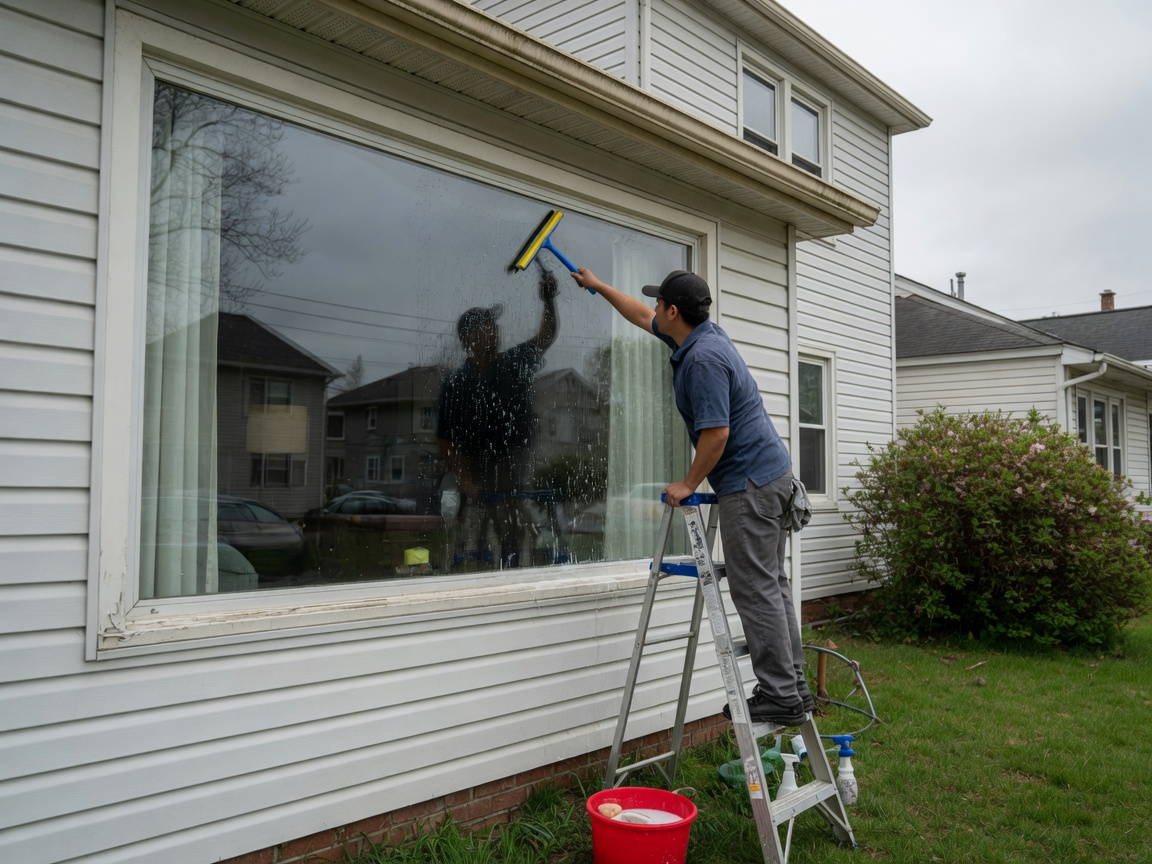
Residential window cleaning is route work: you clean the same houses on a repeating cadence — every two, three, or six months — and your business gets stronger every time a customer rebooks. A typical job is one to three hours at a single house: exterior glass, or interior and exterior, plus screens and tracks. You carry a ladder, a bucket, and a belt of hand tools, and you leave behind something the customer can see from every room in the house.
Two things make this trade unusual. First, it is one of the cheapest legitimate startups in home services — a few hundred dollars buys professional gear, which is why this course's base case starts at $300 to $800. Second, it puts you on a ladder at nearly every house. The low cost of entry is why competitors are everywhere; the ladder is why customers happily pay someone else to do it. Your edge is being the person who shows up on time, works safely, and gets the glass perfect.
- You sell three things: exterior-only cleans, full in-and-out cleans, and add-ons (screens, tracks, skylights, light fixture glass)
- The stable money is the repeat route — customers on a 2–6 month cadence
- The hidden job: ladder logistics and safety, every single house, every single day
- The base case this course uses: 4–6 houses a week at $120–$180 average, roughly $1,700–$4,200 a month profit before tax at full route — an estimate, not a promise
Action · task
The ladder test
Today, borrow or find a sturdy ladder and — with someone spotting you — climb to a comfortable working height (10+ feet) and stay there for two full minutes, moving your arms as if cleaning. Notice how your body reacts. Write one honest sentence: 'At height I felt ___.' If the answer is panic, this course's honest advice is to pick a ground-based business instead.
Ready to make it yours?
A Launch Kit turns this Blueprint into your business: personalized name, brand, pricing, website copy, documents, and Action Plan.
Basic
$119 current
Pro
$199 current
Apply your Blueprint credit to Basic for +$60 or Pro for +$140.
More Blueprints
Related course · Home Services
Pressure Washing Blueprint
Launch a pressure washing business where before/after photos do the selling.
Related course · Home Services
Residential Cleaning Business Blueprint
Launch a solo residential cleaning business — from first supply kit to a recurring weekly client base.
Recommended next · Home Services
Lawn Care Business Blueprint
From honest fit-check to first customer — one short, practical step at a time.
Recommended next · Home Services
Mobile Detailing Business Blueprint
Launch a mobile detailing business from your driveway to your first paying route.
Recommended next · Home Services
Handyman Services Blueprint
Turn small repairs and endless to-do lists into a trusted local business.
These figures are not inherited from the Discover profile for this course, so all figures are planning estimates the author derived from supply-retailer pricing and typical suburban market rates — verify them in your own market before relying on them. The base case throughout: a solo operator doing residential route work at 4–6 houses a week, a $120–$180 average ticket, about $10 in fuel and supplies per job, about $150 a month in fixed costs, and a $300–$800 startup (professional squeegee kit at the low end, entry-level water-fed pole at the high end). All profit figures are before tax and before anything you pay yourself. Ranges are typical planning outcomes, not guarantees — no income is guaranteed, and your market, prices, and effort decide where you land. Legal, tax, and insurance lessons are education only, not professional advice; requirements vary by state, county, and city. Ladder safety content is general education drawn from OSHA and NIOSH guidance, not site-specific safety training.
Educational guidance only — not legal, tax, or financial advice.Details
OwnerLaunch provides educational business guidance, AI-generated drafts, and checklists. It is not a law firm, tax advisor, CPA, registered agent, or government agency. Information may not be complete or current for your specific location. Always verify requirements with official federal, state, city, and county sources and consult qualified professionals when needed.