
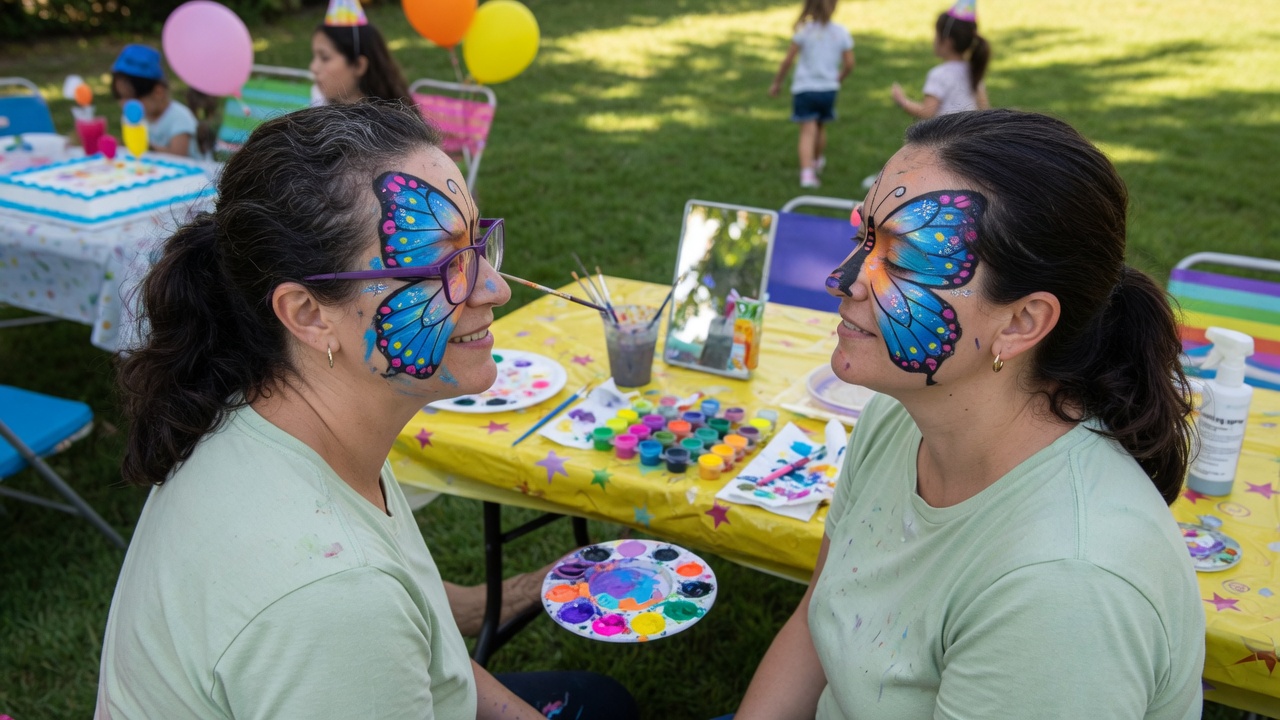
Face Painting & Kids' Entertainment Blueprint
Blueprint Course
Face Painting & Kids' Entertainment Blueprint
Weekend gigs that turn into party-circuit referrals.
This course takes you from painting your own kids at Halloween to running a booked face painting business that party parents pass around their group chats. Every money example uses the same explicit base case: kids' parties, festivals, and corporate or community events booked at $100 to $175 per event-hour with a 2-hour minimum, a working painter holding 2 to 5 bookings a week at steady state — heavily weekend-weighted — painting 8 to 15 quick designs an hour from a rehearsed menu, paint and supplies costing roughly $5 to $10 per event-hour, fixed costs around $75 to $150 a month, after a startup investment of $300 to $800 in a professional kit. Those are planning estimates for a typical U.S. market — ranges, not promises; no income is guaranteed, and all profit figures are before tax. Two numbers run this business. The first is faces per hour: your hourly rate is really 8 to 15 delighted kids at roughly $10 to $17 of value each, which is why speed on a small rehearsed menu — not a hundred Pinterest designs — is the core professional skill. The second is what goes on those faces: this course's non-negotiable is that ONLY cosmetic-grade paints made with color additives permitted for cosmetic use ever touch a child's skin. Craft paint, acrylic paint, and markers are never acceptable — the FDA's color-additive rules exist for exactly this reason — and your hygiene protocol (one sponge per face, sanitized brushes, clean water) is what separates a professional from a liability. Face painting is largely an unlicensed trade — no state board stands between you and your first paid party — so the legal module covers what is commonly required anyway: general business licensing, festival vendor permits, insurance event organizers ask about, and taxes, all framed the honest way: location-dependent, verified locally.
What you get
Built for operators who want a clear path — not a pile of generic tips.
The base case
One worked example, not a target
Planning estimates, before tax and before anything you pay yourself — no income is guaranteed. Your own prices, volume and costs will differ; the course walks you through replacing every number here with yours.
Who this fits
- You genuinely like kids and can stay warm and patient while a five-year-old changes her mind three times with a line of twelve more waiting
- You have steady hands and can learn fast, repeatable designs — professional face painting is speed and consistency on a small menu, not fine art
- Your weekends are available and you want them working — parties cluster on Saturday and Sunday afternoons, and festivals eat whole weekend days
- You take safety and hygiene seriously enough to follow a protocol every single face, even when the line is long and a parent is hovering
- You can promote yourself with photos and a booking link — this business is won on a portfolio of painted faces and fast, professional replies to party inquiries
Honest risks
- Skin safety is the career-ending risk: craft or acrylic paint on skin, a shared sponge, or ignoring a child's eczema flare can cause real harm to a child and end your business in one incident. The safety module is not optional reading — it is the trade.
- Demand is weekend-concentrated and seasonal — spring and summer party season and fall festivals boom while deep winter is quiet, and 2–5 bookings a week is a steady-state target, not a first-month expectation. No income is guaranteed in any month.
- Underpricing is the classic failure: painters who charge $50 an hour 'because it's fun' discover that prep, travel, setup, teardown, and brush cleaning turn a 2-hour party into 4-plus real hours — and the math stops working before tax, let alone after.
- Festivals can be a trap for beginners: booth fees, vendor permits, and 6-hour days at per-face prices only pay when your faces-per-hour speed is genuinely there — a slow painter loses money on the same booth where a fast painter has her best day of the month.
- Your body is the production line: a full festival day is six or more hours on a stool with your arms up, and there is no revenue when you are sick — which also means painting sick kids to protect a booking is a temptation you must refuse.
- Some jurisdictions and event organizers impose their own rules — vendor permits, insurance minimums, even product restrictions — and a painter who shows up without the paperwork an organizer requires forfeits the gig and the relationship.
Who should skip this one
- You are not actually comfortable around young children. The client is a squirmy, chatty, sometimes crying five-year-old, and no amount of artistic skill compensates for visible impatience at a birthday party.
- You will cut corners on safety to save money or time. If using the cheap craft paint 'just this once', reusing a sponge on a long line, or painting a child with an active rash to keep a parent happy sounds like a reasonable shortcut, this trade should not have you in it.
- You need dependable income every month right now. Bookings are weekend-concentrated, seasonal, and slow to build; the first weeks are mostly practice faces and discounted portfolio gigs — no income is guaranteed.
- You refuse weekend work. Parties happen Saturday and Sunday afternoons and festivals run whole weekends — a weekday-only face painter is choosing a hobby, not a business.
Curriculum
10 modules · 35 lessons · 1 hr 54 min of reading
01Is a Face Painting Business Right for Youfree sample4 lessons · 15 min
What the job actually is — a speed-and-safety trade with an artistic face — the faces-per-hour math that decides your income, an honest week and month under the base case, and a go/no-go decision before you spend a dollar on a kit.
- What This Business Really Is4 min
- The Throughput Lesson: Faces Per Hour(free sample below)4 min
- The Money: An Honest Week and Month4 min
- Founder Fit: The Go/No-Go Decision3 min
02Startup Costs and Your Professional Kit3 lessons · 10 min
Where the $300–$800 actually goes, the buy-first list that gets you gig-ready, and the beginner traps — cheap paint, giant palettes, and gear you don't need until you're booked.
- Where the $300–$800 Actually Goes4 min
- The Buy-First List: Gig-Ready, Not Collection-Ready3 min
- What Not to Buy (Yet)3 min
03Paint Safety: The Non-Negotiables4 lessons · 14 min
The centerpiece of this course: only cosmetic-grade, FDA-compliant products ever touch skin — never craft or acrylic paint; skin-sensitivity and patch-test awareness; the one-sponge-per-face hygiene protocol; and the professional judgment to say no.
- Cosmetic-Grade Only: Never Craft or Acrylic Paint4 min
- Sensitive Skin, Reactions, and Patch-Test Awareness3 min
- One Sponge Per Face: The Hygiene Protocol4 min
- When to Say No (and How)3 min
04Services and Pricing4 lessons · 14 min
Price the event from throughput and real costs — not from what feels nice for a hobby: the hourly-with-minimum party model, festival per-face math, corporate rates, and the deposit and travel policies that protect your weekends.
- Pricing the Event, Not Your Time-Feels4 min
- Party Packages and What's Included3 min
- Festival and Per-Face Pricing4 min
- Deposits, Travel, and the Policies That Protect Weekends3 min
05Legal, Insurance, and Taxes (Education, Not Advice)4 lessons · 12 min
Face painting is largely an unlicensed trade — but general business licensing, festival vendor permits, insurance organizers demand, and self-employment taxes are all real. Everything here is education, commonly-required framing, and location-dependent verification — never legal or tax advice.
- The Licensing Reality: Largely Unlicensed, Locally Variable3 min
- Festival Vendor Permits and Organizer Rules3 min
- Insurance: The Policy That Books Gigs3 min
- Taxes and the Set-Aside Habit3 min
06Your Design Menu and Speed3 lessons · 9 min
The 8–12 design menu board that controls your line, the practice system that gets each design to three-to-six minutes, and why crisp-and-fast beats elaborate-and-slow at every gig you'll ever work.
- The Menu Board: 8–12 Designs, Not 1003 min
- Practicing to Professional Speed3 min
- Quality at Speed: What Parents Actually See3 min
07Branding and Being Findable3 lessons · 9 min
A name parents can remember and spell, a portfolio built on real faces with real permission, and the free findability stack — Google Business Profile, Instagram, and a booking link — that turns party guests into next month's bookings.
- A Name Parents Remember at Pickup Time3 min
- Portfolio Photos — With Real Permission3 min
- The Free Findability Stack3 min
08Marketing: Your First 10 Customers4 lessons · 12 min
A four-lane plan to ten paid bookings: warm-circle outreach that doesn't feel like begging, parent groups and gig platforms, one visibility gig that seeds a season of referrals, and the fast-reply habit that wins every tie.
- The First 10 Plan3 min
- Warm-Circle Outreach Without the Cringe3 min
- Parent Groups, Nextdoor, and Gig Platforms3 min
- The Visibility Gig and Your First Recurring Venues3 min
09Service Delivery: Running a Great Event3 lessons · 10 min
The party runbook from confirmation text to packed-up kit, festival booth-day logistics that protect your margin and your back, and the corporate-gig polish that earns top-of-range rates and rebookings.
- Party Flow and Line Management4 min
- Festival Booth Day3 min
- Corporate and Community Gigs: The Top of Your Range3 min
10Reviews, Referrals, Operations, and Growth3 lessons · 9 min
The review engine that compounds every party, the weekly operations rhythm that keeps a weekend business sane, and the honest growth paths — higher rates, added services, and the second-painter decision.
- The Review and Referral Engine3 min
- The Weekly Operations Rhythm3 min
- Growth Paths: Rates, Add-Ons, and the Second Painter3 min
Why people buy this
Built for first-time operators who want a clear path — not generic AI chat.
Honest fit check
Who should start — and who should skip — so you don't waste months on the wrong business.
Do-this-next lessons
Every lesson ends in an action: scripts, checklists, pricing math you can use this week.
One-time purchase
One payment of $59. No course subscription.
Face Painting & Kids' Entertainment Blueprint is part of the OwnerLaunch founding library. Figures in the course are planning estimates before tax — no income is guaranteed.
Blueprint FAQ
Why $59 for this Blueprint?+
You get a full operator course (10 modules, 35 lessons), a free sample lesson before you buy, downloadable templates after purchase, and a path into a personalized Launch Kit if you want one. It's a one-time payment — not a subscription for the course itself.
What do I get before I pay?+
The full curriculum outline, honest fit/risk lists, money base-case assumptions, a short course preview video when available, and one complete free sample lesson — real course content, not a teaser paragraph.
Is this legal, tax, or financial advice?+
No. OwnerLaunch is educational only. Licensing, insurance, tax, and filing requirements are location-dependent — verify with official sources and licensed professionals.
Can I upgrade to a Launch Kit later?+
Yes. Blueprint owners typically pay only the difference for a personalized Launch Kit (names, brand, pricing, copy, documents, 30-day plan). The course and kit are separate purchases.
Included templates & tools
- 30-Day Face Painting Launch Checklist — The whole course sequenced into four weeks: safety standards and kit first, pricing and legal second, brand and practice third, outreach and first gigs fourth.
- Booking Inquiry Reply Scripts — Word-for-word replies for party inquiries, group recommendation threads, price pushback, and the corporate quote — built for the reply-within-the-hour standard.
- Party Booking Agreement & Intake Template — A one-page fill-in agreement covering the booking details, deposit and reschedule policy, safety and hygiene policies, photo permission with opt-out, and event-day logistics.
- Face Painting Pricing Calculator — Hand-computed worksheet: true cost per booking, the per-face value framing, before-tax margin at three price points, and the festival booth go/no-go model.
- Safety & Launch Readiness Quiz — A ten-question self-check on the non-negotiables — paints, hygiene, pricing math, and legal basics — with answers and the module to reread for each.
Free sample lesson
Real course content — not a teaser paragraph. The rest unlocks after purchase.
From module: Is a Face Painting Business Right for You
The Throughput Lesson: Faces Per Hour
~4 min read
Here is the throughput number your entire party rate stands on: faces per hour. A professional painting quick, rehearsed designs completes 8 to 15 faces an hour — three to six minutes each, including the seat swap. At the base-case midpoint of $135 an hour, that is roughly $10 to $17 of value per painted face. Parents intuitively understand this math: $135 for an hour that delights ten to fifteen kids at a party is cheaper per child than most party activities. Your rate is not 'a lot for painting' — it is a fair price per delighted kid, delivered fast.
Throughput is also why the amateur fails at the same gigs. A hobbyist who takes twelve minutes per elaborate full-face design paints five faces an hour. At a 15-kid party booked for two hours, the pro finishes every kid with time for cheek art seconds; the hobbyist leaves five kids unpainted and one parent writing a lukewarm review. Same rate, same party — the difference is a rehearsed menu of fast designs. Speed is not the enemy of quality; a crisp three-minute tiger beats a smudged twelve-minute masterpiece on a wiggling five-year-old every time.
- 8–15 faces per hour is the professional band; build your menu so most designs take 3–6 minutes
- $135/hr ÷ 10 faces ≈ $13.50 per face — the per-kid framing that makes your rate an easy yes for parents
- Festivals price this directly: $8–$15 per face at 10–12 faces an hour is $80–$180 gross per painted hour, before booth fees, supplies, and tax
- Your real hourly is lower than your rate: a 2-hour party carries roughly 2 more hours of kit prep, travel, setup, teardown, and brush cleaning — Module 4 prices that in
Action · worksheet
Time your own throughput
Pick three simple designs (for example: butterfly, tiger, cheek rainbow). Paint each on a practice head, willing family member, or your own arm, and time it. Divide 60 by your average minutes-per-design to get your current faces per hour. Write it next to the professional band (8–15) — the gap is your practice plan, and Module 6 closes it.
Ready to make it yours?
A Launch Kit turns this Blueprint into your business: personalized name, brand, pricing, website copy, documents, and Action Plan.
Basic
$119 current
Pro
$199 current
Apply your Blueprint credit to Basic for +$60 or Pro for +$140.
More Blueprints
Related course · Events & Creative
Balloon Décor Blueprint
Installations and garlands for every celebration.
Recommended next · Events & Creative
Event Photography Blueprint
Book, shoot, deliver — a working local photo business.
Recommended next · Events & Creative
Wedding Videography Blueprint
High-ticket weekends built on a reliable process.
Recommended next · Events & Creative
Mobile Bartending Service Blueprint
Bring the bar, not the liability — a weekend business built on about fifty Saturdays.
All figures in this course are planning estimates for a typical U.S. market under a stated base case: $100–$175 per event-hour with a 2-hour minimum across kids' parties, festivals, and corporate events; 2–5 bookings a week at steady state (weekend-heavy); 8–15 quick designs painted per hour; paint and supplies roughly $5–$10 per event-hour; fixed costs about $75–$150 a month; and a startup budget of $300–$800 for a professional, FDA-compliant cosmetic-grade kit. These figures are not inherited from the Discover profile for this trade, so these numbers are stated here and flagged for verification in the sources list — verify them against real painters' published rates and supplier prices in your market. All profit figures are before tax. Your results depend on your market, season, speed, pricing, and effort; these are estimates, not promises, and no income is guaranteed.
Educational guidance only — not legal, tax, or financial advice.Details
OwnerLaunch provides educational business guidance, AI-generated drafts, and checklists. It is not a law firm, tax advisor, CPA, registered agent, or government agency. Information may not be complete or current for your specific location. Always verify requirements with official federal, state, city, and county sources and consult qualified professionals when needed.