
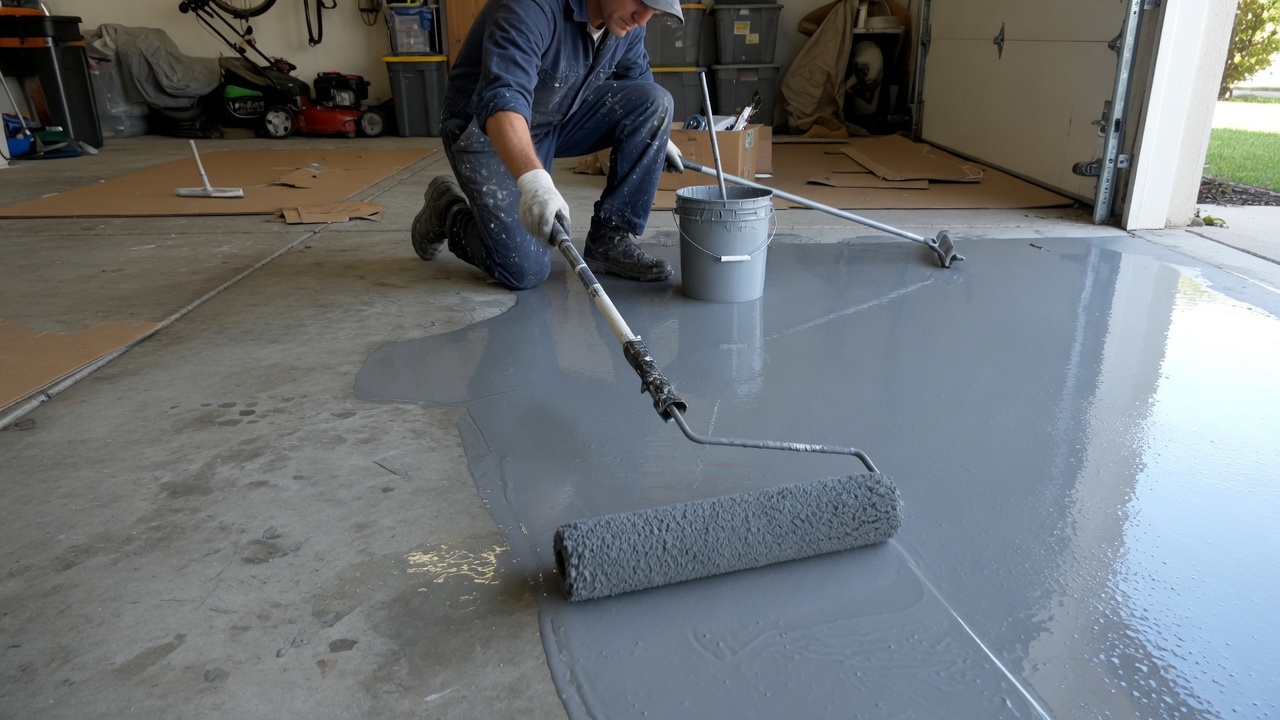
Epoxy Garage Floor Coating Blueprint
Blueprint Course
Epoxy Garage Floor Coating Blueprint
High-ticket work where the money is made in the prep and lost in the shortcut.
Coating a garage floor is one of the highest-ticket jobs a solo operator can sell to a homeowner: a typical two-car garage runs around $2,800 in the base case used throughout this course, and a single job contributes more than an entire month of most other home-services businesses in this library. It is also the least forgiving. A floor that delaminates six months later is not a callback you fix in an hour — it is a full redo, at your cost, on a job worth thousands, and nearly every one of those failures traces back to preparation that was skipped or a slab that should never have been coated. That asymmetry shapes the whole course. The base case: a blended job price of about $2,780 across two-car, single-car, and larger garages; about $1,133 per job in materials, diamond wear, disposal, fuel, card fees, and a helper day; and about $905 a month in fixed costs. Each job contributes about $1,647, so you break even at roughly one job a month — the ongoing overhead is small. At four jobs a month that pencils to roughly $5,683 a month before tax; across a planning envelope of two to six jobs the range is roughly $2,400 to $9,000 a month before tax. Those are estimates under stated assumptions, not promises, and no income is guaranteed. What is not small is the startup: about $8,000 to $20,000, the highest equipment barrier in this catalog, dominated by a concrete grinder and a HEPA-rated dust extraction system. That equipment is not optional and it is not only about finish quality — grinding concrete produces respirable crystalline silica, which OSHA regulates under a specific standard, and dust control here is a legal and health obligation rather than a preference. The coatings themselves are the second health gate and they get their own module: epoxies, polyurethanes, polyureas and polyaspartics are reactive chemistry, not paint. Isocyanates — commonly present in the faster-curing systems this trade increasingly uses — are respiratory sensitizers, and sensitization is permanent: once it happens, a person can react to tiny future exposures and may not be able to work around these products again. The course covers: whether this is genuinely your business, given that barrier; the legal line, including silica, insurance, and whether your work needs a contractor license where you are; the chemicals you apply, including safety data sheets, ventilating a closed garage, respiratory and skin protection, solvents and ignition sources, and who should not be in the building; preparation, which gets four lessons because it is the entire trade; coating systems and materials without the marketing; how to price a floor by square footage and condition rather than by guess; the money model; getting your first ten jobs when each customer buys once in a decade; and running a job without the two mistakes that cause redos. Three honest warnings. First, the equipment barrier is real and renting is a poor long-term substitute if you intend to do this seriously. Second, this is physically hard work — grinding is heavy, dusty, and unpleasant, and the finished-floor photographs do not show it. Third, you will have to walk away from jobs: slabs that fail a moisture test, slabs with existing coatings you cannot properly remove, and customers who want it done in one day when it cannot be. Learning to say no is a core skill here, not an inconvenience.
What you get
Built for operators who want a clear path — not a pile of generic tips.
The base case
One worked example, not a target
Planning estimates, before tax and before anything you pay yourself — no income is guaranteed. Your own prices, volume and costs will differ; the course walks you through replacing every number here with yours.
Who this fits
- You want higher-ticket, lower-frequency work rather than a high-volume route, and you can wait longer between paydays
- You are willing to do the unglamorous, dusty, physically demanding preparation properly every single time
- You can raise or finance a genuine equipment budget, and you understand why a grinder and dust extraction are not optional
- You are comfortable telling a customer their slab is not suitable and walking away from the money
Honest risks
- A coating failure is a full redo at your cost on a job worth thousands — the single largest financial risk in this trade, and almost always caused by preparation or an unsuitable slab.
- Grinding concrete generates respirable crystalline silica, which OSHA regulates under a specific standard; inadequate dust control is both a regulatory and a permanent health risk.
- Isocyanates are commonly present in polyurea, polyaspartic, and many polyurethane topcoat products, and they are respiratory sensitizers. Sensitization is permanent, can be triggered afterwards by very small exposures, and can end a person's ability to work in this trade — which makes ventilation, respiratory protection, and reading the product's safety data sheet a condition of doing the work, not an option.
- You are applying reactive chemistry inside a small closed room in someone's home: amine hardeners can burn and sensitize skin, solvent vapour is flammable and a residential garage commonly contains ignition sources such as a gas water heater or furnace pilot, and the product keeps off-gassing after you leave, which affects the occupants and their pets.
- The equipment barrier is high and the equipment wears: grinders, diamonds, and vacuums are ongoing costs, not one-time purchases.
- Moisture in a concrete slab will delaminate a coating regardless of workmanship. Testing is the only protection and it must be done before quoting confidently.
- Temperature and humidity windows constrain when you can coat, which makes this seasonal in many climates.
- Each customer buys once in many years, so there is almost no repeat revenue — every month starts from zero.
Who should skip this one
- You cannot fund the equipment. This has the highest startup barrier in this catalog, and doing it properly requires a grinder and HEPA-rated dust extraction rather than improvisation.
- You are tempted to skip preparation to finish faster. Nearly every coating failure is a prep failure, and a failure is a full redo at your cost on a job worth thousands.
- You are unwilling to manage silica dust properly. Grinding concrete generates respirable crystalline silica, OSHA regulates it, and the health consequences are permanent.
- You are not willing to read a safety data sheet and set up ventilation and protective equipment before opening a tin. These coatings are reactive chemistry, and isocyanates in the faster-curing systems can sensitize your airways permanently — which can end your ability to work in this trade at all.
- You struggle to say no. You will encounter slabs that should not be coated, and taking that job anyway is how operators lose money and reputation simultaneously.
- You need frequent, predictable income. Each customer buys once in many years, so this is a lumpy business that depends on continuously finding new jobs.
Curriculum
9 modules · 30 lessons · 4 hr 7 min of reading
01Is This Actually Your Business?free sample3 lessons · 25 min
The high-ticket, high-barrier shape of this trade, an honest go/no-go, and what the income looks like.
- High Ticket, Low Frequency, High Barrier8 min
- The Go / No-Go: Should You Start This?(free sample below)9 min
- What the Income Actually Looks Like8 min
02The Legal Line: Silica, Insurance, and Licensing3 lessons · 25 min
The dust standard that governs this trade, the insurance that responds to a coating failure, and whether you need a license.
- Silica: The Standard That Governs This Trade9 min
- Insurance and the Redo Risk8 min
- Licensing, Registration, and the Job Value Threshold8 min
03The Chemicals You Apply4 lessons · 36 min
Isocyanates and permanent sensitization, safety data sheets, ventilating a closed garage, respiratory and skin protection, solvent vapour and ignition, and who else is in the building.
- Isocyanates, Hardeners, and the Safety Data Sheet10 min
- Ventilating a Closed Garage8 min
- Respirators, Gloves, and Eyes9 min
- Solvents, Ignition Sources, and Who Else Is in the Building9 min
04Prep Is the Job4 lessons · 34 min
Moisture testing, mechanical profiling, repairs, and the jobs to refuse — the four lessons that prevent redos.
- Moisture Testing: The Test You Never Skip9 min
- Grinding: Mechanical Profile, Not Acid9 min
- Repairs, Temperature, and Humidity8 min
- The Jobs to Refuse8 min
05Systems and Materials3 lessons · 23 min
Choosing a coating system, working with suppliers, and what to promise about durability.
- Choosing a Coating System8 min
- Suppliers and What Materials Really Cost8 min
- What to Promise About Durability7 min
06Pricing a Floor4 lessons · 32 min
Pricing by area and condition, quoting after inspection, deposits, and the race to the bottom to avoid.
- Price by Area and Condition9 min
- The On-Site Quote8 min
- Deposits, Contracts, and Getting Paid7 min
- Avoiding the Race to the Bottom8 min
07The Money Model3 lessons · 23 min
The monthly arithmetic, equipment payback, and seasonality.
- The Monthly Math8 min
- Equipment Payback: Your Real First Milestone8 min
- Seasonality and Cash7 min
08Your First 10 Jobs3 lessons · 25 min
Where jobs come from when nobody rebooks, the portfolio that sells, and quoting without competing on price alone.
- Where the First 10 Jobs Come From9 min
- The Portfolio That Sells a Floor8 min
- Quoting Against a Cheaper Competitor8 min
09Running the Job and the First 30 Days3 lessons · 24 min
The job day sequence, handover, and a first month plan.
- The Job, Start to Finish9 min
- Handover and Aftercare7 min
- Your First 30 Days8 min
Why people buy this
Built for first-time operators who want a clear path — not generic AI chat.
Honest fit check
Who should start — and who should skip — so you don't waste months on the wrong business.
Do-this-next lessons
Every lesson ends in an action: scripts, checklists, pricing math you can use this week.
One-time purchase
One payment of $59. No course subscription.
Epoxy Garage Floor Coating Blueprint is part of the OwnerLaunch founding library. Figures in the course are planning estimates before tax — no income is guaranteed.
Blueprint FAQ
Why $59 for this Blueprint?+
You get a full operator course (9 modules, 30 lessons), a free sample lesson before you buy, downloadable templates after purchase, and a path into a personalized Launch Kit if you want one. It's a one-time payment — not a subscription for the course itself.
What do I get before I pay?+
The full curriculum outline, honest fit/risk lists, money base-case assumptions, a short course preview video when available, and one complete free sample lesson — real course content, not a teaser paragraph.
Is this legal, tax, or financial advice?+
No. OwnerLaunch is educational only. Licensing, insurance, tax, and filing requirements are location-dependent — verify with official sources and licensed professionals.
Can I upgrade to a Launch Kit later?+
Yes. Blueprint owners typically pay only the difference for a personalized Launch Kit (names, brand, pricing, copy, documents, 30-day plan). The course and kit are separate purchases.
Included templates & tools
- 30-Day Epoxy Coating Launch Checklist — Four weeks from silica and chemical controls, safety data sheets, and insurance through to your first quotes, with a practice job as a hard prerequisite.
- Job Pricing and Equipment Payback Calculator — Price a floor from area and condition, compute true contribution, and find how many jobs pay back your equipment.
- Customer Scripts: Quoting, Refusing, and Handover — What to say when explaining your price, when a slab fails testing, when conditions force a reschedule, and when you brief the household on odour and off-gassing.
- Site Visit, Prep, and Job Day Templates — The checklists that prevent redos and keep you safe: your product's data and safety sheets, inspection before quoting, the preparation sequence, job-day conditions, and the chemical-safety setup before anything is mixed.
- Self-Check Quiz — Ten questions on prep, moisture, silica, the chemicals you apply, equipment payback, and the jobs you should refuse.
Free sample lesson
Real course content — not a teaser paragraph. The rest unlocks after purchase.
From module: Is This Actually Your Business?
The Go / No-Go: Should You Start This?
~9 min read
Two things disqualify people from this trade, and neither is talent. The first is capital: you cannot do this properly without a grinder and dust extraction, and improvising around that produces failures and health risk. The second is temperament: you must be willing to do dull, heavy preparation properly on every job, and to walk away from jobs that fail testing.
- Can you fund or finance $8,000 to $20,000 of equipment? Renting occasionally is fine to learn; it is a poor basis for a real business.
- Are you genuinely willing to grind, vacuum, patch, and test on every job, even when the customer is impatient and the floor looks fine?
- Will you manage silica dust properly, every time, including on the day you are tired and running late?
- Can you tell a customer their slab failed a moisture test and walk away from a $2,800 job?
- Can you handle heavy, dusty, physical work for full days?
There is a sensible middle path. Work with an established installer for a season if you can, or start with smaller jobs while you build equipment and skill. Learning what a bad slab looks like on someone else's job is much cheaper than learning it on your own.
Action · task
Answer honestly, especially question two
Write your answer to all five questions. Then write what you would actually say to a customer whose slab fails a moisture test after you have already driven out and quoted. If that sentence is hard to write, practice it — you will need it.
Ready to make it yours?
A Launch Kit turns this Blueprint into your business: personalized name, brand, pricing, website copy, documents, and Action Plan.
Basic
$119 current
Pro
$199 current
Apply your Blueprint credit to Basic for +$60 or Pro for +$140.
More Blueprints
Related course · Home Services
Pressure Washing Blueprint
Launch a pressure washing business where before/after photos do the selling.
Related course · Home Services
Handyman Services Blueprint
Turn small repairs and endless to-do lists into a trusted local business.
Related course · Home Services
Carpet Cleaning Blueprint
Equipment-led deep cleaning homeowners rebook.
Recommended next · Home Services
Lawn Care Business Blueprint
From honest fit-check to first customer — one short, practical step at a time.
Recommended next · Home Services
Residential Cleaning Business Blueprint
Launch a solo residential cleaning business — from first supply kit to a recurring weekly client base.
Recommended next · Home Services
Mobile Detailing Business Blueprint
Launch a mobile detailing business from your driveway to your first paying route.
Every money figure in this course is before tax and before anything you pay yourself, and assumes one operator with occasional helper labour coating residential garage floors in a typical U.S. market. The base case is a blended job price of about $2,780 (across $2,800 two-car, $1,700 single-car, and $4,500 larger garages at a 60/25/15 mix), about $1,133 per job in materials, diamond wear, disposal, fuel, card fees and a helper day, and about $905 a month in fixed costs — giving a contribution of about $1,647 a job and a breakeven of roughly one job a month. Four jobs a month pencils to roughly $5,683 a month before tax; a planning envelope of two to six jobs gives roughly $2,400 to $9,000 a month before tax. Startup is about $8,000 to $20,000, the highest in this catalog. These figures are not inherited from the Discover profile for these numbers: they are OwnerLaunch planning estimates stated so you can replace them with your own. Typical ranges are estimates of common outcomes, not guarantees — no income is guaranteed. Grinding concrete generates respirable crystalline silica, which OSHA regulates federally; state plans may add requirements. The chemical-safety material in this course is education, not a substitute for the manufacturer's data or for professional safety advice: it deliberately states no exposure limits and recommends no specific respirator cartridge, because the correct controls depend on the exact product, the task, and the space. The governing documents are the Safety Data Sheet for the product you actually buy and the manufacturer's instructions, and selecting respiratory protection properly is a reasonable thing to get help with from a safety supplier or an occupational health professional. Contractor licensing thresholds, business registration, and permit requirements are location-dependent and vary by state, county and city. All product-specific values — mixing ratios, cure times, moisture limits, temperature and humidity windows — are governed by the manufacturer's technical data sheet for the product you actually use, and this course defers to it rather than substituting a general rule.
Educational guidance only — not legal, tax, or financial advice.Details
OwnerLaunch provides educational business guidance, AI-generated drafts, and checklists. It is not a law firm, tax advisor, CPA, registered agent, or government agency. Information may not be complete or current for your specific location. Always verify requirements with official federal, state, city, and county sources and consult qualified professionals when needed.