
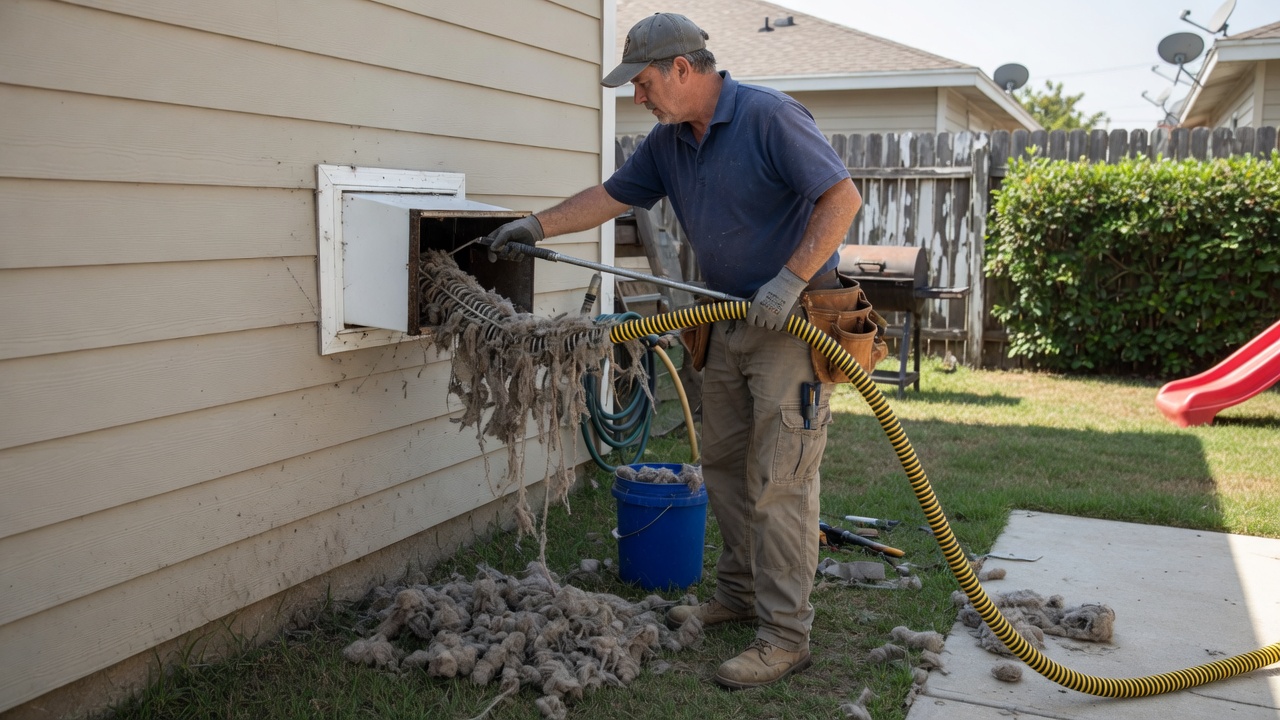
Dryer Vent Cleaning Blueprint
Blueprint Course
Dryer Vent Cleaning Blueprint
Launch a dryer vent cleaning business built on honest fire-safety education and an annual repeat route.
This course takes you from zero to a working dryer vent cleaning business: what the work really is, what a rotary brush kit and vacuum cost, how to price by the vent run instead of by the hour, how to teach fire safety honestly instead of scaring people, how to land your first 10 customers, and how to turn one-off cleanings into an annual reminder route. It is built for a solo operator starting with roughly $400 to $1,000 — $400 for a drill-driven rotary brush kit, a capable shop vacuum, and basic hand tools and PPE; closer to $1,000 if you add an inspection camera, an airflow meter, and your first insurance payment. Every money example uses the same base case: 8 to 15 jobs a week at $90 to $180 per job depending on run length, termination, and access, 45 to 90 minutes on site per job, about $5 to $10 per job in consumables and fuel, and about $120 to $200 a month in fixed costs. That pencils out to roughly $2,400 to $10,400 a month in profit before tax at full route density — most new operators should plan around the low end of that range for their first months. What makes this niche work is the pitch: U.S. fire agencies publish real statistics on clothes dryer fires, and failure to clean is the leading factor they cite. You are not selling fear — you are selling a measurable service, proven with a before-and-after airflow demonstration and a lint pile the customer can see. These are planning estimates, not local facts: verify prices against your own market before you set yours. Your results depend on your market, your route density, and your effort; no income is guaranteed.
What you get
Built for operators who want a clear path — not a pile of generic tips.
The base case
One worked example, not a target
Planning estimates, before tax and before anything you pay yourself — no income is guaranteed. Your own prices, volume and costs will differ; the course walks you through replacing every number here with yours.
Who this fits
- You like the idea of a clean, repeatable indoor job — 45 to 90 minutes, a visible result, no crew required
- You are comfortable teaching: the sale is a two-minute honest explanation of why lint in a vent matters
- You want a low startup cost with a kit that fits in any car trunk — no trailer, no ladder rack required for most jobs
- You want recurring revenue: dryer vents are an annual service, so every happy customer is a route stop next year
- You already run (or plan to run) a gutter or window route and want a bundled add-on that works year-round
Honest risks
- Fear-based selling is the industry's reputation problem: some operators inflate fire risk or invent 'code violations' to upsell. Honest education is both the ethical path and the durable one — but it means slower closes than scare tactics, and you must accept that.
- Gas dryers raise the stakes: moving a gas dryer can stress or kink the flexible gas connector. You never disconnect or reconnect gas lines — if a connection looks damaged or you smell gas, you stop and refer out. Cutting this corner risks lives, not just reviews.
- Roof-terminated vents mean ladder and roof-edge work with all its fall risk — the same discipline the gutter-cleaning trade lives by. Steep, high, or wet roofs are refer-out or reschedule, never push-through.
- Property damage inside homes is easy: scratched hardwood from a dragged dryer, torn vinyl flooring, a crushed transition hose reconnected badly and leaking hot moist air into a wall cavity. Insurance and a careful routine are the cost of playing.
- Demand must be created, not just captured: most homeowners have never hired a vent cleaner and don't search for one until the dryer stops drying. Your marketing is education first, which takes more touches than an emergency service gets.
- Vent repair and rerouting can cross into licensed trade work (HVAC, general contracting) depending on your area — quoting duct reroutes, new terminations, or in-wall repairs casually invites legal trouble. Clean and report; refer repairs out.
Who should skip this one
- You are tempted to sell with fear — exaggerating fire risk to close a sale is dishonest, it poisons reviews, and this course will not teach it. If 'your house could burn down tonight' sounds like a good pitch, this business is not for you.
- You will not carry general liability insurance from job one — you are working inside homes, moving customers' appliances, and touching gas-dryer connections' surroundings; one scratched floor or crushed gas flex line is an expensive day.
- You need every vent to be an easy first-floor wall job — a real route includes roof terminations, crawl-space runs, and bird nests, and if ladder work is completely off the table you will turn away a meaningful slice of jobs.
- You need immediate high volume — this is a niche service most homeowners have never bought; the first months are education-heavy marketing at the low end of the base case, and no income is guaranteed.
Curriculum
10 modules · 33 lessons · 1 hr 42 min of reading
01Is Dryer Vent Cleaning Right for You?3 lessons · 10 min
What the work actually looks like, the honest math of a vent-cleaning week, and a clear go/no-go decision before you spend a dollar.
- What the Work Really Is3 min
- The Math of a Vent-Cleaning Week4 min
- Who This Fits — and the Go/No-Go3 min
02Fire Safety Is the Productfree sample3 lessons · 10 min
The real dryer-fire statistics and how to use them honestly — education that closes sales without a single scare tactic, plus the warning signs customers already feel.
- Dryer Fires by the Numbers(free sample below)4 min
- Educate, Never Scare: The Two-Minute Pitch3 min
- The Signs Customers Already Feel3 min
03Startup Costs & Setup: $400–$1,0003 lessons · 9 min
Exactly what the startup money buys, the boring-but-necessary business setup, and a load-out that fits in any car trunk.
- Your Startup Budget: ~$400 Core Kit, ~$1,000 Fully Equipped4 min
- The Boring-but-Necessary Setup3 min
- Your Vehicle and the Trunk Load-Out2 min
04Equipment & Supplies: The Rotary Kit Deep-Dive3 lessons · 9 min
How the rotary brush actually works, capturing lint instead of spreading it, and the optional camera and meter that turn a cleaning into a documented service.
- The Rotary Brush Kit and How It Works3 min
- Lint Capture: Clean Job, Clean House3 min
- The Camera, the Meter, and What Can Wait3 min
05Services & Pricing: By the Run, Never by the Hour4 lessons · 12 min
Pricing from real costs by run length, termination, and access; a clean add-on menu; and the phone-quote script that books jobs sight unseen.
- Price by the Run, Not the Hour4 min
- Build Your Price Card and Add-On Menu3 min
- Quoting on the Phone in Three Questions3 min
- What You Don't Sell (and Why That Sells)2 min
06Legal, Insurance & Taxes (Education, Not Advice)3 lessons · 9 min
What's commonly required to operate legitimately, why insurance comes before the first paid job, and the tax set-aside habit — all location-dependent education, never legal advice.
- Licenses, Registration, and What's Commonly Required3 min
- Insurance Before the First Paid Job3 min
- Taxes and the Set-Aside Habit3 min
07Branding & Being Findable3 lessons · 9 min
A name and look that says 'safety professional', a Google Business Profile fed by lint photos and airflow numbers, and a one-page site built on the education pitch.
- A Name and Look That Says 'Safe to Let Inside'3 min
- Your Google Business Profile and the Photo Engine3 min
- A One-Page Site That Teaches and Books3 min
08Your First 10 Customers4 lessons · 12 min
A two-week sprint built on honest education: warm circle first, doorstep and flyer outreach that teaches, and referral partners who see clogged vents every week.
- The First 10 Plan3 min
- Doorstep and Flyer Education That Books3 min
- Partners Who See Clogged Vents Every Week3 min
- Bundling Onto Gutter and Window Routes3 min
09Service Delivery: The Perfect Vent Job4 lessons · 13 min
The step-by-step job routine, the before/after airflow demonstration that is your signature, gas-dryer and roof-termination safety, and what to do with what you find in there.
- The Perfect Vent Job, Step by Step4 min
- The Before/After Airflow Demonstration3 min
- Gas Dryers, Hard Stops, and When to Walk Away3 min
- Roof Terminations: Ladder Rules or No Job3 min
10Reviews, the Annual Route & Growth3 lessons · 9 min
Turning documented jobs into reviews, the reminder system that makes this a route business, and honest paths to growth — density, bundles, and knowing your season.
- Reviews Built on Proof, Asked for Every Time3 min
- The Annual Reminder Route: Your Real Business3 min
- Seasons, Bundles, and Honest Growth3 min
Why people buy this
Built for first-time operators who want a clear path — not generic AI chat.
Honest fit check
Who should start — and who should skip — so you don't waste months on the wrong business.
Do-this-next lessons
Every lesson ends in an action: scripts, checklists, pricing math you can use this week.
One-time purchase
One payment of $59. No course subscription.
Dryer Vent Cleaning Blueprint is part of the OwnerLaunch founding library. Figures in the course are planning estimates before tax — no income is guaranteed.
Blueprint FAQ
Why $59 for this Blueprint?+
You get a full operator course (10 modules, 33 lessons), a free sample lesson before you buy, downloadable templates after purchase, and a path into a personalized Launch Kit if you want one. It's a one-time payment — not a subscription for the course itself.
What do I get before I pay?+
The full curriculum outline, honest fit/risk lists, money base-case assumptions, a short course preview video when available, and one complete free sample lesson — real course content, not a teaser paragraph.
Is this legal, tax, or financial advice?+
No. OwnerLaunch is educational only. Licensing, insurance, tax, and filing requirements are location-dependent — verify with official sources and licensed professionals.
Can I upgrade to a Launch Kit later?+
Yes. Blueprint owners typically pay only the difference for a personalized Launch Kit (names, brand, pricing, copy, documents, 30-day plan). The course and kit are separate purchases.
Included templates & tools
- 30-Day Launch Checklist — The whole course sequenced into four weeks — from fact card and kit to first paid jobs, airflow demos, and your first reminder entries.
- Partner Outreach & Phone Quote Scripts — Word-for-word scripts: the referral-partner pitch for HVAC/inspectors/realtors/property managers, the three-question phone quote, and the follow-up messages.
- Vent Inspection & Service Report Template — The one-page fill-in report you leave with every customer — findings, before/after airflow readings, photos list, recommendations, and next service date.
- Fire-Safety Education Flyer Template — A fill-in flyer built on honest, sourced statistics and the felt-symptom pitch — designed to be kept on the fridge, not binned as a scare ad.
- Pricing Calculator Worksheet — Hand-computed formulas from cost per job and fixed costs to before-tax margin at each price point — know your floor price before you print a price card.
- Safety & Honesty Self-Check Quiz — Fifteen self-check questions on the fire-safety facts, gas and ladder rules, and the honesty standards — pass this before your first paid job.
Free sample lesson
Real course content — not a teaser paragraph. The rest unlocks after purchase.
From module: Fire Safety Is the Product
Dryer Fires by the Numbers
~4 min read
Your entire pitch rests on a few public, verifiable numbers — so learn them exactly and never inflate them. The U.S. Fire Administration has estimated roughly 2,900 clothes dryer fires reported in residential buildings per year, causing an estimated 5 deaths, 100 injuries, and about $35 million in property loss. The leading contributing factor they cite is failure to clean — lint building up where heat lives. Incidence peaks in fall and winter, when dryers work hardest. NFPA's safety guidance says the same thing in plain language: clean the lint filter every load, and get the vent pipe cleaned regularly.
- ~2,900 reported residential dryer fires a year (USFA estimate) — real, and worth taking seriously
- Also real: there are tens of millions of dryers in U.S. homes, so any ONE dryer's annual odds are low — say this out loud, because honesty is your brand
- 'Failure to clean' is the leading factor cited — which is precisely the thing your service removes
- The felt benefits are immediate and honest: shorter dry times, a cooler laundry room, less strain on the machine
Here is the frame this course drills: you are not selling 'your house will burn down.' You are selling 'here is a small, well-documented risk that is cheap to remove, plus a dryer that works noticeably better today.' The first frame is fear-mongering and your customers can smell it. The second is education — and it is stronger, because a customer who feels informed rather than pressured books you again next year and tells the neighbors. These statistics get revised as agencies publish new reports, so verify the current figures before you print anything.
Action · task
Build your one-card fact sheet
Today, visit usfa.fema.gov and nfpa.org and find their current clothes-dryer fire pages. Write the key figures on one index card in your own words, with the source next to each number and the date you checked. Add one honesty line: 'Any one dryer's odds are low — this is cheap insurance, not an emergency.' This card becomes the backbone of your flyer, your website, and your doorstep pitch, and you will re-verify it every year.
Ready to make it yours?
A Launch Kit turns this Blueprint into your business: personalized name, brand, pricing, website copy, documents, and Action Plan.
Basic
$119 current
Pro
$199 current
Apply your Blueprint credit to Basic for +$60 or Pro for +$140.
More Blueprints
Related course · Home Services
Gutter Cleaning Blueprint
Launch a gutter cleaning business built around two big seasons and a repeat route.
Related course · Home Services
Window Cleaning Blueprint
Launch a residential window cleaning route with a few hundred dollars of gear and a repeatable safety routine.
Recommended next · Home Services
Lawn Care Business Blueprint
From honest fit-check to first customer — one short, practical step at a time.
Recommended next · Home Services
Residential Cleaning Business Blueprint
Launch a solo residential cleaning business — from first supply kit to a recurring weekly client base.
Recommended next · Home Services
Mobile Detailing Business Blueprint
Launch a mobile detailing business from your driveway to your first paying route.
This course independently states the following planning estimates: a base case of 8–15 jobs per week at $90–$180 per job (45–90 minutes on site), about $5–$10 variable cost per job, about $120–$200/month fixed costs, and roughly $2,400–$10,400 a month in profit before tax at full route density — with the high end requiring a mature route and reminder book that typically takes months to years to build, so plan around the low end at first. Startup runs roughly $400–$1,000: about $400 for the core rotary brush kit, shop vacuum, and PPE, rising toward $1,000 with an inspection camera, airflow meter, sellable hose stock, and first insurance payments. Fire-safety statistics cited in this course come from U.S. Fire Administration and NFPA publications that are periodically revised — re-verify current figures at usfa.fema.gov and nfpa.org before using them in marketing. All figures are estimates to verify against your own market (local competitor prices, real insurance quotes, real supplier receipts) before you rely on them; actual results vary with market, route density, pricing, and effort, and no income is guaranteed. Legal, licensing, insurance, and tax content in this course is location-dependent education, not legal, tax, or professional advice — verify requirements locally, and note that vent repair or rerouting can require HVAC or contractor licensing in some areas.
Educational guidance only — not legal, tax, or financial advice.Details
OwnerLaunch provides educational business guidance, AI-generated drafts, and checklists. It is not a law firm, tax advisor, CPA, registered agent, or government agency. Information may not be complete or current for your specific location. Always verify requirements with official federal, state, city, and county sources and consult qualified professionals when needed.