
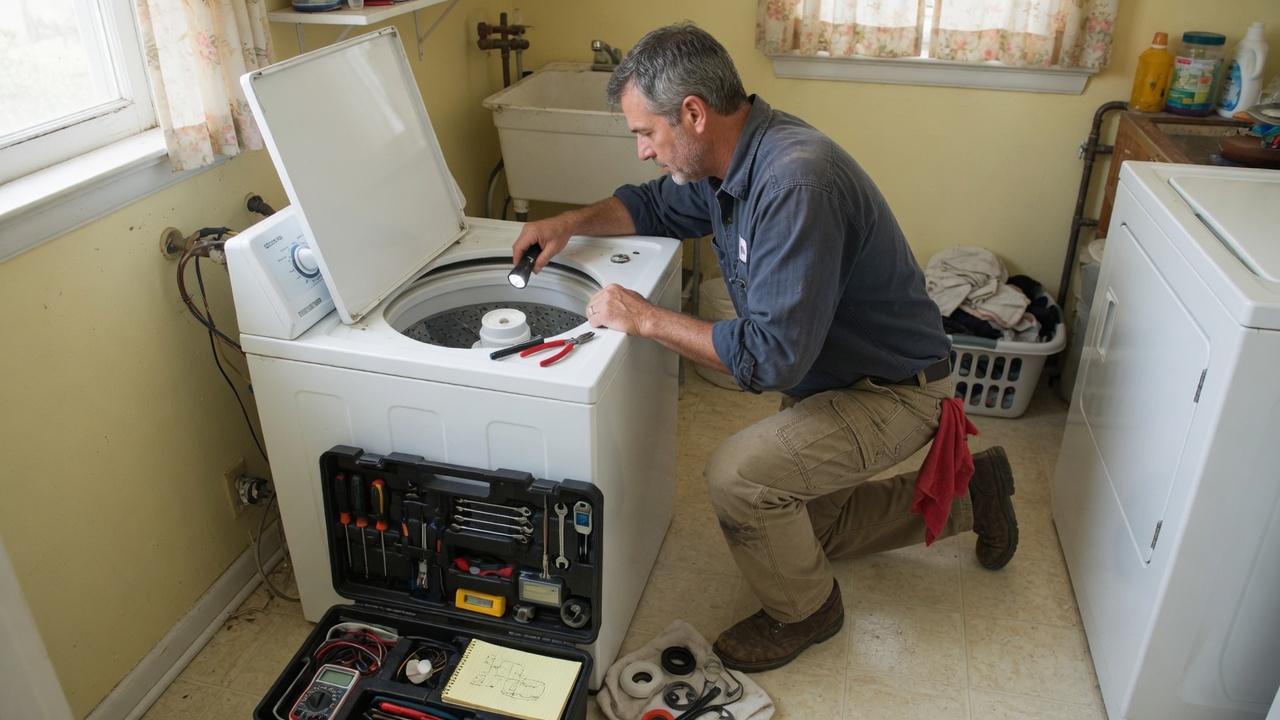
Appliance Repair Blueprint
Blueprint Course
Appliance Repair Blueprint
Diagnose it right, carry the part, and tell people the truth about whether to fix it.
Appliance repair is a skilled diagnostic trade with an unusual revenue structure: you charge a diagnostic fee to find the fault, labour to fix it, and parts with a markup. That structure means two technicians doing identical work can earn very different amounts depending on one number — how often they finish the job on the first visit. A repair completed on the first call earns the full ticket for one trip. The same repair needing a return visit because the part was not on the van earns the same money for two trips, roughly halving what you make per hour. Almost everything in this course serves that number: what you carry in the van, how well you diagnose over the phone before you drive out, and how quickly you can source a part. The base case used throughout: a blended job value of about $268.50 across completed repairs, diagnostic-only visits where the customer declines, and larger repairs; about $86.50 per job in parts, fuel and card fees; and about $750 a month in fixed costs including vehicle, insurance, parts inventory, and marketing. Each job contributes about $182, so you break even at roughly five jobs a month. At thirty jobs a month that pencils to roughly $4,710 a month before tax; across a planning envelope of fifteen to fifty jobs the range is roughly $2,000 to $8,350 a month before tax. Those are estimates under stated assumptions, not promises, and no income is guaranteed. Startup runs about $4,000 to $12,000 for vehicle preparation, hand and diagnostic tools, initial parts stock, certification, and insurance. The course covers: whether this is genuinely your business; the legal line, including the EPA Section 608 certification genuinely required to handle refrigerants — and the fact that a viable business exists without it if you decline sealed-system work; tools, van stock, and the first-call completion rate that decides your economics; diagnosis and the single most important conversation in this trade, which is telling a customer honestly whether their machine is worth repairing; pricing across diagnostic, labour and parts; the money model; getting your first ten customers when nobody thinks about you until something breaks; and a first thirty days. Three honest warnings. First, this is a real skill and it takes time to build — you will be slow and occasionally wrong at the start, and pretending otherwise costs customers. Second, parts availability is outside your control and will sometimes make you look bad through no fault of yours. Third, the work is physical and awkward: appliances are heavy, they live in tight spaces, and you will spend a lot of time on your knees behind them.
What you get
Built for operators who want a clear path — not a pile of generic tips.
The base case
One worked example, not a target
Planning estimates, before tax and before anything you pay yourself — no income is guaranteed. Your own prices, volume and costs will differ; the course walks you through replacing every number here with yours.
Who this fits
- You genuinely enjoy diagnosing problems — the satisfying part of this trade is working out what is wrong, not turning the screwdriver
- You are willing to invest real time in learning, because this is a skill rather than a service you can start doing well immediately
- You are comfortable telling a customer the honest answer even when it costs you the job
- You can be organized about parts, stock, and scheduling, because that is what turns skill into income
Honest risks
- Handling refrigerants without EPA Section 608 certification is a federal compliance failure, not a paperwork oversight.
- First-call completion drives the economics: a job needing a return visit earns the same money for twice the trips, roughly halving contribution per hour.
- Parts availability is outside your control. Discontinued or backordered parts will sometimes leave you unable to finish a job through no fault of your own.
- Misdiagnosis costs you twice: the wrong part is money spent and a return visit is time lost, and repeated misdiagnosis ends a local reputation quickly.
- You are working on customers' property and occasionally with water, gas, or electricity — damage claims are a real exposure.
- The work is physically demanding in awkward positions, and back and knee problems are the trade's long-term risk.
Who should skip this one
- You want to start earning well immediately. Diagnostic skill takes time to build and you will be slow at first — that is normal and it is a real cost.
- You intend to do sealed-system refrigeration work but are not willing to obtain EPA Section 608 certification. Handling refrigerants requires it, and there is no informal version.
- You would rather sell a repair than tell someone their machine is not worth fixing. That conversation is the foundation of a referral business here, and getting it wrong is how technicians end up with a bad local reputation.
- You cannot handle physical, awkward work. Appliances are heavy, they sit in tight spaces, and much of the job is on your knees behind them.
- You are disorganised about stock and scheduling. First-call completion is the economics of this trade and it is an organisational skill as much as a technical one.
Curriculum
8 modules · 26 lessons · 3 hr 29 min of reading
01Is This Actually Your Business?free sample3 lessons · 26 min
What the trade really is, an honest go/no-go, and the one number that decides your income.
- This Is a Diagnostic Trade8 min
- The Go / No-Go: Should You Start This?(free sample below)9 min
- The One Number That Decides Your Income9 min
02The Legal Line: EPA 608, Licensing, and Insurance3 lessons · 24 min
The federal certification refrigerant work requires, what licensing applies where you are, and the insurance that covers customers' appliances.
- EPA Section 608: The Refrigerant Gate9 min
- Licensing and Registration Where You Are7 min
- Insurance: You Are Working On Their Property8 min
03Tools, Van Stock, and First-Call Completion4 lessons · 33 min
What to buy, what to carry, how to source parts fast, and how to raise the number that pays you.
- The Tools That Actually Earn8 min
- Van Stock: Buying Your Completion Rate9 min
- Sourcing Parts Fast8 min
- The Phone Call Before the Visit8 min
04Diagnosis and the Honest Conversation4 lessons · 33 min
Working systematically, knowing your limits, and telling customers whether a machine is worth fixing.
- Diagnose Systematically, Not by Instinct9 min
- Knowing What to Decline8 min
- "Is It Worth Fixing?" — The Conversation That Builds the Business9 min
- Warranties and Callbacks7 min
05Pricing: Diagnostic, Labour, and Parts3 lessons · 23 min
The three-part price, marking up parts fairly, and raising prices.
- The Diagnostic Fee8 min
- Labour and Parts Markup8 min
- Raising Prices7 min
06The Money Model3 lessons · 23 min
The monthly arithmetic, what the completion rate does to it, and paying yourself.
- The Monthly Math8 min
- What the Completion Rate Is Worth8 min
- Paying Yourself and Reserving for the Van7 min
07Your First 10 Customers3 lessons · 23 min
Being findable at the moment of breakage, the trade referrals that matter, and converting the call.
- Being Findable at the Moment It Breaks8 min
- The Referrals That Actually Produce Work8 min
- Converting the Call7 min
08Running the Business and Your First 30 Days3 lessons · 24 min
The service call sequence, the numbers to track, and a first month plan.
- The Service Call, Start to Finish8 min
- The Numbers Worth Tracking7 min
- Your First 30 Days9 min
Why people buy this
Built for first-time operators who want a clear path — not generic AI chat.
Honest fit check
Who should start — and who should skip — so you don't waste months on the wrong business.
Do-this-next lessons
Every lesson ends in an action: scripts, checklists, pricing math you can use this week.
One-time purchase
One payment of $59. No course subscription.
Appliance Repair Blueprint is part of the OwnerLaunch founding library. Figures in the course are planning estimates before tax — no income is guaranteed.
Blueprint FAQ
Why $59 for this Blueprint?+
You get a full operator course (8 modules, 26 lessons), a free sample lesson before you buy, downloadable templates after purchase, and a path into a personalized Launch Kit if you want one. It's a one-time payment — not a subscription for the course itself.
What do I get before I pay?+
The full curriculum outline, honest fit/risk lists, money base-case assumptions, a short course preview video when available, and one complete free sample lesson — real course content, not a teaser paragraph.
Is this legal, tax, or financial advice?+
No. OwnerLaunch is educational only. Licensing, insurance, tax, and filing requirements are location-dependent — verify with official sources and licensed professionals.
Can I upgrade to a Launch Kit later?+
Yes. Blueprint owners typically pay only the difference for a personalized Launch Kit (names, brand, pricing, copy, documents, 30-day plan). The course and kit are separate purchases.
Included templates & tools
- 30-Day Appliance Repair Launch Checklist — Four weeks from the refrigerant decision and insurance through to your first jobs, with the return-visit log started on day one.
- Pricing and First-Call Completion Calculator — Build your blended job value and contribution, then put a number on what raising your completion rate is worth.
- Phone Intake and Customer Scripts — The six intake questions that raise your completion rate, plus the worth-fixing conversation and callback handling.
- Service Call Checklist and Van Stock Log — The job sequence that protects the customer's home, plus the return-visit log that decides what you carry.
- Self-Check Quiz — Eight questions on completion rate, the refrigerant gate, the diagnostic fee, and the honest conversation.
Free sample lesson
Real course content — not a teaser paragraph. The rest unlocks after purchase.
From module: Is This Actually Your Business?
The Go / No-Go: Should You Start This?
~9 min read
The honest thing about this trade is that you will be slow and occasionally wrong at the start, and that has a real cost — in time, in wrong parts, and in customers who do not call back. Everyone goes through it. The question is whether you can afford to and whether you will keep learning through it.
- Are you willing to spend months genuinely learning, including formal training or working with an established technician?
- Can you afford $4,000 to $12,000 of vehicle, tools, and initial parts stock before the income is reliable?
- If you intend to work on sealed refrigeration systems, will you obtain EPA Section 608 certification first? If not, will you decline that work cleanly?
- Can you tell a customer their machine is not worth repairing, and lose the job?
- Can you handle heavy, awkward physical work in tight spaces?
A sensible sequence: work for an established repair company first if you can. You learn diagnosis on their time, see hundreds of machines, and find out whether you like it — before you have bought a van full of parts.
Action · task
Answer the five, and price the training
Write your answer to each question. Then find one real training route — a technical course, a manufacturer program, or a local company hiring an apprentice — and price it. Your learning plan is part of your startup cost, not an optional extra.
Ready to make it yours?
A Launch Kit turns this Blueprint into your business: personalized name, brand, pricing, website copy, documents, and Action Plan.
Basic
$119 current
Pro
$199 current
Apply your Blueprint credit to Basic for +$60 or Pro for +$140.
More Blueprints
Related course · Home Services
Handyman Services Blueprint
Turn small repairs and endless to-do lists into a trusted local business.
Related course · Online & Digital
Local IT Support Blueprint
Be the tech person small offices call first.
Related course · Home Services
Dryer Vent Cleaning Blueprint
Launch a dryer vent cleaning business built on honest fire-safety education and an annual repeat route.
Recommended next · Home Services
Lawn Care Business Blueprint
From honest fit-check to first customer — one short, practical step at a time.
Recommended next · Home Services
Residential Cleaning Business Blueprint
Launch a solo residential cleaning business — from first supply kit to a recurring weekly client base.
Recommended next · Home Services
Mobile Detailing Business Blueprint
Launch a mobile detailing business from your driveway to your first paying route.
Every money figure in this course is before tax and before anything you pay yourself, and assumes one solo technician serving residential customers in a typical U.S. market. The base case is a blended job value of about $268.50 (across 65% completed repairs at $280, 20% diagnostic-only visits at $95 where the customer declines, and 15% larger repairs at $450), about $86.50 per job in parts, fuel and card fees, and about $750 a month in fixed costs — giving a contribution of about $182 a job and a breakeven of roughly five jobs a month. Thirty jobs a month pencils to roughly $4,710 a month before tax; a planning envelope of fifteen to fifty jobs gives roughly $2,000 to $8,350 a month before tax. These figures are not inherited from the Discover profile for these numbers: they are OwnerLaunch planning estimates stated so you can replace them with your own. Typical ranges are estimates of common outcomes, not guarantees — no income is guaranteed. EPA Section 608 certification is a federal requirement for handling refrigerants. Business registration and any trade licensing are location-dependent and vary by state, county and city. This course teaches the BUSINESS of appliance repair: all repair procedures, diagnostic sequences, and safety requirements come from the manufacturer's service documentation for the specific appliance and from proper technical training, not from this course.
Educational guidance only — not legal, tax, or financial advice.Details
OwnerLaunch provides educational business guidance, AI-generated drafts, and checklists. It is not a law firm, tax advisor, CPA, registered agent, or government agency. Information may not be complete or current for your specific location. Always verify requirements with official federal, state, city, and county sources and consult qualified professionals when needed.