
Pool Cleaning & Maintenance Blueprint
Blueprint Course
Pool Cleaning & Maintenance Blueprint
Weekly recurring routes with sticky customers.
This course takes you from zero to a working residential pool service route: what a weekly stop actually involves, what it costs to start, what to buy, how water chemistry really works, how to price monthly service from your real chemical and fuel costs instead of guessing, how to land your first 10 pools, and how seasonality shapes the whole business. It is built for a solo operator starting with roughly $600 to $1,500 — poles, nets, brushes, a vacuum setup, and a professional test kit at the low end, adding a stock of chemicals and better gear at the high end. Because these figures are not inherited from the Discover profile for this trade, every money example uses one explicit base case: a weekly route of 15 to 25 pools at $120–$200 per pool per month with chemicals included, roughly $25–$45 per pool per month in chemicals, testing supplies, and fuel, and about $200 a month in fixed costs. Run full, that pencils out to a typical range of roughly $1,000 to $4,000 a month in profit before tax — a planning estimate and a range, never a promise. Your results depend on your market, your prices, and your effort; no income is guaranteed. Two things make this trade special: the revenue is recurring — customers pay monthly, all year in warm climates — and the skill that separates professionals from splash-and-dash competitors is water chemistry, which this course teaches from public-health guidance, not folklore.
What you get
Built for operators who want a clear path — not a pile of generic tips.
The base case
One worked example, not a target
Planning estimates, before tax and before anything you pay yourself — no income is guaranteed. Your own prices, volume and costs will differ; the course walks you through replacing every number here with yours.
Who this fits
- You want recurring monthly revenue instead of one-off jobs — the same pools, every week, billed automatically
- You like routine and route efficiency: 15–25 stops a week, each 20–40 minutes, wins on consistency
- You are willing to actually learn water chemistry — testing, dosing, and balancing — not just skim leaves
- You are comfortable working outdoors in summer heat, because peak season is the hottest months
- You want a startup under $1,500 with a clear path to a route that runs on part-time hours
Honest risks
- Chemical injury is the defining personal risk: chlorine products and muriatic acid burn skin and eyes, and mixing incompatible chemicals — even residue in a bucket — can release toxic gas. Transport and storage rules are not optional.
- Seasonality: in climates where pools close for winter, most route revenue is compressed into roughly May–September; income planning has to survive the off-season.
- Liability: a mis-dosed pool can damage plaster, heaters, and salt cells, or irritate swimmers — and you are the last professional who touched the water.
- Low barrier to entry means price competition from unlicensed, uninsured operators; you win on chemistry competence, reliability, and reviews, not on being cheapest.
- Chemical prices swing — chlorine costs have spiked sharply in recent years — and a chemicals-included price that ignored real dosing costs loses money quietly, pool by pool.
- It is physical, hot work: brushing, hauling chemicals, and lifting filter lids all summer, often in 90°F+ heat.
Who should skip this one
- You will not respect chemical safety — pool chlorine and muriatic acid can produce toxic gas if mixed and cause serious burns; someone who stores chemicals loosely in a hot trunk or eyeballs doses is a danger to themselves and their customers.
- You live where pools close for half the year and you need steady twelve-month income immediately — in cold climates route revenue drops sharply between fall closing and spring opening, and the off-season plan in this course takes time to build. No income is guaranteed in any season.
- You want to skip the chemistry and 'just clean pools' — a green pool, an etched plaster surface, or a chlorine-smelling pool that irritates swimmers will cost you the account and possibly a damage claim. The chemistry is the job.
- You will not carry general liability insurance from day one — you are dosing chemicals into other people's pools next to their equipment, pets, and kids, and one mistake can exceed a year of profit before tax.
Curriculum
10 modules · 34 lessons · 1 hr 48 min of reading
01Is Pool Service Right for Youfree sample3 lessons · 10 min
Before you buy a pole, understand the job: recurring route work, real chemistry, summer heat, and hard seasonality — and whether all four fit you.
- What the Work Really Is(free sample below)4 min
- The Money: An Honest Look3 min
- Go or No-Go3 min
02Startup Costs and Setup3 lessons · 9 min
Where the $600–$1,500 actually goes, the setup steps that make you a real business, and what to skip until revenue exists.
- Where the Money Goes3 min
- The Setup That Makes You Real3 min
- Lean Start vs. Loaded Start3 min
03Equipment and Supplies3 lessons · 10 min
The tools of a professional route: cleaning gear, the test kit that runs your business, and the chemicals you'll carry every day.
- The Core Cleaning Kit3 min
- The Test Kit IS the Business3 min
- The Chemicals You'll Carry4 min
04Water Chemistry Fundamentals4 lessons · 14 min
The professional skill: what the numbers mean, the targets public-health guidance points to, how to dose, and the safety rules that are never optional.
- The Five Numbers That Matter4 min
- Testing and Dosing Without Guessing4 min
- Algae, Green Pools, and Recoveries3 min
- The Safety Rules That Are Never Optional3 min
05Services and Pricing4 lessons · 14 min
Price monthly service from your real chemical, fuel, and time costs — never from an hourly wage — and build a menu with profitable add-ons.
- Your Service Menu3 min
- Know Your Cost Per Pool4 min
- Set the Monthly Price4 min
- Quoting at the Pool3 min
06Legal, Insurance, and Taxes3 lessons · 9 min
Education only — what's commonly required to operate legally, why insurance precedes your first stop, and the tax habit that prevents an April disaster.
- Licenses and Registration3 min
- Insurance Before the First Stop3 min
- Taxes and the Set-Aside Habit3 min
07Branding and Being Findable3 lessons · 8 min
A trustworthy name and look, a Google Business Profile that works while you sleep, and the photo habit that sells water clarity.
- Name and Look3 min
- Your Google Business Profile3 min
- Photos That Sell Water2 min
08Marketing: Your First 10 Pools4 lessons · 12 min
The warm circle, the pool-dense neighborhood loop, referral partners, and the close that turns a quote into a weekly account.
- The Warm Circle First3 min
- The Pool-Dense Neighborhood Loop3 min
- Referral Partners Who Already Talk to Pool Owners3 min
- Close the Account, Onboard Like a Pro3 min
09Service Delivery: The Perfect Route Stop3 lessons · 9 min
The repeatable 20–40 minute stop, the route-day system that keeps 25 pools on schedule, and how to handle problems and claims like a professional.
- The Route Stop Routine3 min
- Route-Day Systems3 min
- Problems, Callbacks, and Claims3 min
10Seasonality, Reviews, and Growth4 lessons · 13 min
Surviving the off-season where pools close, the review engine that compounds, the route math of growth, and what comes after solo.
- The Seasonality Plan4 min
- The Review Engine3 min
- Route Math and Growth3 min
- Growing Past Solo3 min
Why people buy this
Built for first-time operators who want a clear path — not generic AI chat.
Honest fit check
Who should start — and who should skip — so you don't waste months on the wrong business.
Do-this-next lessons
Every lesson ends in an action: scripts, checklists, pricing math you can use this week.
One-time purchase
One payment of $59. No course subscription.
Pool Cleaning & Maintenance Blueprint is part of the OwnerLaunch founding library. Figures in the course are planning estimates before tax — no income is guaranteed.
Blueprint FAQ
Why $59 for this Blueprint?+
You get a full operator course (10 modules, 34 lessons), a free sample lesson before you buy, downloadable templates after purchase, and a path into a personalized Launch Kit if you want one. It's a one-time payment — not a subscription for the course itself.
What do I get before I pay?+
The full curriculum outline, honest fit/risk lists, money base-case assumptions, a short course preview video when available, and one complete free sample lesson — real course content, not a teaser paragraph.
Is this legal, tax, or financial advice?+
No. OwnerLaunch is educational only. Licensing, insurance, tax, and filing requirements are location-dependent — verify with official sources and licensed professionals.
Can I upgrade to a Launch Kit later?+
Yes. Blueprint owners typically pay only the difference for a personalized Launch Kit (names, brand, pricing, copy, documents, 30-day plan). The course and kit are separate purchases.
Included templates & tools
- 30-Day Launch Checklist — The whole course sequenced into four weeks: setup, gear, chemistry practice, and the first-10 push.
- First-10 Outreach Scripts — Word-for-word scripts: the warm-circle announcement, the door conversation, the referral-partner pitch, and the review ask.
- Service Agreement + New-Pool Intake Template — A friendly one-page service agreement (with the chemical price-adjustment clause) and the first-visit baseline intake form.
- Monthly Route Pricing Calculator — The by-hand worksheet: cost per pool per month, price from margin, and full-route profit before tax at three price points.
- Weekly Stop + Truck Checklist — The laminated card: the 7-step route stop, the 60-second morning truck check, and the never-mix chemical rules.
- Launch Readiness Self-Check — Fifteen honest questions across chemistry, safety, pricing, legal, and marketing — with the module to revisit for any miss.
Free sample lesson
Real course content — not a teaser paragraph. The rest unlocks after purchase.
From module: Is Pool Service Right for You
What the Work Really Is
~4 min read
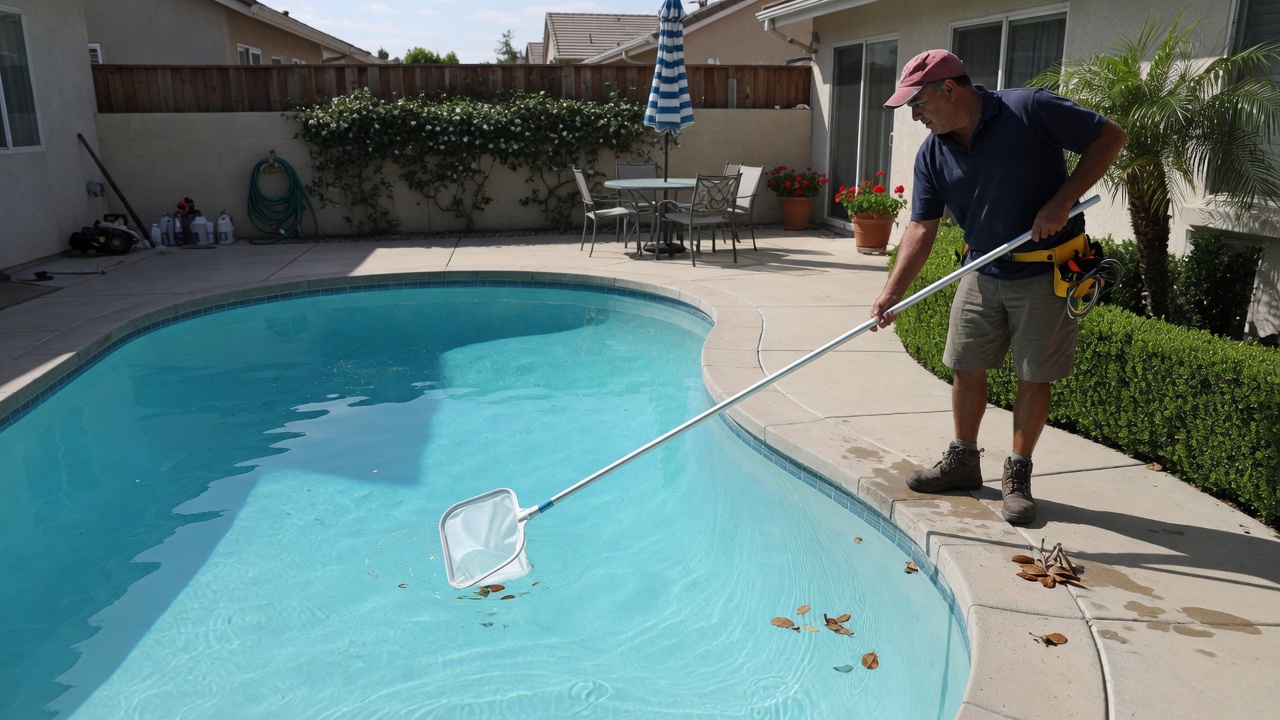
Residential pool service is recurring route work: the same 15 to 25 pools, every week, billed monthly. A typical stop is 20 to 40 minutes — skim the surface, empty the baskets, brush the walls, vacuum as needed, test the water, dose the chemicals, check the equipment, and log what you did. The customer isn't buying a clean pool once; they're buying the promise that their pool is always ready to swim in without them thinking about it. That promise is why pool customers are famously sticky: once they trust you, they keep paying month after month, year after year.
Two things separate this trade from most home services. First, the revenue is recurring — a full route is a predictable monthly number, not a pipeline of one-off jobs you have to keep refilling. Second, the core skill is invisible: water chemistry. Anyone can scoop leaves. Keeping water balanced so it's safe, clear, and not slowly destroying a $10,000 plaster surface or a $2,500 heater is what customers are actually paying for — and it's what this course teaches from public-health guidance, not pool-store folklore.
- You sell one main thing: weekly service at a monthly rate ($120–$200 per pool in this course's base case, chemicals included) — plus add-ons like green-pool cleanups, filter cleans, and openings/closings
- The stable money is the route: at 15–25 pools the base case pencils to roughly $1,000–$4,000 a month profit before tax — an estimate, not a promise
- The hidden job: chemistry and chemical safety, every stop, every week
- The hard constraint: seasonality — in cold climates pools close for winter and route revenue compresses into roughly May–September
Action · task
The route reality check
Today, drive or map one 15-minute loop through the most pool-dense neighborhood you know (satellite view on any map app makes backyard pools obvious). Count the pools you can spot. Write down two numbers: pools counted, and how many total you could reach within 20 minutes of home. If you can't find 40+ candidate pools within that radius, pool density may be your first real constraint — note it now.
Ready to make it yours?
A Launch Kit turns this Blueprint into your business: personalized name, brand, pricing, website copy, documents, and Action Plan.
Basic
$119 current
Pro
$199 current
Apply your Blueprint credit to Basic for +$60 or Pro for +$140.
More Blueprints
Related course · Home Services
Lawn Care Business Blueprint
From honest fit-check to first customer — one short, practical step at a time.
Related course · Home Services
Pressure Washing Blueprint
Launch a pressure washing business where before/after photos do the selling.
Recommended next · Home Services
Residential Cleaning Business Blueprint
Launch a solo residential cleaning business — from first supply kit to a recurring weekly client base.
Recommended next · Home Services
Mobile Detailing Business Blueprint
Launch a mobile detailing business from your driveway to your first paying route.
Recommended next · Home Services
Handyman Services Blueprint
Turn small repairs and endless to-do lists into a trusted local business.
These figures are not inherited from the Discover profile for this course, so all figures are planning estimates the author derived from supply-retailer pricing and typical market rates — verify them in your own market before relying on them. The base case throughout: a solo operator running a weekly residential route of 15–25 pools at $120–$200 per pool per month with chemicals included, roughly $25–$45 per pool per month in chemicals, testing supplies, and fuel, about $200 a month in fixed costs, and a $600–$1,500 startup (poles, nets, brushes, vacuum setup, and a professional test kit at the low end; opening chemical stock and upgraded gear at the high end). All profit figures are before tax and before anything you pay yourself. Ranges are typical planning outcomes, not guarantees — no income is guaranteed, and your market, climate, prices, and effort decide where you land. Seasonality matters enormously: in cold climates pools close for roughly half the year and route revenue compresses into the swim season. Legal, tax, and insurance lessons are education only, not professional advice; requirements vary by state, county, and city. Water chemistry content is general education drawn from CDC Model Aquatic Health Code and Healthy Swimming guidance, and chemical safety content is general education — neither replaces product labels, safety data sheets, or local codes.
Educational guidance only — not legal, tax, or financial advice.Details
OwnerLaunch provides educational business guidance, AI-generated drafts, and checklists. It is not a law firm, tax advisor, CPA, registered agent, or government agency. Information may not be complete or current for your specific location. Always verify requirements with official federal, state, city, and county sources and consult qualified professionals when needed.