
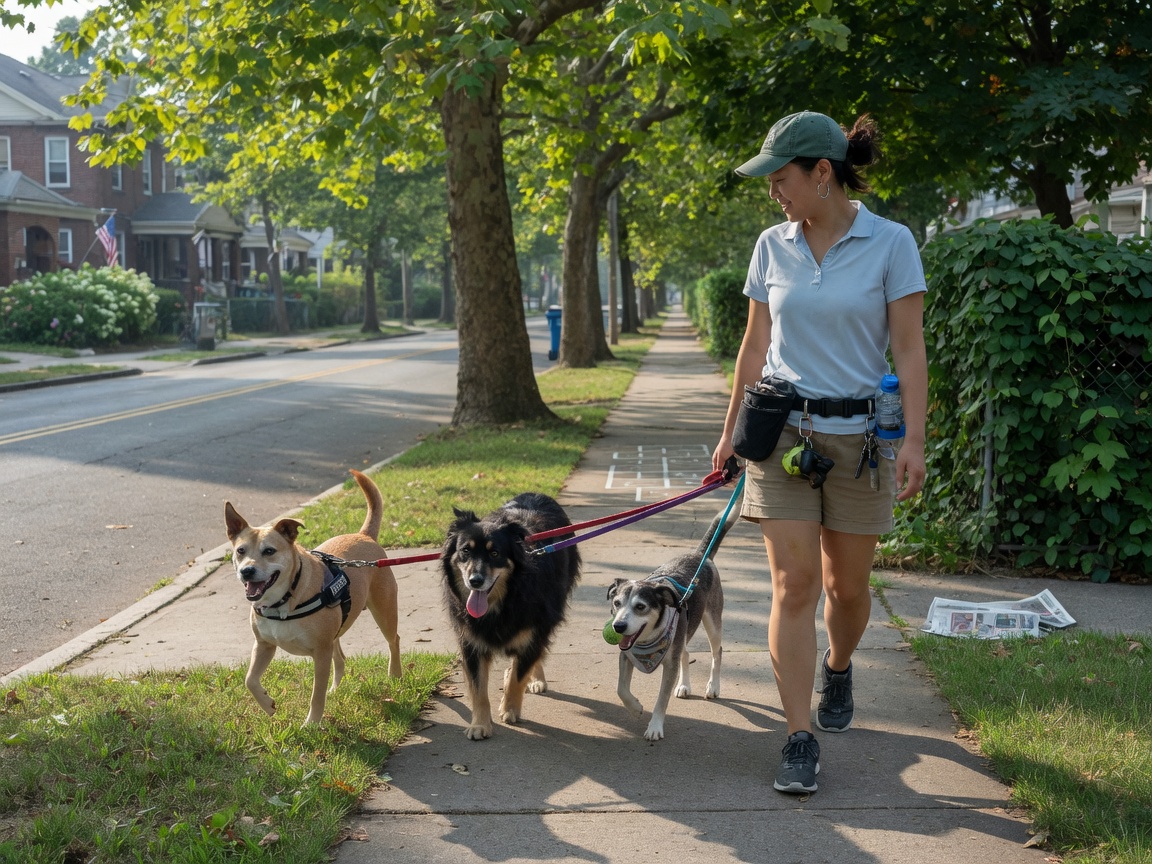
Dog Walking & Pet Sitting Blueprint
Blueprint Course
Dog Walking & Pet Sitting Blueprint
Launch collection candidateMidday routes and overnight stays on repeat.
This course takes you from 'I like dogs' to running a real dog walking and pet sitting business: what the work actually is (a Monday-through-Friday midday route, not a hobby), what it costs to start ($200–$600 — one of the cheapest launches there is), how to price walks and drop-in visits from your real costs, how to read dog body language and prevent bites, how to handle other people's house keys without ever losing their trust, and how to get your first 10 paying clients. Because these figures are not inherited from the Discover profile for dog walking, every money example uses one explicit base case: a solo walker doing 22 walks a week at a $25 average ($20–$35 per 30-minute walk or drop-in visit in most markets; a full solo midday book runs 15–30 walks a week), about $3 of variable cost per walk ($2–$5 — fuel share, waste bags, treats, gear wear), and about $140 a month in fixed costs ($100–$180: pet-care liability insurance, scheduling software, phone). That pencils out to roughly $1,000–$3,700 a month in profit before tax across the 15-to-30-walk range, around $1,950 at the base case — a planning estimate under stated assumptions, never a promise; no income is guaranteed. Pet sitting, overnights, and weekend drop-ins stack on top of the midday backbone. The economics of this business are route economics: like lawn care, the walker with 12 clients in two neighborhoods beats the walker with 12 clients scattered across town, because the midday window — roughly 10am to 2pm, when office workers' dogs need out — is fixed and travel time between walks is the silent margin killer. Three things come before the first paid walk. First, safety: reading dog body language and preventing bites is the core professional skill, and this course treats it as a full module, not a paragraph. Second, insurance and local law: pet-care liability insurance with care, custody, and control coverage is the industry standard, and leash laws, city animal ordinances, and off-leash rules are location-dependent homework in Module 6. Third, trust systems: you will hold keys and door codes to strangers' homes — the key-handling, lockbox, and visit-report protocols in Module 7 are what turn a dog lover into a professional. One boundary note: this is a different business from pet grooming — grooming is a licensed-adjacent craft service on a 4–8 week client cycle; walking and sitting is a daily recurring logistics business. If clippers and creative work appeal to you more than routes and reliability, look at the Pet Grooming Blueprint instead — and once you are running, groomers make excellent referral partners.
What you get
Built for operators who want a clear path — not a pile of generic tips.
The base case
One worked example, not a target
Planning estimates, before tax and before anything you pay yourself — no income is guaranteed. Your own prices, volume and costs will differ; the course walks you through replacing every number here with yours.
Who this fits
- You want the cheapest realistic startup in this catalog — $200–$600 covers insurance, basic gear, and simple software, with no vehicle wrap, no equipment trailer, and no license requirement in most places (verify yours)
- You can commit to the same midday window every weekday — recurring Monday-through-Friday clients are the backbone of this business, and reliability IS the product
- You genuinely like being outside in all weather and on your feet — a full route is 3–5 hours of walking a day, rain, heat, or snow
- You are calm and observant around dogs, willing to study body language and bite prevention seriously rather than assuming every dog is friendly
- You are trustworthy in a way you can prove — you will hold clients' keys and alarm codes, and your systems (not your charm) are what make that safe
- You like route-density thinking: stacking clients within a tight radius, like a lawn care operator, so the midday window holds more paid walks and less windshield time
Honest risks
- Dog bites and dog-on-dog incidents are the defining risk: even well-known dogs bite under stress, and an incident on your leash can mean vet bills, medical bills, and a destroyed reputation. Body-language education, honest screening, and conservative pack limits are the mitigation — and they are on you.
- A lost key, an unlatched gate, or an escaped dog can end a client relationship — or the business — in one afternoon. Key-handling and door-check protocols are not bureaucracy; they are the product.
- Leash laws, city animal ordinances, off-leash rules, and limits on how many dogs one person may walk are location-dependent and vary by city, county, and park system. Operating against them risks fines and gives an insurer a reason to deny a claim.
- Midday route density decides margin: scattered clients mean the fixed 10am–2pm window fills with driving instead of paid walks. Weak service-area discipline quietly kills this business the same way it kills lawn care routes.
- Marketplace apps (Rover-class platforms) provide leads but commonly take roughly 15–25% of each booking, and the client relationship belongs to the platform. Building only on a marketplace means renting your client list at a permanent margin discount.
- Income concentrates in a small client roster: losing two midday regulars — a move, a layoff, a dog passing away — can cut revenue meaningfully overnight. No income is guaranteed, and diversification (sitting, overnights, more regulars) takes months to build.
- The work is physical and weather-exposed: 3–5 hours of walking daily in heat, rain, ice, and dark winter afternoons. Injuries and burnout are real operational risks for a solo walker.
Who should skip this one
- You cannot protect the midday window. If your schedule, classes, or current job make 10am–2pm on weekdays unavailable, you cannot serve the recurring clients who are the backbone of this business — evenings-and-weekends-only pet care is a much smaller, choppier market.
- You would skip the safety homework. Reading dog body language and preventing bites is the professional core of this trade; if you assume every dog is friendly and would take on a reactive or unknown dog without a meet-and-greet and a plan, you are a liability to yourself, the dogs, and the client.
- You want passive or fast money. This is a walk-by-walk service business: roughly $1,000–$3,700 a month before tax at a full solo book under this course's stated assumptions, built over months of showing up on time every single weekday. No income is guaranteed.
- You are not willing to carry pet-care liability insurance or follow local leash laws and animal ordinances. Walking uninsured, or off-leash where it is not allowed, risks one incident ending the business — and the rules are location-dependent, which means verifying them is your job, not optional.
- You cannot handle the trust burden of other people's homes. Keys, alarm codes, cameras watching you work, and a text with a photo after every visit — if documentation and scrupulous boundaries feel like too much overhead, clients will feel it and churn.
- You mostly want creative, skilled craft work with animals. That is grooming, not walking — consider the Pet Grooming Blueprint; walking and sitting is a logistics-and-reliability business where the skill is consistency.
Curriculum
10 modules · 34 lessons · 1 hr 41 min of reading
01What a Dog Walking Business Really Isfree sample3 lessons · 10 min
The midday backbone, the route-density math that decides your margin, what the money looks like at 22 walks a week, and an honest go/no-go on whether this business fits your life.
- The Midday Backbone and the Route Game(free sample below)4 min
- Walking, Sitting, Overnights — and Why This Is Not Grooming3 min
- Founder Fit: The Go/No-Go Test3 min
02Startup Costs and Setup: $200–$6003 lessons · 9 min
Where the $200–$600 actually goes, what to skip at launch, and the boring setup steps — bank account, business basics — done in the right order.
- Where the $200–$600 Actually Goes3 min
- Business Basics, in the Right Order3 min
- Scheduling, Payments, and the Visit Report Habit3 min
03Gear and Supplies That Earn Their Keep3 lessons · 8 min
The professional walking kit: leashes and handling gear that keep dogs safe, the pouch you carry every walk, and the first-aid basics you hope to never use.
- The Professional Walking Kit3 min
- Weather Gear and the 3-Season Body2 min
- The First-Aid Kit and the Emergency Card3 min
04Dog Behavior, Safety, and Bite Prevention4 lessons · 13 min
The professional core: reading body language before it escalates, handling the leash like it matters, managing dog-meets-dog moments, and screening out the dogs you are not ready for.
- Reading the Dog in Front of You4 min
- Leash Craft and the Dog-Meets-Dog Moment3 min
- Pack Walks: The Math and the Limits3 min
- Screening Dogs — and Saying No3 min
05Services and Pricing From Real Costs4 lessons · 11 min
Price the 30-minute walk from your actual cost per walk and fixed costs — never from an hourly wage — then build the menu: drop-ins, sitting, overnights, and the recurring-client discount that buys route density.
- Know Your Cost Per Walk First3 min
- Setting the Rate Card3 min
- The Month That Pays: Base-Case Math3 min
- Policies That Protect the Calendar2 min
06Legal, Insurance, and Taxes for Walkers4 lessons · 12 min
Education, not legal advice: pet-care liability insurance with care/custody/control coverage, leash laws and animal ordinances, the client contract, and the self-employment tax habit — with everything local flagged for verification.
- Insurance: The Line That Makes You a Professional3 min
- Leash Laws, Animal Ordinances, and Off-Leash Rules3 min
- The Service Agreement That Prevents Arguments3 min
- Taxes: The 25–30% Habit3 min
07Trust Systems: Keys, Lockboxes, and Onboarding3 lessons · 9 min
You are being handed keys to strangers' homes. The meet-and-greet protocol, the key-handling system that never loses one, and the visit report habit that makes trust visible.
- The Meet-and-Greet: Where Clients Are Won3 min
- Keys, Codes, and Lockboxes: The System That Never Fails3 min
- Visit Reports, Cameras, and Working in Glass Houses3 min
08Branding, Findability, and the Marketplace Question3 lessons · 9 min
A trustworthy local identity, the free profiles that make you findable, and the honest math on Rover-class apps versus direct clients — use marketplaces as a lead source, never as the business.
- A Name and Look That Says 'Safe With Your Dog'2 min
- The Free Findability Stack3 min
- Rover-Class Apps vs Direct Clients: The Honest Math4 min
09Marketing: Your First 10 Clients3 lessons · 9 min
A concrete two-week sequence to land the first 10: warm circle first, the neighborhood-thread play, vet-and-groomer referral partners, and converting one-off sits into standing midday walks.
- Days 1–4: The Warm Circle3 min
- Days 5–10: Neighborhood Threads and Referral Partners3 min
- Days 10–14: Convert Everything to Standing Midday Slots3 min
10Great Visits, Reviews, Routes, and Growth4 lessons · 11 min
The repeatable visit that earns five stars, the review engine, route optimization as an ongoing discipline, and the honest growth paths — deeper routes, sitting and overnights, and (eventually) a second walker.
- The Repeatable Great Visit3 min
- The Review Engine2 min
- Route Discipline: The Ongoing Margin Practice3 min
- Growth: Deeper, Wider, or a Second Walker3 min
Why people buy this
Built for first-time operators who want a clear path — not generic AI chat.
Honest fit check
Who should start — and who should skip — so you don't waste months on the wrong business.
Do-this-next lessons
Every lesson ends in an action: scripts, checklists, pricing math you can use this week.
One-time purchase
One payment of $59. No course subscription.
Dog Walking & Pet Sitting Blueprint is part of the OwnerLaunch founding library. Figures in the course are planning estimates before tax — no income is guaranteed.
Blueprint FAQ
Why $59 for this Blueprint?+
You get a full operator course (10 modules, 34 lessons), a free sample lesson before you buy, downloadable templates after purchase, and a path into a personalized Launch Kit if you want one. It's a one-time payment — not a subscription for the course itself.
What do I get before I pay?+
The full curriculum outline, honest fit/risk lists, money base-case assumptions, a short course preview video when available, and one complete free sample lesson — real course content, not a teaser paragraph.
Is this legal, tax, or financial advice?+
No. OwnerLaunch is educational only. Licensing, insurance, tax, and filing requirements are location-dependent — verify with official sources and licensed professionals.
Can I upgrade to a Launch Kit later?+
Yes. Blueprint owners typically pay only the difference for a personalized Launch Kit (names, brand, pricing, copy, documents, 30-day plan). The course and kit are separate purchases.
Included templates & tools
- 30-Day Launch Checklist — The whole course sequenced into four weeks: setup and insurance, safety reps and trust systems, first-client sprint, and standing-slot conversion.
- Warm Circle & Referral Partner Scripts — Word-for-word openers for the first-10 sprint: warm-circle texts, the neighborhood-group intro, the partner pitch, and the standing-slot conversion lines.
- New Client Intake & Service Agreement — Fill-in meet-and-greet paperwork: dog profile, home access, emergency card, and a plain-language service agreement — a starting point to adapt, not legal advice.
- Pricing & Route Calculator — Hand-computed worksheet: variable cost per walk, fixed-cost share, before-tax margin at three price points, and the route-density math that shows what drive time really costs.
- Visit Report & Client Update Templates — Copy-paste visit report formats — standard walk, drop-in, sitting day summary, and the incident/health-flag report — the 60-second habit that retains clients.
- Safety & Body Language Self-Check — 12 scenario questions on body language, encounters, pack limits, and protocols — pass it cold before your first paid walk.
Free sample lesson
Real course content — not a teaser paragraph. The rest unlocks after purchase.
From module: What a Dog Walking Business Really Is
The Midday Backbone and the Route Game
~4 min read
A dog walking business looks like a collection of pleasant strolls. It is actually a logistics business with a fixed bottleneck: the midday window. The clients who pay reliably, every week, all year, are office workers and long-shift households whose dogs need out between roughly 10am and 2pm, Monday through Friday. Those midday-recurring weekday clients are the backbone of the business — everything else (weekend drop-ins, pet sitting, overnights, puppy visits) stacks on top of that base. A walker with 12 midday regulars has a business; a walker with 12 one-off bookings has a busy phone.
Because the window is fixed, your margin is decided by route density — exactly like lawn care. Every walk is about 30 minutes of paid time; the question is what surrounds it. Twelve clients spread across town means the 4-hour window holds maybe 5 paid walks and 2 hours of driving. Twelve clients across two adjacent neighborhoods means the same window holds 7 or 8 walks with 5-minute hops between them. Same effort, very different month. This course's base case — stated independently rather than inherited from a Discover profile, so verify these figures against your own market — is 22 walks a week at $25 per 30-minute walk ($20–$35 is the common range), which pencils to roughly $1,950 a month in profit before tax after about $3 per walk in variable costs and $140 a month in fixed costs. The 15-to-30-walk range spans roughly $1,000–$3,700 before tax. Estimates, not promises — no income is guaranteed.
- The backbone: midday-recurring weekday clients — 10am–2pm, Monday–Friday, same dogs, standing schedule
- The margin lever: route density — tight neighborhoods beat scattered bookings, every time
- The add-ons: weekend drop-ins, vacation pet sitting, overnights — stacked on the base, never a substitute for it
- The real product: reliability and trust — you hold keys to people's homes and the leash of their family member
Action · task
Map your midday territory
Open a map and draw a circle 10 minutes around where you will start each midday. List the 3–5 neighborhoods inside it with the most dogs (apartments and townhomes near offices are gold). This circle is your service area draft — every marketing decision in this course points inside it. Write down the neighborhoods and keep the list.
Ready to make it yours?
A Launch Kit turns this Blueprint into your business: personalized name, brand, pricing, website copy, documents, and Action Plan.
Basic
$119 current
Pro
$199 current
Apply your Blueprint credit to Basic for +$60 or Pro for +$140.
More Blueprints
Related course · Beauty & Personal Care
Pet Grooming Blueprint
Wags, clippers, and a loyal recurring clientele.
Recommended next · Local Professional
Mobile Notary & Loan Signing Blueprint
Appointments, stamps, and signing-table professionalism.
Recommended next · Local Professional
Real Estate Photography Blueprint
The agent reshoots every month — win the turnaround, keep the client for years.
Recommended next · Local Professional
Senior Companion (Non-Medical) Blueprint
Companionship and errands for aging neighbors.
All figures are estimates: these figures are not inherited from the Discover profile for dog walking, so the course states its own base case and every money figure inherits its assumptions — a solo walker with no employees in a typical U.S. market, doing 22 thirty-minute walks or drop-in visits a week at a $25 average (market range $20–$35 per visit; a full solo midday book runs 15–30 walks a week), spending about $3 per walk on variable costs ($2–$5: fuel share, waste bags, treats, gear wear), and carrying about $140 a month in fixed costs ($100–$180: pet-care liability insurance with care/custody/control coverage, scheduling software, phone). Startup of $200–$600 covers insurance, gear, lockboxes, and basic software. All profit figures are before tax and before anything you pay yourself; the roughly $1,000–$3,700 monthly range is a typical outcome under these assumptions, not a guarantee — no income is guaranteed, and your market, route density, prices, reliability, and effort decide where you land. Midday-recurring weekday clients are assumed as the revenue backbone; pet sitting and overnights are additive and not included in the base range. Dog-behavior and bite-prevention content summarizes public veterinary-association education (AVMA/CDC-style guidance) and is education, not veterinary or medical advice. Leash laws, animal ordinances, off-leash rules, handler dog-count limits, insurance, contracts, and taxes are location-dependent education only, not legal, tax, or insurance advice — verify everything with your city, county, park system, an insurer, and a tax professional before relying on it.
Educational guidance only — not legal, tax, or financial advice.Details
OwnerLaunch provides educational business guidance, AI-generated drafts, and checklists. It is not a law firm, tax advisor, CPA, registered agent, or government agency. Information may not be complete or current for your specific location. Always verify requirements with official federal, state, city, and county sources and consult qualified professionals when needed.